When the lake calls, must we answer in tears?
IN the quiet hours before dawn, as mist hangs low and silence blankets the water, many fishermen on Lake Victoria push their wooden boats into the lake, completely unaware that their routine workday may end in tragedy. Drowning, that is an invisible, silent killer claims the lives of hundreds every year.
Yet, despite the toll, many of these stories are never told. Drowning is defined as the process of experiencing respiratory impairment due to submersion or immersion in liquid. It can lead to death, severe injury, or survival. Unlike other emergencies, drowning often happens quickly and quietly—without warning, without screams and without a chance to call for help.
Victims, especially children under five, rarely make noise during the event. But worryingly, in Africa’s Lake regions, it is not just children dying. Adults too, particularly fishers, are succumbing to this silent threat in increasingly disturbing numbers.
Across the African continent, drowning remains one of the leading yet underreported causes of accidental death.
According to the World Health Organisation (WHO), over 236,000 people die globally from drowning each year and that is 90 per cent of them in low- and middle-income countries. In sub-Saharan Africa, the annual drowning death rate is a staggering 19.3 per 100,000 people.
ALSO READ: ‘Kijani Space’ project launched to boost climate-smart farming, fishing in Lake Victoria
Experts trace this crisis to limited access to swimming lessons, poor water safety awareness, lack of supervision near water and a severe shortage of emergency response systems. In many rural communities, drowning isn’t just a health crisis, it is also a grim reflection of poverty, poor infrastructure and long-standing neglect.
To help address this crisis, the Environmental Management and Economic Development Organisation (EMEDO) has launched a bold new initiative aimed at fishing communities along the shores of Lake Victoria. Dubbed the Lake Victoria Drowning Prevention Project, the programme forms part of EMEDO’s broader mission to improve the safety and livelihoods of fishers who risk their lives every day on the water.
“Fishing is globally recognised as one of the most high-risk professions, yet in our communities, the real scale of drowning remains invisible,” said EMEDO’s Programme Manager, Mr Arthur Mugema, during a recent event in Mwanza City.
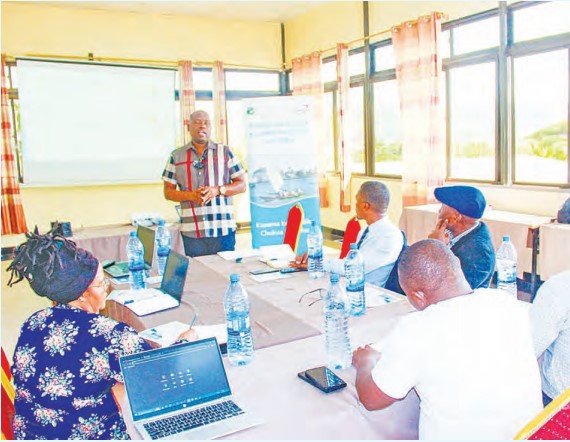
At this special event, Mr Mugema welcomed and introduced eight journalists from various local media houses who were appointed as Drowning Prevention Champions.
These include Mr Benard James (Star TV), Reginald Ndesika (Tanzania Broadcasting Corporation – TBC), Mr Tony Alphonce (freelance journalist and Mwanza Press Club Member), Mr Virtus Audax (environmental journalist, Nipashe Newspaper), Mr Sudi Shaban (Executive Director, News Update Media), Ms Glory Kiwia (Chief Editor, Jembe FM), Mr George Binagi (environmental journalist, BMG Online Media) and the writer of this article.
“These journalists are now part of a national movement to tell the stories behind the statistics and save lives in the process,” said Mr Mugema. He emphasised that they were appointed as champions to advocate for drowning prevention and raise awareness about the challenges facing lakeside communities.
“We have enlisted these journalists as part of our awareness-raising strategy,” he explained.
“These media professionals have been selected with a mandate to use their platforms to educate fishing communities about water safety and the dangers of drowning,” he said.
ALSO READ: Dar Water Institute set for 21st World Lake Conference
“We are expecting you to play a vital role in changing mindsets and behaviours through storytelling, investigative reporting and human-interest features.” Mr Mugema further added, “We are expecting you to highlight the realities of drowning in Lake Victoria, share survival stories, promote safety practices and hold stakeholders accountable.”
The hard truth Mr Mugema pointed out that the challenge of drowning is far from theoretical.
“A 2018 study by the Mwanza Intervention Trials Unit (MITU) and the Royal National Lifeboat Institution (RNLI) recorded 86 drowning deaths in just eight fishing communities 70 of them were fishers,” he revealed.
“This is a clear indication that drowning is not only underreported but also underestimated in terms of public health and economic impact,” he emphasised.
Although WHO estimates that over 2,500 Tanzanians die from drowning each year, official statistics from the Ministry of Health record only about 30 cases annually.
“Many cases are not reported, while some are duplicated. This has made it hard to understand the true magnitude of the problem,” he explained.
Lake Victoria was chosen for the pilot because of its economic importance; it contributes over 50 per cent of Tanzania’s fishery income and employs more than 100,000 fishers.
“This lake contributes 1.7 per cent to our national GDP, yet the people who depend on its use face constant life-threatening risks,” he stressed.
EMEDO’s approach is peoplefocused. “Our strategy involves training fishers, boat operators and women fish processors on safety and emergency response,” said Mr Mugema.
The project adopts human-centred design to tailor solutions to local contexts.
“We brought together fishing crews, community leaders and government stakeholders to co-design a safety curriculum that speaks to the real-life experiences and risks our people face,” he said.
“So far, we have trained and verified 11 trainers who will deliver the fishers’ safety training course,” he added.
EMEDO also plans to promote water safety in schools, use theatre and sports to create awareness and introduce locally made buoyancy devices to improve survival chances during accidents.
“Ultimately, our goal is not only to save lives but to transform the culture around water safety in fishing communities,” Mr Mugema said. Plans are also in motion to scale up the initiative nationwide through the formation of a National Drowning Prevention Network (NDPN).
“For now, our hope lies in empowered communities, trained fishers and the voices of journalists who have taken up the mantle to turn the tide against drowning,” he affirmed.
Building a national movement Speaking on the NDPN, Ms Mary Francis, EMEDO’s Advocacy Officer, noted that the network has made important progress since its establishment in 2021.
She said the NDPN was born during the first-ever World Drowning Prevention Day commemorations held on July 25, 2021, in Zanzibar and Kunduchi.
“Its birth was further solidified by the successful hosting of the first African Drowning Prevention Webinar the same year, which set the foundation for collaborative advocacy efforts across the continent,” she said.
She emphasised the critical importance of collaboration, adding, “NDPN’s progress would not have been possible without continued collaboration with government institutions and development partners.” Ms Francis stated that EMEDO currently hosts the NDPN secretariat, a role it took on following its early involvement in the network’s formation.
The secretariat is supported by the Royal National Lifeboat Institution (RNLI) and Irish Aid and is responsible for coordinating the network’s advocacy campaigns, stakeholder engagements and policy dialogues.
“We are proud to support a platform that unites diverse organisations for a common cause—saving lives through drowning prevention,” she said.
Journalists respond to the call The newly appointed journalist champions expressed their commitment to the cause. Ms Glory Kiwia, Chief Editor from Jembe FM Radio, said: “Our goal is to eliminate drowning not just in Lake Victoria, but across all lakes in the country.” Mr Tony Alphonce, a freelance journalist and member of the Mwanza Press Club, commended EMEDO’s initiative and urged other institutions to follow suit.
“I am truly eager to see meaningful change and it’s time for us to address drowning challenges with the seriousness they deserve,” he said.