Mid-season review: Control at top, chaos below

DAR ES SALAAM: NINETEEN matches into the campaign, the Tanzanian Premier League has begun to separate into distinct narratives, with authority at the summit contrasting sharply with uncertainty further down the table. With eleven fixtures remaining, the margins that define success or failure are now narrow enough to intensify every result, yet still wide enough to allow for dramatic shifts.
At the top, Young Africans have set a formidable standard. Their unbeaten record, built on fourteen victories and five draws, is not merely impressive but structurally dominant. Scoring forty-four goals while conceding just three reveals a side that controls match at both ends of the pitch.
Their defensive platform, anchored by Diarra with ten clean sheets, has allowed their attacking players to operate with freedom rather than desperation. The result is a team that rarely looks stretched and almost never looks vulnerable.
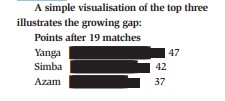
While Simba remain within touching distance, their campaign has been defined by control without complete ruthlessness. Twelve wins and just one defeat underline their quality, yet six draws have subtly eroded their ability to dictate the title race.
They are not chasing from afar, but they are reacting rather than imposing. The creative influence of Elie Mpanzu and the consistency of Mahamadou Kassali have kept them competitive, though the second half of the season will demand greater decisiveness in tight matches.
Azam occupy a curious position, unbeaten like Yanga yet trailing by ten points. Ten draws have turned potential dominance into quiet consistency. Their campaign has been driven by the exceptional influence of Feisal Salum, whose fourteen goal involvements represent the most complete attacking contribution in the league so far. Alongside him, Iddy Seleman has ensured Azam remain fluid and inventive, but without a sharper edge, their title ambitions may gradually fade into a battle for continental security.
The race for CAF places is where the league’s complexity deepens. The top three positions carry direct continental qualification, with the first and second entering the CAF Champions League and the third moving into the Confederation Cup.
The fourth position sits in a conditional space, dependent on the outcome of the domestic FA Cup. Should the cup winner already occupy a top-three league position, fourth place becomes a gateway to continental football, effectively transforming it into one of the most valuable positions outside the title race.
At present, the gap between third and the chasing pack suggests a tiered structure, yet it is far from settled. Singida Black Stars and JKT Tanzania, both on twenty-nine points, are close enough to believe, though not consistent enough to convince. TRA United, slightly behind, have built their challenge on defensive resilience, with Jean Noel matching the league’s elite goalkeepers in clean sheets.
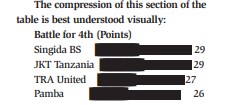
This clustering suggests that a sequence of two or three victories could dramatically reshape the standings, particularly as direct encounters between these sides will carry double significance. Further down, the league enters a phase of instability rather than security.
Teams positioned between seventh and twelfth are not insulated from danger; instead, they exist in a fluctuating zone where poor form could quickly drag them into the relegation conversation. Namungo exemplify this fragility. Despite possessing one of the league’s joint top scorers in Fabrice Ngoy, their reliance on a single attacking outlet leaves them exposed when that source is contained.
ALSO READ: Mbeya electrification project nears completion
Mashujaa, by contrast, have accumulated draws at an extraordinary rate, suggesting resilience but also a lack of cutting edge. The relegation picture, however, is where urgency becomes unavoidable. The structure is unforgiving: the bottom two sides, fifteenth and sixteenth, will be relegated automatically, while the teams finishing thirteenth and fourteenth enter a layered playoff system that offers survival, but only through sustained pressure.
The current standings at the bottom reveal both separation and tension:
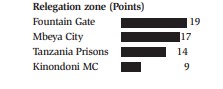
Kinondoni MC appear increasingly isolated. With just nine points and a goal difference of minus twenty-two, their path to survival would require not only improvement but transformation. Tanzania Prisons remain within reach of the playoff zone, yet their lack of goals continues to undermine any momentum.
Mbeya City and Fountain Gate currently occupy the playoff positions, where the structure becomes particularly complex. The two sides will meet over two legs, with the winner securing safety and the loser entering a final survival match against a lower-division challenger.
This format introduces both opportunity and psychological strain, as survival is never secured in a single moment. Individually, the league has been shaped by attacking versatility and defensive discipline in equal measure. Prince Dube and Fabrice Ngoy share the lead in goals, while Pacôme Zouzoua and Mudathir Yahya reinforce Young Africans’ attacking depth.
Creativity has flowed from Allan Okello, whose six assists highlight the importance of structured chance creation, while defenders such as Israel Mwenda and Ibrahim Imoro demonstrate how modern full-backs contribute beyond their primary roles.
As the league moves into its decisive phase, the patterns are clear but not fixed. Young Africans have established control, Simba remain poised to challenge and Azam retain the capacity to influence the outcome. Beneath them, the race for continental football is fluid, while the relegation battle is tightening with each passing round. The remaining eleven matches will not simply confirm trends; they will test them.
A clear way to understand the individual impact on the first half of the season is to bring the leading performers together in one structured view. The numbers underline how certain players have shaped both the title race and the fight for survival, with Feisal Salum emerging as the most influential all-round attacker, while Prince Dube and Fabrice Ngoy have defined the scoring charts.
The table highlights how attacking output is concentrated among a few elite players, particularly within Young Africans and Azam, reinforcing why these sides sit at the top end of the table. Feisal Salum’s presence across both goals and assists reflects a player who dictates matches rather than simply finishing them, while Prince Dube’s efficiency in front of goal has given Young Africans a consistent edge in tight fixtures.
At the same time, the assist charts reveal a broader creative network. Allan Okello leads this category, but the spread of contributors especially from Yanga suggests a system-driven approach rather than reliance on a single playmaker. Even in defence, players such as Israel Mwenda and Ibrahim Imoro show how modern fullbacks are integral to attacking phases.
Defensively, the clean sheet rankings mirror the league standings. Yanga’s Diarra sits at the top, with strong support from Azam and Simba goalkeepers, reinforcing the idea that defensive organisation has been just as decisive as attacking quality in shaping the first half of the season. Taken together, these individual performances do not exist in isolation they directly explain the structure of the table, from title contenders to relegation-threatened sides.