The ocean feeds them, but the system fails them
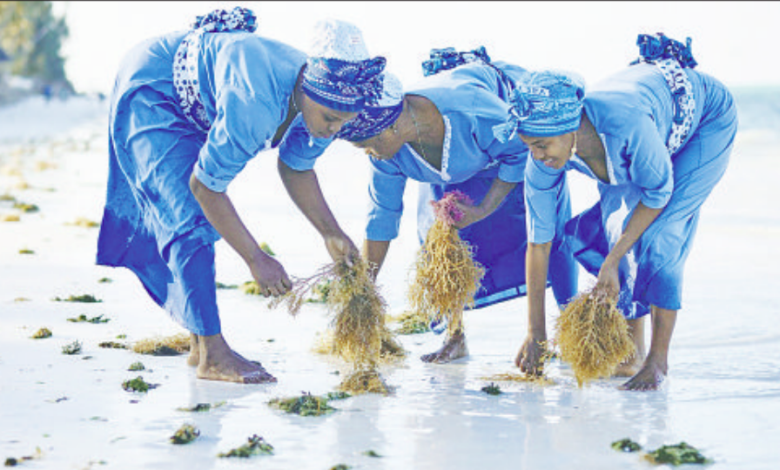
TANGA: AT dawn, before the sun rises over the Indian Ocean, Jamila Ali steps into the water.
Like thousands of women along Tanzania’s coastline, her day begins with seaweed farming, tying lines, checking crops, harvesting what is ready, and carrying it back to shore.
“This is our life,” she says. “We work every day in the ocean. But when decisions are made… we are not there.” Her voice, calm but firm, echoes a central question: Who really benefits from the labour of coastal women?
That question took centre stage at a recent symposium on women and the blue economy, organised by Mission Inclusion in collaboration with the Women Fund Tanzania Trust (WFT) and the International Union for Conservation of Nature (IUCN), with support from Global Affairs Canada.
The symposium was held under the auspices of the Regenerative Seascapes for People, Climate and Nature (ReSea) project.
In her keynote address, ReSea Chief of Party, Perpetua Angima, painted a vivid picture of women’s daily reality.
“Early in the morning along the coast, women are already in the sea, planting seaweed, harvesting it, dragging it to shore, drying it under the sun and later carrying it home to store as they wait for buyers,” she said.
It is quiet, repetitive work, but it sustains entire households.
And it doesn’t end there. Women are deeply involved in crab fattening, sea cucumber farming, sardine processing and even restoring damaged marine ecosystems.
“They are at the frontline of the blue economy,” Angima noted.
“But when decisions about these sectors are made, where are they?” That, she said, is where the real gap lies. “The gap is not in participation,” she emphasised.
“The gap is in decision-making.” Drawing on a gender policy assessment conducted under the ReSea project and presented at the symposium by Humphrey Mrema, Angima challenged stakeholders to move beyond rhetoric.
“We must shift the conversation from data to action,” she said.
The findings confirm what many already know: women are central to the blue economy, but are not at the centre of decisions shaping it. For Angima, the issue is not just inclusion, it is influence. “We often say women are included,” she said.
“But included how? Sitting in meetings? Listening? Or shaping decisions?” she asked. Real change, she stressed, will only come when women’s voices determine outcomes, not just fill seats.
While policy discussions continue, initiatives like the ReSea project are already making tangible differences at the community level.
The project has reached more than 248 women across coastal districts, including Mkinga and Pangani in Tanga Region, as well as Pemba.
Through training in entrepreneurship, technical skills and gender rights, women are beginning to improve productivity, add value to their products, and gain recognition within their communities.
Jamila is among those who have felt the change. “Before, we worked without knowledge,” she says.
“Now we understand business, rights, and how to improve what we do.” But even as these gains take root, deeper structural barriers remain. One of the biggest challenges is pricing.
ALSO READ: Lukanga: Unlocking blue economy for women
Findings presented by Mrema revealed that women in seaweed and sea cucumber value chains often sell their products below cost due to the absence of standardised pricing systems.
“You don’t decide the price,” Jamila says. “You accept what is given.”
With middlemen largely controlling the market, women’s labour continues to be undervalued, despite the sector’s significant contribution to coastal economies.
Access to finance is another major hurdle. Many women cannot afford essential equipment, lack collateral to secure loans, and have little access to financial services tailored to their needs.
Compounding this is a troubling reality, many lack basic literacy skills, a gap the project is now working to address. “You may have the skills,” Jamila explains, “but without capital, you cannot grow.”
These concerns are increasingly recognised at the policy level. Speaking at the symposium, Senior Environmental Officer in the Vice-President’s Office, Evansia Shirima, said the government is working to strengthen gender-responsive financing and ensure women benefit more equitably from the blue economy.
For Jamila, the changing ocean is making an already difficult livelihood even harder. As seaweed shifts to deeper waters due to rising temperatures, many women are unable to access it. “Most of us don’t know how to swim,” she says.
“So we pay men to harvest for us.” It is an added cost that further eats into already small profits.
Shirima acknowledged that climate change is disproportionately affecting women and must be addressed through inclusive policies.
Jamila also points to the daily realities that often go unnoticed. “
There are no toilets. No safe spaces. Sometimes you work in isolated areas for hours,” she says.
The lack of basic infrastructure and safety measures exposes women to risks, including gender-based violence, issues experts say require urgent attention.
Despite dominating production, women remain underrepresented in leadership. “We are many in the work,” Jamila says, “but very few in decision-making.”
Angima warned that this imbalance must change if the blue economy is to become truly inclusive and sustainable.
“When women lead, we see better resource management, stronger accountability, and fairer distribution of benefits,” she said.
As the symposium concluded, one message stood out clearly: the time for talk is over. Angima urged stakeholders to use evidence from the policy study to drive real reforms, transforming systems, strengthening institutions, and ensuring women have a decisive voice. For Jamila, the message is simpler, but just as powerful.
“We are already in the blue economy,” she says “We are the ones carrying it,” then adds firmly: “Now we want to lead it too.”