Ukerewe youths find opportunity as sap harvest gains attention
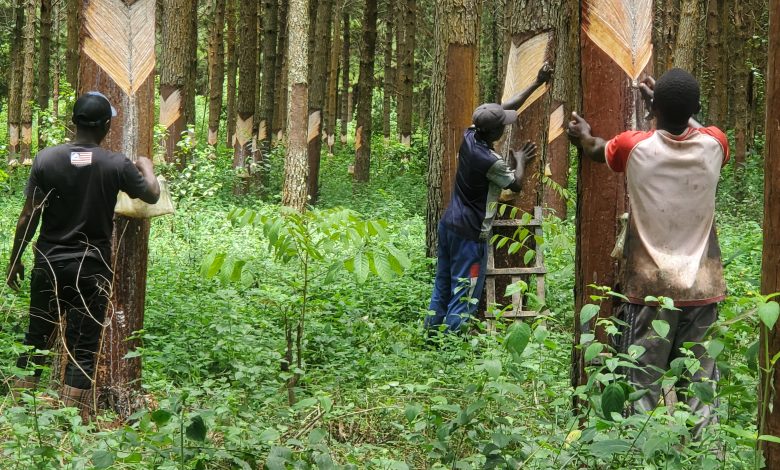
MWANZA: In the quiet stretches of Rubya Forest Plantation in Ukerewe District, Mwanza Region, a routine economic activity has taken on an unexpected second life. What began as a strictly commercial tree sap harvesting venture has gradually evolved into a modest yet intriguing tourist attraction, drawing curious visitors to witness a process that is as methodical as it is visually striking. Ordinarily, tree sap harvesting is not the sort of activity that inspires sightseeing.
It is repetitive, technical, and largely unnoticed outside industrial supply chains. Yet in Rubya, the act of carefully slicing tree bark has produced a distinctive pattern—one that resembles the pages of an open book etched into the trunk.
The result is a landscape that quietly blends labour with artistry, offering visitors something unusual: a glimpse into both nature and human industry at work. For the young men engaged in the activity, tourism was never part of the plan.
Their expectations were straightforward—earn wages, support themselves, and move on with daily life. Among them is Mustapher Shaban, who explained that each worker is typically assigned between 1,000 and 1,200 trees to tap over the course of a month.
The scale of the task is significant, but the method remains simple and controlled. Using a knife, workers make precise cuts along the left and right sides of the tree bark. Over time, the pattern that emerges creates the now well-known “open book” appearance.
It is this visual effect—unintended yet captivating—that has begun attracting visitors, some of whom arrive out of curiosity and leave with a deeper appreciation of the process. From an economic standpoint, the work remains productive. Mustapher noted that he is able to collect approximately 1,500 kilogrammes of sap each month, which is sold at 270/- per kilogramme to a private company operating in the plantation.
For many youths in the area, this income provides a reliable supplement to other activities such as farming and fishing in Lake Victoria. The work schedule itself is another factor contributing to its appeal. Sap tapping is typically completed within four hours each day, allowing workers to pursue additional economic activities in the afternoon. This flexibility has made the practice particularly attractive to young people seeking to diversify their income sources without abandoning traditional livelihoods.
“It hardly consumes more than half a day,” Mustapher explained, noting that the structured guidelines set by plantation management ensure both efficiency and sustainability. Workers are instructed to make only one cut per day on each designated section of the tree, preventing overexploitation while maintaining steady production. Despite their hands-on involvement, many workers admit they are not fully aware of the sap’s end use.
Informal knowledge suggests it is processed into a range of products, including chewing gum, incense, and mosquito repellents, after undergoing chemical treatment.
This gap in information has prompted calls for greater transparency and local value addition. Another sap harvester, Frank Shaban, urged authorities to consider establishing processing facilities within Rubya. Such a move, he argued, would not only create additional employment opportunities but also strengthen the economic impact of the activity while preserving its emerging role as a tourist attraction.
ALSO READ: EAC kicks off high-level talks to shape future of agriculture in East Africa
Oversight of the harvesting process falls under conservation guidelines designed to protect the long-term viability of the forest. According to Sunday Anuti, a conservationist in the plantation, only trees aged 18 years and above are eligible for tapping. This ensures that the trees are mature enough to withstand bark removal without compromising their growth. The process itself is carefully regulated.
Bark is removed within a vertical stretch of about 250 centimetres, with only one side of the tree tapped at a time. A small plastic container is attached to collect the sap as it flows. These measures are not arbitrary; they are grounded in the biological functions of the tree.
Tree bark plays a critical role in transporting water, minerals, and nutrients from the soil to the leaves. It also contributes to the tree’s defence against diseases. The sap, often compared to blood in the human body, is essential for maintaining the tree’s internal balance. Excessive or poorly managed extraction could therefore have serious consequences.
Anuti emphasised that the current guidelines strike a balance between utilisation and conservation. Mature trees, he explained, are capable of producing significant amounts of sap from relatively small incisions, making the process both efficient and sustainable when properly managed. Beyond its economic and environmental dimensions, the activity has added a new layer to Rubya’s tourism profile.
Visitors are not only drawn to the sap harvesting itself but also to the surrounding natural attractions. Among these is Rubya Beach, a stretch of white sand along Lake Victoria that is often described as one of the most pristine in Ukerewe. Covering approximately 7.9 acres, the beach offers clear, unpolluted waters and a tranquil environment enhanced by the surrounding forest.
The experience is often described as “forest therapy,” where visitors enjoy fresh air, scenic landscapes, and the sounds of birdlife, including species such as the sunbird and the African kingfisher. The plantation is also home to the so-called Peace Monument, a structure with historical significance.
Originally established during the colonial era as an observation point for monitoring illegal activities and wildfires, it later served a strategic role during the Kagera War. Today, it stands as a vantage point for visitors, offering panoramic views of the plantation and its surroundings.
Tourism activities in Rubya have gradually expanded to include camping, swimming, fishing, hiking, boat rides, canoeing, photography, and research. Designated campsites allow visitors to fully experience the area’s sunsets along the western shores of the lake, adding to its appeal as a multi-faceted destination.
Nearby attractions further enrich the visitor experience. These include the “dancing stone” at Nyabhulebheka and a historic one-storey castle built in 1928 for Chief Gabriel Ruhumbika, who ruled Ukerewe from 1864 to 1938.
His legacy includes facilitating the establishment of missionary activities that contributed to the development of churches, schools, and health centres in the region.
Despite these assets, visitors have pointed out gaps in infrastructure that limit the area’s full tourism potential. Farida Mbaraka, one of the tourists, noted the absence of essential services such as accommodation and dining facilities. She suggested that investments in hotels, lodges, and restaurants—particularly near the beach—could significantly enhance the visitor experience.
“Spending a few days here would be ideal if such services were available,” she observed, adding that the combination of lake views, fresh air, and natural scenery creates a compelling case for extended stays. Her remarks reflect a broader sentiment that Rubya’s growth as a destination will depend on coordinated efforts between government and private investors.
According to Pius Mbilla, Information Officer for the Tanzania Forest Services (TFS) Lake Zone, the emergence of sap harvesting as a tourist attraction has added a new dimension to the plantation’s appeal. While it was never planned, it has effectively diversified the range of experiences available to visitors.
He encouraged prospective investors to explore opportunities in the area, particularly in developing hospitality infrastructure such as hotels, tented camps, event halls, and restaurants. With improved facilities, Rubya could position itself as a key destination within Mwanza Region’s tourism landscape.
Access to Ukerewe is already relatively straightforward, with both road and marine transport options available from Mwanza. This accessibility, combined with the area’s natural and cultural attractions, provides a strong foundation for future growth. What makes Rubya particularly noteworthy, however, is not just its scenic beauty or historical landmarks.
It is the way in which an ordinary economic activity—tree sap harvesting—has unexpectedly contributed to this broader narrative. Without deliberate planning or promotion, it has become a point of interest, illustrating how innovation and opportunity can emerge from the most routine practices. For the youths who continue to work among the trees, the focus remains on productivity and income.
Yet, as visitors pause to observe the patterns carved into bark and the careful rhythm of the work, it becomes clear that Rubya offers something more: a quiet intersection of labour, nature, and discovery. In that sense, the plantation stands as a reminder that development does not always follow a predictable path. Sometimes, it grows—quite literally—from the ground up, shaped by human effort, natural processes, and a touch of the unexpected.