TPA cuts port levy by half as TZ seeks 16.1tri/- for ports’ upgrade
DAR ES SALAAM: THE Tanzania Ports Authority (TPA) has reduced the Port Infrastructure Development Levy (PID) from 9 per cent to 4.5 per cent of customs duty, in a move aimed at easing the cost of doing business, while sustaining major investments in the expansion and modernisation of the country’s ports.
Speaking during an interview with journalists in Dar es Salaam, the Director of Marketing and Communications at TPA, Dr George Fasha, said the decision follows extensive consultations with stakeholders in the maritime, logistics and business sectors, who raised concerns over the initial implementation of the levy.
Dr Fasha said the revised rate reflects a balance between facilitating trade and ensuring the authority secures adequate funding for critical infrastructure projects needed to support the rapidly growing cargo volumes handled through Tanzania’s ports.
“This adjustment demonstrates that TPA has listened to stakeholders. We have reduced the levy from 9 per cent to 4.5 per cent of customs duty, ensuring that we support business competitiveness while continuing to invest in strategic port infrastructure,” he said.
He explained that stakeholders, including importers, clearing and forwarding agents and transport operators, had engaged TPA between October and December 2025, raising issues such as existing contractual obligations under earlier cost structures, as well as the need for wider sensitisation on the new levy.
Some stakeholders also expressed concern that the initial 9 per cent rate was relatively high given the cumulative cost structure of customs duties and related charges.
Dr Fasha said TPA carefully reviewed all submissions before settling on a revised framework that maintains financial sustainability without disrupting trade operations.
“We have taken into account all concerns raised, including the need to avoid disruption of ongoing contracts and to ensure that the levy does not become a barrier to trade efficiency,” he said.
Despite the reduction, TPA maintained that the levy remains a critical financing instrument for port expansion and modernisation programmes across the country.
The authority is implementing an ambitious infrastructure development plan estimated at 16.1tri/-, aimed at transforming key maritime gateways, including Dar es Salaam, Tanga and Mtwara ports, as well as inland dry ports and logistics corridors.
ALSO READ: Dar Port reaps big from major infrastructure overhaul
Out of the total investment, 11.2tri/- is expected to be mobilised through TPA revenues, including the revised levy, while 4.9tri/- will be sourced from the private sector through Public-Private Partnership (PPP) arrangements.
Dr Fasha said the investment programme has become urgent due to increasing congestion and capacity limitations at major ports, driven by sustained growth in cargo volumes.
According to TPA statistics, Tanzania’s ports handled 29.6 million tonnes of cargo between July 2025 and March 2026, with projections indicating that total throughput will exceed 32.8 million tonnes by the end of the 2025/26 financial year.
For the first time, container throughput also surpassed one million Twenty foot Equivalent Units (TEUs) within nine months, marking a significant milestone in the country’s maritime trade performance.
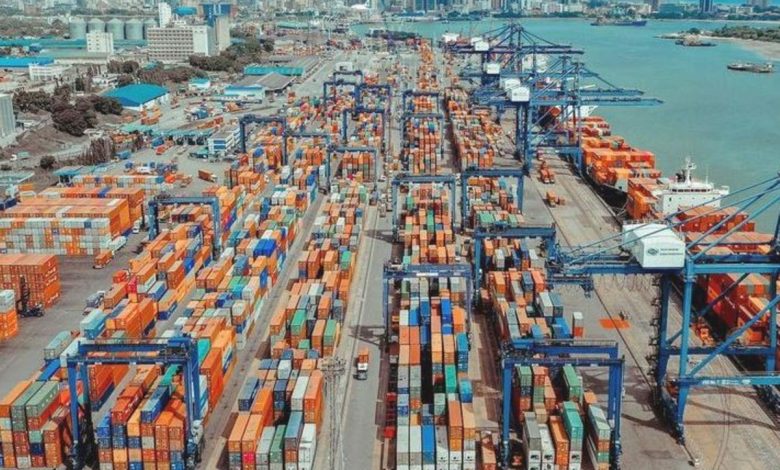
However, Dr Fasha noted that the surge in cargo has placed significant pressure on existing infrastructure, particularly at the Port of Dar es Salaam, where an average of 20 vessels are currently waiting offshore daily due to limited berth capacity.
He also highlighted increasing road congestion linked to port operations, saying truck traffic has risen from about 1,000 trucks per day five years ago to approximately 3,000 trucks per day currently, affecting major corridors including Kurasini, Mandela Road, Morogoro Road and the Dar es Salaam– Chalinze route.
At the Port of Tanga, he said, congestion has also emerged for the first time, with at least six vessels currently waiting offshore for berthing space.
“This is a sign of success in terms of growing trade volumes, but it is also a clear signal that infrastructure expansion is urgently required,” he said.
To address these challenges, TPA is implementing a series of strategic projects across the country, including the construction of four new berths (Nos 12 to 15) at the Port of Dar es Salaam, two additional berths measuring a total of 500 metres, development of oil reception and storage facilities and establishment of a rail terminal within the port.
Other projects include the development of a specialised cargo port at Kisiwa-Mgao in Mtwara, expansion of Tanga Port facilities for liquid bulk and general cargo and development of dry ports in Kurasini Phase II, Kwala (Coast Region), Ihumwa (Dodoma) and Chuo cha Polisi area.
TPA is also advancing plans for Bagamoyo Port (Mbegani area) and Mwambani Port in Tanga, alongside supporting road infrastructure aimed at improving cargo evacuation efficiency, including a planned logistics corridor linking Dar es Salaam Port to Chalinze.
Dr Fasha said without a dedicated infrastructure levy, TPA would rely solely on incremental savings from operational revenues, a process that could take five to ten years to complete a single major project.
He warned that such delays would not match the pace of Tanzania’s growing economy and increasing demand for import, export and transit cargo services.
“As the economy grows, demand for efficient port services also increases. Without timely investment, ports risk becoming bottlenecks to economic activity,” he said.
He added that delays in infrastructure expansion could affect industrial production, agricultural exports, mineral trade and regional transit cargo flows.
TPA further noted that Tanzania’s ports continue to play a vital role in serving neighbouring landlocked countries, including Rwanda, Burundi, Uganda, Zambia, the Democratic Republic of Congo and Malawi, contributing significantly to cargo throughput and national revenue.