Role of media in mutual learning of civilisations
BEIJING, CHINA: WHEN one talks of earliest recorded human civilisations, it would be absurd not to include those in Mesopotamia (modern day Iraq), Ancient Egypt, the Indus Valley, and China. However, before we delve deeper into the topic, perhaps it would be prudent to define what civilisation is as it would mean different to different individuals.
Modern day experts have defined civilisation as a complex society characterised by advanced social structures, organised government, and cultural achievements. Salient features would include urbanisation, social stratification and the development of symbolic systems of communication beyond basic language.
Historical records have shown that long distance travels and trade have contributed immensely to the exchanges of civilisations among peoples of the world. Speaking of exchanges, and mutual learning of civilisations, recently, the city of Beijing in China, which some scholars in Africa have referred to as the political and economic capital of the Global South hosted a major event.
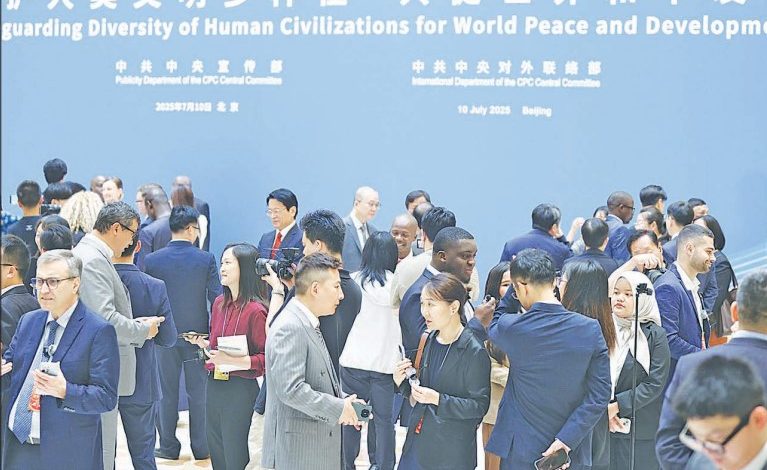
The event dubbed ‘Global Civilisations Dialogue Ministerial Meeting’ brought together 600 delegates from 140 countries. With a theme titled “Safeguarding Diversity of Human Civilisations for World Peace and Development,” the event focused on the importance of cultural diversity and mutual learning in advancing human progress.
During parallel subforums of the two-day dialogue, participants explored the crucial role of intercivilisation exchange and mutual learning in building an inclusive world and promoting global development and prosperity, cultural inheritance and innovation, understanding and friendship among peoples, scientific and technological progress, and academic exchange.
One would question, ‘how can this exchange and mutual learning among civilisations be strengthened? And what could be the vital role of the media in this noble endeavour?
In a world where information travels faster than ever before, the media isn’t just a mirror of society rather a bridge that connects people, cultures and the ideas across vast distances. The stories the media chooses to tell, and how they are told, can shape perceptions, foster understanding and promote harmony among civilisations.
The history of human civilisation is, in many ways one of communication. Long before modern technologies connected the world ancient routes and trades like Arabs, Persian, Indian, and Chinese merchants, as well as indigenous groups like the Swahili people and various African groups in the interior served as arteries for trade, knowledge, and cultural exchange.
These traders facilitated the exchange of goods such as silk, ivory, gold, slaves, and cloth across long distances. Along these routes, it was not only the goods that were exchanged, but also philosophies, languages, art and even the early forms of media such as manuscripts, paintings and sculptures.
Elkana Kuhenga is the Editor for the Daily News of Tanzania who covers Arts, Culture, Sports and Entertainment and was present during the dialogue. He says over the years, media in Tanzania has created awareness and promoted the use of different languages.
“From documenting early trades with Arabs along the east African coast to the early diplomatic and military support from China during the liberation struggles, the current sharing of cultures through TV drama and films the media has done it all” he tells.
He adds that the media acts as a bridge for cultural divides among civilisations. “In 2024 for example, there was a Swahili Symposium in Cuba where variations of Swahili cultures were showcased. During this event a Swahili-Spanish dictionary was unveiled.
We could do the same for Chinese-Swahili”, says Kuhenga. “In the same spirit, Chinese history is filled with examples of how communication has been a driving force of progress”, says Dr Wee Ka Siong, President of Malaysian Chinese Association (MCA).
He adds that China has consistently demonstrated that dialogue and cultural openness are key to building understanding and prosperity.
As media professionals, the focus should be on the role of media in promoting cultural exchanges, according to Sovann Heng, editorin-chief of the Cambodian version of Contemporary World magazine.
He says, “through media collaboration, we can understand each other more and better.” Speaking on the influence of western media and the challenges it poses, Sovann says, “Every country has its own view, its own perspective as well as its own independence, and the world cannot be dominated by one voice or one civilisation”.
One of the countries represented during the Dialogue was Indonesia, a country with diverse ethnicities, cultures and religions due to the inculturation of various countries that have visited it over the centuries, such as China, for example.
“With the diversity of cultures in Indonesia, especially in the capital city of Jakarta, we have learned to be open-minded and accepting of differences; there is no exclusivity. This is something our leaders have consistently emphasised,” says Ms Maria Rosari, Senior Editor with Antara News Agency in Indonesia.
As countries celebrate these achievements, one must acknowledge the challenges faced in the new era of information. There is no doubt that the today wields immense power, but it is a double-edged sword according to critics.
They say it can be a tool for education, enlightenment and unity but at the same time it can be exploited to spread misinformation, deepen misunderstandings and fuel division especially with Artificial Information (AI). In several countries some people have already faced the wrath of ‘deep fakes’. As a way to counter this, media experts are calling for cooperation initiatives for responsible reporting.
“I believe that cooperation among media outlets, journalists and communication platforms across nations is vital,” says Dr We Ka Siong.
He adds that media should not be seen merely as a commercial enterprise but as a social institution with the ability to foster dialogue, correct misconceptions and amplify stories that unite us.
Kuhenga points out that further media exchanges among nations could broaden understanding between cultures and help shape narratives especially those propagated by western media.
There is a need to establish media platform/forum for the Global South, one that can help countries of the region amplify their voices at global stage. And we as partner nation we can help on that”, sums up Hon. Liu Jianchao, Minister of the International Department of the Communist Party of China (IDCPC) Central Committee.