Practical training strengthens miners’ knowledge and financial access
SINGIDA: Practical training strengthens miners’ knowledge and financial access By ABELA MSIKULA TAKE any random sampling, in many mining communities, the ability to identify valuable minerals is often seen as the preserve of trained geologists equipped with advanced tools and laboratory facilities.
However, in practice, the first clues are frequently far more accessible. A keen eye, basic observation, and an understanding of simple physical characteristics can provide important early indications of what lies beneath the surface.
This was the central message delivered during a recent training workshop in Singida Region, where artisanal and small-scale miners (ASMs) were encouraged to rely not only on formal geological surveys but also on practical, observable features when identifying minerals.
The session demonstrated that recognising colour, texture, weight, and other visible traits can serve as a useful starting point in determining the potential value of rocks, stones, or sand.
According to geologist Geofrey Mutagwa from the Singida Resident Mining Office, minerals often reveal themselves through distinctive characteristics. Some ores glitter or display multiple colours, while others may appear dull but possess unusual density. Certain samples are soft and easily broken, while others are hard and resistant.
These differences, he explained, can offer valuable hints to miners working in the field.
“There are minerals that appear glassy and transparent,” he said.
“When exposed to light, they may show internal fractures while remaining smooth on the outside.” Such visual cues, though simple, can help miners distinguish between ordinary rock and materials with potential economic value. Mutagwa further explained that the way a material breaks can also provide insight. Some minerals crumble into fine particles when struck, while others split into larger, defined pieces.
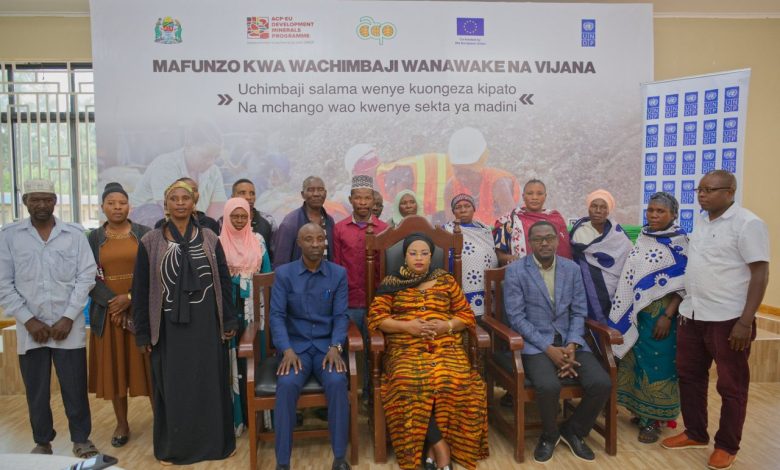
This behaviour, though often overlooked, is part of a broader set of physical properties that can guide initial identification. The training formed part of the “Building Skills for Safe Profitable Mining” workshop, a two-day event organised by the United Nations Development Programme in collaboration with the Mining Commission and the Singida Resident Mining Office.
The initiative focuses on strengthening the capacity of women and youth engaged in artisanal and small-scale mining. It also falls under the Development Minerals Programme, a three-year initiative running from 2025 to 2027 and supported by the European Union, UNDP, and the African, Caribbean and Pacific Group of States.
The programme aims to improve productivity, safety, and sustainability within the mining sector. Beyond visual inspection, the geologist introduced simple field tests that miners can perform. One such method involves applying a drop of hydrochloric acid to a suspected mineral. If the sample produces a hissing sound, it may contain carbonates—an indicator of certain types of valuable deposits.
He also pointed out that some minerals appear as small but unusually heavy particles, often indicating a high metal content. Others are found in areas where rainwater consistently flows, gradually exposing deposits over time. These are typically dark, fine particles used in various industries, including manufacturing applications such as paints, aviation components, and electronic accessories.
For materials like glittering sand, Mutagwa advised caution and curiosity in equal measure. Such samples, he noted, could contain silica minerals, which are widely used in the production of glass and related products. However, he stressed that field observations should always be followed by laboratory testing to confirm composition and value.
“Take time to conduct an initial survey of anything you suspect,” he told participants. “But always submit samples to a laboratory for final verification. Colour alone can be misleading.” This blend of practical knowledge and scientific validation formed a key theme of the workshop. By equipping miners with basic identification skills, organisers aim to reduce the risk of financial losses caused by misjudging the value of materials.
UNDP Project Manager Godfrey Nyamrunda explained that the training is designed to address common challenges faced by ASMs, including limited technical knowledge and difficulty identifying valuable ores.
ALSO READ: NSC Sports Awards set to recognise top performers in May
These gaps often lead miners to sell unprocessed materials at low prices or overlook resources with significant potential. To complement the geological training, participants also received guidance on financial access and cooperative formation.
These sessions focused on helping miners organise into formal groups, develop simple business plans, and connect with local financial institutions such as Savings and Credit Cooperative Societies and Village Community Banks.
“The goal is to enable miners to adopt safer practices, improve compliance, and build stronger financial linkages,” Nyamrunda said.
He added that several groups are already preparing to register as cooperatives, marking a shift towards more structured and profitable operations. Formalisation was further emphasised by Hashim Mkwayu from the Tanzania Revenue Authority, who encouraged miners to register their activities and operate within the legal framework.
He explained that forming recognised groups requires obtaining a Taxpayer Identification Number, establishing a constitution, identifying operational locations, and outlining tax obligations. Unlike many other businesses, he noted, small-scale mining groups are taxed on profits rather than gross income, with a rate of 30 percent applied to earnings. He also recommended the use of electronic fiscal devices to track sales and profits, enhancing transparency and financial management.
Access to finance remains a critical issue for many ASMs, and this was addressed by Happy Mutafurwa, Relationship Manager at NMB Bank.
She informed participants about loan facilities available to small-scale entrepreneurs, including funds introduced under the leadership of Samia Suluhu Hassan. These loans, ranging from 100,000 to 4 million shillings, are accessible even to individuals without formal business licences, provided they possess an entrepreneurship identification card issued by local authorities.
The terms, she said, are designed to be flexible and supportive of small enterprises. For many participants, the workshop provided new perspectives on materials they had previously overlooked. Joanitha Rutenta, a miner working with gypsum, shared how the training changed her understanding of the mineral.
She explained that gypsum exists in two forms—one soft and the other more rigid—yet both possess similar quality and applications. Previously, she and others had dismissed the harder variety, assuming it was less valuable.
“Now we understand its importance,” she said, recalling how unprocessed gypsum can resemble a wet mattress, with its final form depending on the level of compression it undergoes. The insight, while simple, has immediate implications for how miners approach extraction. Closing the workshop, Singida Regional Commissioner Halima Dendegu highlighted the region’s progress in the mining sector.
She noted that revenues have grown significantly, from 1 billion shillings in 2019 to over 33 billion shillings currently, reflecting increased activity and improved management. She attributed this growth to a combination of factors, including the availability of diverse mineral resources and government efforts to create an enabling environment for investors. To date, more than 1,200 licences have been issued to small-scale miners, alongside permits for processing operations and larger investments.
The region has also established designated mining areas for ASMs and developed local mineral markets and centres to facilitate trade. In addition, industrial mineral processing has expanded, with products such as copper finding markets in neighbouring countries including Burundi and Rwanda.
Dendegu encouraged miners to think beyond extraction and invest in value addition. Small-scale industries, such as chalk manufacturing and similar ventures, can enhance profitability and create employment opportunities within the region.
“Singida is moving towards an industrial economy,” she said.
“The raw materials are here. What is needed now is investment in processing and production.” She also urged participants to apply and share the knowledge gained from the workshop, emphasising that skills development is essential for sustaining growth in the mining sector. The discussions in Singida highlight a broader shift within artisanal mining—from informal, trial-and-error practices towards more informed, structured approaches.
While advanced technology and scientific analysis remain important, the ability to recognise value in the field remains a crucial first step. In this evolving landscape, a simple observation—a glint of light, an unexpected weight, a subtle reaction—can be the beginning of opportunity. When combined with training, organisation, and access to resources, such knowledge has the potential to transform not only individual livelihoods but the sector as a whole.