MyLegacy schools rise as climate justice frontlines
DAR ES SALAAM: IN a world and Tanzania inclusive increasingly battered by climate change effects including floods, prolonged heatwaves and growing water scarcity, a new conversation is taking shape about, who bears the heaviest burden of climate change a g convened by MyLEGACY, journalists gathered to examine the role of the press not only in reporting climate change, but in championing a more just and inclusive response.
Opening the meeting, MyLEGACY Director Fortunata Temu underscored the urgency of reframing climate discourse in Tanzania. She said the organisation had deliberately engaged the media because public understanding and accountability depend on informed reporting.
“The media is not just a channel for information,” Ms Temu said. “It is a powerful advocacy platform. If we are serious about addressing climate change, we must ensure that coverage reflects the lived realities of women, girls and vulnerable groups who are disproportionately affected.” Ms Temu explained that the meeting forms part of the implementation of the project Promoting Gender-Responsive Climate Action for a Better Tomorrow, widely known as Kesho Njema.
Supported by the Embassy of Ireland in Tanzania, the initiative seeks to ensure that climate action does not overlook those most affected. Across Tanzania, she noted, communities are grappling with intensifying environmental shocks. Floods wash away homes and infrastructure.
Heatwaves stretch longer. Water sources shrink. But the impacts are not evenly distributed.
“Climate change widens existing gender gaps,” the Director said.
“It increases the risk of gender-based violence and disrupts access to sexual and reproductive health services and rights. Yet these dimensions are often missing from climate planning frameworks.” She stressed that infrastructure responses, while essential still cannot be the sole focus.
“We clean drainage systems, we rehabilitate roads, we talk about physical adaptation. But we rarely ask how climate shocks are affecting a girl’s safety, a woman’s health, or a person with disability’s access to services. Climate resilience without gender equity is incomplete.” Through the Kesho Njema project, MyLEGACY has concentrated its interventions in the wards of Kawe, Kunduchi and Wazo Hill in Kinondoni District, Dar es Salaam.
The goal, Ms Temu explained, is to strengthen gender-responsive climate adaptation strategies while building long-term community resilience. Further providing detailed insight into the technical work behind the initiative, MyLEGACY Programme Coordinator Amina Alliy outlined the findings of a comprehensive assessment conducted in Kinondoni District.
“All climate action plans were reviewed from 2013/14 to 2024/25,” she pointed out.
“We examined ward-level plans, school disaster preparedness systems and community governance structures to determine the extent to which Sexual and Reproductive Health and Rights and the prevention of Gender-Based Violence have been integrated.” The findings, she noted, reveal a persistent gap between environmental planning and social protection. “At ward level, climate response plans prioritise infrastructure interventions such as cleaning and rehabilitating drainage systems and promoting environmental sanitation,” Alliy explained.
“These are important. However, Sexual and Reproductive Health and Rights and gender-based violence issues are not adequately embedded in formal climate planning systems.”
She added that gender concerns are not systematically addressed and that coordination between environmental, health and gender departments remains limited.
“We also found insufficient sex-disaggregated data on climate impacts, which makes it difficult to design targeted interventions. Participation of women, youth and marginalised groups in climate decision-making remains low.”
According to Ms Alliy, the assessment does not merely highlight weaknesses; it proposes solutions. Recommendations include integrating clear indicators on sexual and reproductive health rights and gender-based violence prevention into local climate strategies, strengthening interdepartmental coordination, adopting gender-responsive climate budgeting and expanding meaningful participation of women and youth in climate governance.
“If we fail to integrate these elements,” she said, “we risk designing climate responses that are technically sound but socially blind.”
Classrooms as climate laboratories While policy reform is essential, both the Director and Programme Coordinator emphasised that transformation must also begin with young people. Under the Kesho Njema project, 775 students aged between nine and seventeen members of WASH clubs in 25 schools have participated in specialised climate education sessions.
“Ms Alliy explained that schools are powerful entry points for longterm change. “These clubs serve as catalysts for disseminating knowledge not only within schools but also into surrounding communities,” she said.
The programme has revealed critical lessons. Early stakeholder engagement, for instance, proved indispensable.
“In some cases, newly appointed head teachers were not aware of earlier communications about the project,” Alliy said. “This showed us the importance of maintaining continuous coordination with District Education Officers and school boards to ensure institutional ownership and continuity.” Equally transformative has been the adoption of participatory, child-centred learning approaches. Storytelling, group discussions, role-play and art have replaced purely lecture-based methods.
“When children connect climate concepts to their daily lives how energy is used at home, how waste is managed, how heat affects concentration the learning becomes real,” Alliy observed. Students have demonstrated their understanding through drawings, exhibitions and peer discussions, translating abstract climate science into lived experience.
Ms Temu added that integrating gender and social justice themes into environmental education has been critical.
“When we link energy conservation and climate change to gender-based violence and sexual and reproductive health rights, students begin to see the human face of environmental degradation,” she said.
“It fosters empathy and responsibility.” Students have also taken on leadership roles as “Energy Champions,” promoting responsible environmental behaviour among peers. “Young people are not passive victims of climate change,” Temu stressed. “They are potential drivers of behavioural transformation in schools and communities.”
The knowledge Café model
Beyond schools, MyLEGACY has invested in structured community dialogue through a platform known as the Knowledge Café. The sessions have brought together 249 participants, including local leaders, women, youth, teachers and persons with disabilities.
According to Temu, these dialogues have demonstrated that communities possess deep knowledge of their own environmental challenges.
“When given safe and inclusive spaces, community members identify not only the problems but also practical, locally grounded solutions,” she said.
ALSO READ: Cutting costs, saving forests: The new era of tobacco curing
“Their participation is not optional; it is essential.” Alliy highlighted that discussions repeatedly underscored the intersectional nature of climate change.
“Climate change does not operate in isolation,” she said. “It intersects with gender inequality, disability inclusion, education and health systems. Women, girls and persons with disabilities face compounded vulnerabilities that must be addressed deliberately.” However, awareness alone is insufficient.
“Many communities understand the issues,” Alliy explained, “but lack the systems and resources to translate knowledge into sustained action. Waste management systems, enforcement of environmental by-laws, inclusive budgeting processes and stronger climate education frameworks are still uneven.” Institutional strengthening, she argued, is necessary to ensure that community readiness is matched by implementation capacity.
Institutional strengthening, she argued, is necessary to ensure that community readiness is matched by implementation capacity.
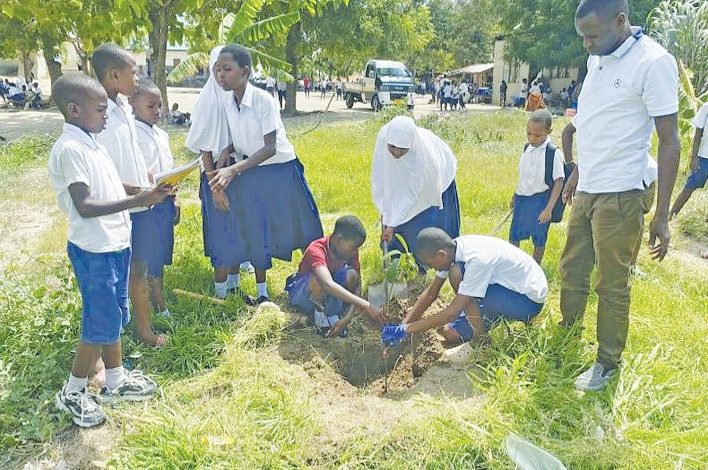
From talk to trees Practical action has anchored the project’s philosophy. School WASH and Environmental Clubs have led tree-planting initiatives in schools and neighbouring communities, aiming to reduce deforestation and promote sustainable conservation.
“Alliy reported that 2,000 shade and fruit trees have been planted across 24 schools,” she said. “These trees will improve school environments, reduce heat and dust and provide shaded spaces for study and recreation.” The initiative has also reinforced gender-responsive awareness. Girls have participated equally in planting and maintaining the trees, strengthening confidence and leadership.
Discussions during the activities have reinforced understanding of how climate stress can heighten social vulnerabilities, including the risk of gender-based violence. Students have gained practical skills in tree planting, watering and maintenance, including low-cost drip irrigation methods using discarded plastic bottles.
“We are turning waste into solutions,” Alliy noted. Ms Temu described the symbolism as profound. “Planting a tree is not just an environmental act,” she said. “It is a declaration that resilience must be rooted in equity.”
A broader mission
My LEGACY’s climate justice work aligns with its broader mandate to eradicate extreme poverty in marginalised communities by expanding access to decent housing, economically empowering women and youth, promoting inclusive community leadership and advocating for the rights of women and children.
“The integration of gender equity into climate action reflects who we are as an organisation,” Temu said. “Environmental sustainability, social justice and economic empowerment are interconnected.” As Tanzania confronts escalating climate threats, both leaders were unequivocal. Infrastructure alone will not secure the future. Nor will awareness campaigns without institutional reform.
“The climate crisis is not gender-neutral,” Temu concluded. “Our response must not be either.”
And as she reminded the journalists gathered in the room, the media’s voice may prove decisive in ensuring that no one especially women, girls and vulnerable groups is left behind.