Growing Together: One city, one food system, a shared future
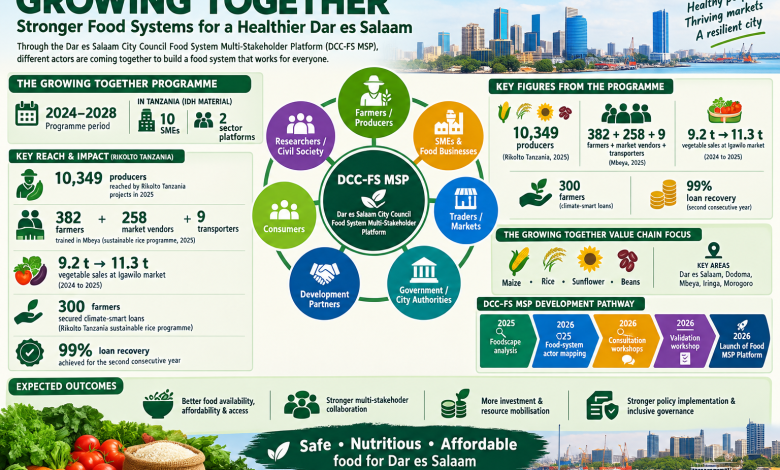
DAR ES SALAAM: DAR ES SALAAM is taking a new step towards strengthening the way food is produced, traded, distributed and consumed through the establishment of the Dar es Salaam City Council Food System Multi-Stakeholder Platform (DCC-FS MSP), an initiative being developed under the Growing Together programme.
The platform brings together government institutions, farmers, food producers, traders, private-sector companies, civil society, researchers, development partners and other actors whose activities influence the city’s food system.
Its central purpose is to create a space where these stakeholders can jointly identify challenges, coordinate responses and contribute to improving access to safe, affordable, nutritious and quality food for Dar es Salaam residents.
Growing Together is a 2024–2028 programme led by IDH- the Sustainable Trade Initiative and funded by NORAD, with Rikolto playing an implementation role in Tanzania.
According to Rikolto, the programme in Tanzania is designed to strengthen local food markets by professionalizing small and medium-sized enterprises involved in food processing and distribution.
The programme is being implemented in Dar es Salaam and Dodoma as part of a wider intervention covering Tanzania and Ethiopia.
The importance of the programme becomes clearer when food production is viewed not only as a farming issue, but as a system that connects farmers to markets, transporters, processors, traders, businesses and consumers.
Rikolto describes its approach as one that links sustainable production, inclusive markets and an enabling environment, with the objective of creating food systems that can provide healthy and sustainable diets while supporting farmers and food-chain businesses.
Agriculture remains an important foundation of this system. Rikolto says that its work in Tanzania focuses on structured trading systems, farmer business management and sustainable, quality and safe food production and consumption.
In 2025, its Tanzania projects reached 10,349 producers, while its work included cities such as Arusha, Mbeya, Dodoma, Dar es Salaam and Tanga.
ALSO READ: Farmer-market links key to farm growth
Some of the organisation’s recent agricultural interventions illustrate the connection between production and markets. In Mbeya, Rikolto trained 382 farmers, nine transporters and 258 market vendors, while vegetable sales at Igawilo market increased from 9.2 tonnes in 2024 to 11.3 tonnes in 2025, according to the organisation.
In another intervention, 300 farmers had secured climate-smart loans, while farmers recorded a 99 percent loan recovery rate for the second consecutive year.
These experiences are relevant to Growing Together because the programme is not designed simply to increase agricultural production.
Its wider objective is to make food markets work better by strengthening the businesses and relationships that connect producers with consumers.
IDH (The Sustainable Trade Initiative) describes Growing Together as a programme supporting 10 SMEs and two large off-takers in the maize, rice, sunflower and beans value chains.
The programme seeks to strengthen smallholder productivity, improve food-system resilience and optimise value chains for investment and trade, while also promoting job creation, higher incomes, gender transformation and data-driven decision-making.
The programme’s value-chain focus is particularly significant for urban food security. Rikolto’s earlier programme planning identified maize, rice, sunflower and common beans as key value chains and Dar es Salaam, Dodoma, Mbeya, Iringa and Morogoro as geographical areas for intervention.
The work also includes analyzing food flows, market inefficiencies, distribution models and links between farmers and markets.
The DCC-FS MSP therefore provides an institutional space through which these different parts of the food system can be connected.
The presentation prepared for the platform identifies a development process that began with food-system analysis and actor mapping in 2025, followed by consultation and validation workshops in 2026 before the launch of the platform.
Its expected outcomes include improved food availability, affordability and access; stronger collaboration among food-system actors; increased investment and resource mobilisation; and stronger policy implementation and inclusive governance.
This approach reflects Rikolto’s wider experience with urban food systems. The organisation says cities are critical entry points for transforming food systems because urban areas concentrate consumers, markets and food-chain businesses.
Its Good Food for Cities programme seeks to bring local food-system actors together so that urban food environments and supply chains can provide healthier, sustainable and nutritious diets.
Rikolto has also previously worked with cities in Tanzania on food-system initiatives. In Mbeya, for example, food systems have been incorporated into the city’s five-year strategic plan, with a Food Smart City Platform contributing to the process.
ALSO READ: RC calls for orderly commercial trading spaces
In Dar es Salaam, Rikolto has also worked with youth-led enterprises on digital food-distribution models intended to make food chains more efficient and improve traceability and food-safety practices.
For Dar es Salaam, the new platform could therefore serve as a bridge between these different experiences and the city’s current food-system priorities.
The proposed platform is expected to go beyond meetings. Its framework identifies regular multi-stakeholder dialogues, support for implementing agreed priorities, institutionalisation of the platform, mobilisation of resources and partnerships, and support for food businesses as important next steps.
This is also consistent with IDH’s broader approach. IDH says it works by convening multi-stakeholder collaborations, mobilising public and private capital and co-creating programmes with businesses, governments, investors and communities.
Its food-system work places emphasis on developing sustainable business models and improving sector governance.
For farmers, this could mean stronger connections to reliable markets and business services. For SMEs, it could create opportunities for improved technical capacity, investment and market linkages.
For government and other institutions, the platform offers a mechanism for coordinating policies and responses.
And for consumers, the long-term objective is a food environment where safe, nutritious and affordable food is more consistently available.
Ultimately, Growing Together places the DCC-FS MSP within a broader effort to connect agricultural production with the needs of a rapidly growing urban population.
Rather than treating food security as the responsibility of farmers or government alone, the platform recognizes that the journey from farm to table involves an entire network of actors.
If that network can work around shared priorities, better information and coordinated action, the platform could become an important mechanism for shaping a more inclusive and resilient food system for Dar es Salaam one that supports farmers and food businesses while improving the city’s access to safe, affordable and nutritious food.
Speaking recently during the Food Systems Platform Regional Director in East Africa from Rikolto, Kain Mvanda which was set to bring together various stakeholders to strengthen access to safe, quality and nutritious food for residents of Dar es Salaam.
He said, “The establishment of the Dar es Salaam City Council Food System Multi-Stakeholder Platform (DCC-FS MSP) is an important step towards creating a more coordinated, inclusive and resilient food system in the city,”
“The platform is designed to bring together different actors involved in the food system, including government authorities, farmers and producers, food businesses, traders, researchers, development partners and consumers,” Mvanda added.
He indicated that, “By creating a common space for these stakeholders to work together, the platform can help address challenges that cannot easily be solved by one institution or sector alone,”
He highlighted that, one of the major benefits of the platform is its potential to improve the availability, affordability and accessibility of food in Dar es Salaam.
“In 2025, its projects reached 10,349 producers across the country. In Mbeya, the organisation trained 382 farmers, nine transporters and 258 market vendors, while vegetable sales at Igawilo market increased from 9.2 tonnes in 2024 to 11.3 tonnes in 2025,” he stressed.
On her side, Jane Msagati of the Food and Agriculture Organization of the United Nations (FAO) stressed that, the importance of stronger coordination among stakeholders in addressing food security and nutrition challenges.
She explained that, “Improving food systems requires looking beyond food production alone and considering how food is distributed, accessed and consumed, particularly by vulnerable groups,”
She has also emphasized that food production does not automatically guarantee good nutrition, noting that some areas that produce significant amounts of food can still experience malnutrition when household decision-making and access to nutritious food are unequal.
“In this context, the Food System Multi-Stakeholder Platform can provide an important space for government institutions, development partners, farmers, businesses, civil society and other actors to share knowledge, identify gaps and coordinate practical responses. Such collaboration can help ensure that efforts to strengthen agricultural production are also connected to nutrition, food safety, market access and equitable distribution,” she indicated.
She addressed that, “For Dar es Salaam, where the food system depends on a wide network of producers, traders, processors, distributors and consumers, stronger coordination can help address challenges across the entire food chain,”
“The platform therefore offers an opportunity to move from isolated interventions towards a more coordinated approach in which stakeholders work around shared priorities to improve access to safe, quality and nutritious food for city residents,” she concluded.