Xi’s four-point vision offers Africa a new path to mineral wealth
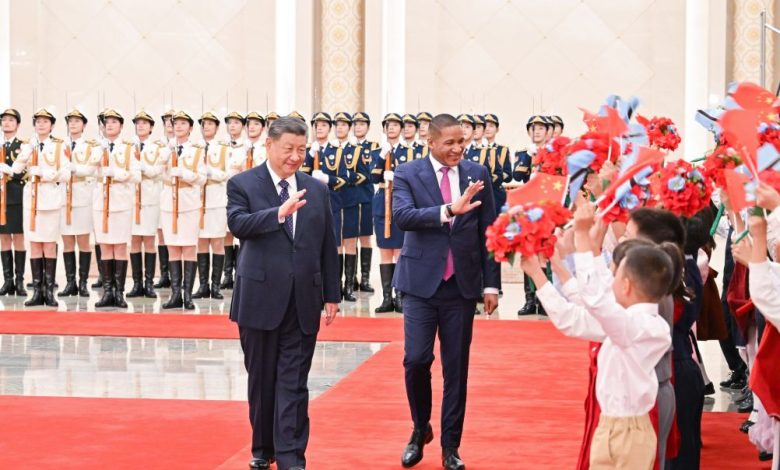
DAR ES SALAAM: ON the afternoon of October 13, President Xi Jinping held talks with President Duma Gideon Boko of Botswana, who was on a state visit to China, at the Great Hall of the People in Beijing.
Many people, especially Gen Z, do not realise that during the late nineteenth-century Scramble for Africa, European powers claimed nearly the entire continent. Looking back, the maps they used to divide Africa were largely inaccurate.
When defining the boundaries of their new territories, European negotiators often drew straight lines on maps, taking little or no account of the many traditional monarchies, chiefdoms and other African societies and cultures already there.
On closer examination, nearly half of the new borders imposed on Africa followed geometric patterns: Lines of latitude or longitude, other straight lines, or circular arcs.
Some divided African societies, cutting through about 190 cultural groups. In other cases, Europe’s newly acquired colonial territories encompassed hundreds of diverse, independent groups with no shared history, culture, language, or religion.
As European powers continued to haggle over African territory, land and people became little more than pieces on a chessboard.
Thus, as the famous British Martin Meredith writes, modern African states were born. Unfortunately, this also marked the birth of a historical reality that other continents, both old and new, have overlooked, wittingly or unwittingly.
History does not repeat itself, but it often rhymes. A US-backed infrastructure project connecting Angola’s Atlantic port of Lobito with the mineral-rich Central African Copperbelt in the Democratic Republic of Congo and Zambia is presented as development.
It is a slick, modern initiative, yet it also recalls a much darker history of exploitation stretching back more than a century. The Lobito Corridor is all about minerals: making it easier for the region’s minerals to reach global markets.
But look a little deeper and it is hard not to recognise shades of the same old story. While some view the project as a potential trade hub that could benefit African countries, many fear it is simply a gateway to further exploitation of the region’s natural resources.
As a DRC economic analyst put it, this project is an organised sell-off of the region’s natural resources in a capitalist system. From an economic and strategic perspective, the Lobito Corridor is only the tip of the iceberg.
Many fear that the current US administration’s appetite for critical minerals is fuelling sociopolitical instability worldwide. What about security resources? And Minerals-forAid? Schemes to acquire minerals under the guise of peace and development sound all too familiar.
From partitioning the whole continent to targeting specific critical resources, the tactics may have changed, but the practice remains plainly unjust.
When it comes to cooperation, African countries are better off with more credible partners, partners who treat one another with genuine respect and equality and, most importantly, ensure mutual benefit and future reciprocity.
With this in mind, I found the message from the recent meeting between Chinese President Xi Jinping and Botswana’s President Duma Gideon Boko to be very informative.
Many will recall that on 13 October 2026, President Xi welcomed President Boko to Beijing and, during their talks, put forward a four-point proposition for ChinaAfrica mining cooperation.
First, the starting principle should be African resources belonging to Africa. China stands ready to share its experience and help African countries formulate mining development plans consistent with their national conditions.
Second, the guiding philosophy should be a right approach to friendship and interests and ensuring mutual benefit. China will continue to encourage Chinese companies to enhance their operational capacity, transfer green technologies suited to Africa’s conditions and promote SouthSouth cooperation in mining development.
Third, the direction of cooperation should be high-quality development.
China will continue to move China-Africa mining cooperation toward industrial value addition, explore new financing models that are affordable and sustainable, and support Africa’s modernisation through high-standard cooperation.
Fourth, a fair and open cooperation environment is crucial. Africa’s resources should not be used for geopolitical rivalry.
China would be glad to see other parties providing genuine support for Africa’s development and stands ready to work with Africa to create more enabling conditions for business investment and operation.
While Western powers were colonising Africa, China suffered similar imperialist aggression and semi-colonial humiliation by many of the same powers. Do not do to others what you would not want done to yourself.
This ancient wisdom, deeply rooted in traditional Chinese culture, shapes China’s diplomatic policy. Given their shared history of colonial humiliation, China’s position and practice in promoting China-Africa friendship and cooperation have remained consistent.
The four-point proposition put forward by President Xi regarding China-Africa mining cooperation fully confirms this point.
The four-point proposition offers important leadership lessons for African nations, particularly for SADC member states. Its central message is that a leader’s effectiveness depends on the tangible benefits they deliver to the public, not on the promises they make.
First, national growth must be grounded in national resources. Drawing on China’s approach, African leaders are urged to take ownership of their mineral wealth through sound laws, transparent contracts, and strategic planning, guided by President Xi’s belief that African resources belong to Africa.
Taking Tanzania as an example, this means ensuring that gold, graphite, nickel and other minerals generate not only export earnings but also support domestic businesses, create skilled jobs, transfer technology and provide government revenue.
ALSO READ: Tanzania women pursue greater control of mineral wealth
Second, leadership should prioritise mutual benefit over short-term gains. Strategically, China’s approach emphasises collaboration that links Africa’s resources and development goals with investment, technology and expertise.
Tanzania should avoid agreements that leave the country dependent on raw material exports and instead pursue partnerships that deliver measurable benefits to both investors and citizens. Third, the vision must be put into practice.
Announcing industrialisation goals is not enough; they require funding, capable organisations, clearly defined roles, deadlines and measurable outcomes.
Tanzania should expand domestic supplier participation, technical education, geological research and local mineral processing.
Regular monitoring is essential to determine whether agreements are delivering the intended results. Fourth, strategic leadership depends on independence and transparency.
The principle that African resources should not be used as tools in geopolitical rivalries reminds African nations to act in their national interests.
Tanzania can work more closely with China and other partners to promote genuine investment while ensuring fair competition, transparent regulations, and national decisionmaking authority.
Crucially, these principles must be judged by how they are applied, not simply by diplomatic declarations.
African governments must enforce environmental regulations, protect mining communities, disclose contractual commitments, and impartially evaluate how financial gains are distributed.
Natural resources can generate wealth, but visionary leadership, strong institutions and focused execution turn that potential into national prosperity. This is the ultimate leadership lesson to embrace.
A clear case in point is the recent China-Africa mining collaboration, highlighted by President Xi Jinping’s meeting with Botswana President Duma Gideon Boko during his state visit in October 2026.
To ensure such high-level consensus delivers tangible results, leaders’ suggestions must be implemented locally.
Under the leadership of President Xi Jinping, General Secretary of the CPC Central Committee, China will continue to work hand-inhand with like-minded African partners to turn this strategic vision into concrete reality. Raptors are unwelcome; birds of a feather flock together.