

Global study warns of 400 million annual pesticide poisoning cases
DAR ES SALAA: More than 400 million cases of unintentional acute pesticide poisoning are estimated to occur among farmers and farmworkers around the world every year, highlighting the scale of a public health challenge that continues to affect agricultural communities despite growing efforts to promote safer farming practices.
A new global study published in Frontiers in Public Health estimates that between 402 million and 433 million cases of unintentional acute pesticide poisoning occur annually among the global farming and agricultural workforce.
The estimate is based on a worldwide farming and occupational population of approximately 934 million people, meaning that the annual burden is equivalent to about 46 percent of this population.
The study, which examined evidence covering the period from 2006 to 2023, provides one of the broadest assessments of the occupational burden associated with acute pesticide exposure.
Researchers examined evidence from 139 countries, including 62 countries represented through 214 published studies and another 77 countries covered through mortality data from the World Health Organization database.
The findings indicate that the problem is not concentrated in one part of the world. The largest estimated number of non-fatal poisoning cases occurs in Southern Asia, followed by South-Eastern Asia and Eastern Africa.
The position of Eastern Africa among the regions with the highest estimated burden places the issue within the wider agricultural and public health concerns facing countries in the region.
The scale of the estimate becomes clearer when the reported cases and the modelled global burden are considered separately. The studies reviewed by the researchers reported approximately 369,632 annual cases of unintentional acute pesticide poisoning, including 9,182 fatalities and 360,450 non-fatal cases.
Based on the available evidence and statistical estimation, the researchers calculated that the actual global annual burden among farmers and farmworkers could reach between 402 million and 433 million cases, including approximately 11,000 deaths.
These figures refer specifically to unintentional acute pesticide poisoning. They should therefore not be interpreted as a count of every person exposed to pesticides or as a total measure of all pesticide-related illnesses.
The study focuses on acute poisoning, which refers to health effects occurring relatively soon after exposure. The researchers also conducted sensitivity analyses to test how different assumptions and study designs affected the estimates, with the global estimate remaining within the broad range of about 402 million to 433 million cases.
Farmers and farmworkers can encounter pesticides at several stages of agricultural production. Exposure can occur while pesticides are being prepared and applied, but also through contact with treated crops, contaminated equipment and clothing. Food containing high levels of pesticide residues can provide another potential route of exposure.
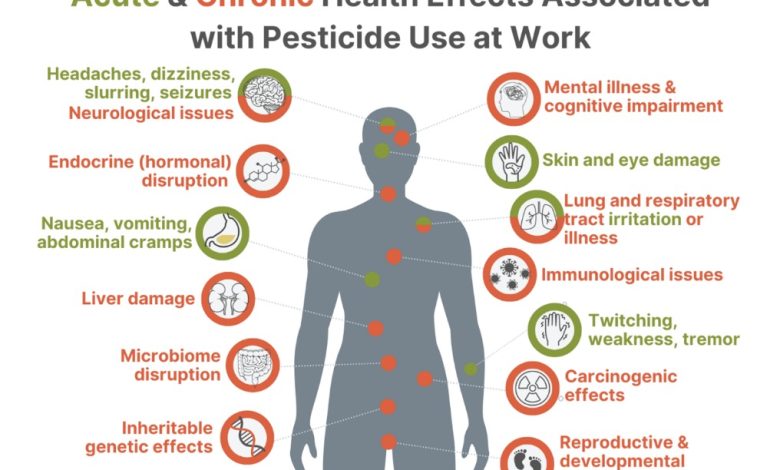
Acute pesticide poisoning may produce symptoms such as headaches, nausea, vomiting and skin irritation. The health effects can vary depending on the chemical involved, the level and route of exposure, and the circumstances surrounding the incident.
Repeated exposure over a longer period also raises broader concerns about chronic health effects, which cannot be fully represented by the annual acute-poisoning estimate.
The burden also extends beyond the farmers who directly handle pesticides. The study points to groups that may face additional risks but are not included in the main global estimate.
Around 84 million children are estimated to work in agriculture worldwide, while rural families can also be exposed through pesticide drift from fields and through contaminated environmental sources. This means that the consequences of pesticide use can reach beyond the individual worker applying chemicals in a farm.
Women are another important part of the discussion, particularly in Africa, where women participate extensively in agricultural activities such as weeding and harvesting.
ALSO READ: Tanzania’s new investment pitch to Germany, build here, export to Africa
Their exposure can occur in working environments where access to protective equipment, safety information and training may be limited. Working conditions can also influence whether protective equipment is practical to use, particularly in areas experiencing high temperatures for much of the year.
For Tanzania and the wider East African region, the findings raise questions about how agricultural workers receive information about pesticide hazards, how protective measures are implemented and how easily farmers can access safer alternatives.
The issue is particularly significant because agriculture remains central to livelihoods across the region, meaning that pesticide safety is closely connected to occupational health, food production and environmental protection.
In Tanzania, the issue is also being highlighted by the Agenda for Environment and Responsible Development, known as AGENDA, an environmental non-governmental organisation working on issues including sound chemicals and waste management, sustainable natural resource management, climate change, advocacy and capacity building.
AGENDA is based in Tanzania and is identified by the International Pollutants Elimination Network as its Anglophone Africa regional hub.
AGENDA’s involvement places the global findings within a local and regional environmental health context. Its work includes chemicals management, policy advocacy, research, training and stakeholder engagement, areas that are directly relevant to the challenge of reducing harmful pesticide exposure in agricultural communities.
The wider international response is increasingly focused not only on how farmers can protect themselves while using pesticides, but also on reducing dependence on the most hazardous chemicals.
The Global Framework on Chemicals, adopted in 2023, established Target A7, which calls for effective measures by 2035 to phase out highly hazardous pesticides in agriculture where risks have not been adequately managed and where safer and affordable alternatives are available.
The Food and Agriculture Organization of the United Nations supports this direction and has highlighted the need to reduce the risks associated with highly hazardous pesticides while promoting safer alternatives.
The framework also encourages broader approaches to sustainable agriculture, including agroecology, integrated pest management and non-chemical alternatives.
The findings therefore shift the pesticide debate from individual incidents to the scale of an international occupational and public health problem.
More than 400 million estimated annual cases among farmers and farmworkers indicate that pesticide exposure is not simply an isolated workplace hazard but a challenge requiring attention across agriculture, health, environmental management, regulation, training and rural development.
For countries in Eastern Africa, the findings also underline the importance of strengthening farmer awareness, improving access to appropriate protective measures, monitoring pesticide exposure and expanding access to safer pest-management methods.
The challenge is not only to respond when poisoning occurs, but also to reduce the circumstances that allow hazardous exposure to happen in the first place.
As the international community moves toward the 2035 target for highly hazardous pesticides, the experience of farmers and agricultural workers will remain central to measuring progress.
The global estimate of 402 million to 433 million annual cases provides a measure of the scale, while the regional concentration of cases and the involvement of vulnerable groups point to the need for stronger evidence, prevention and safer agricultural practices.
The figures presented by the new study ultimately show that the health cost associated with pesticide use deserves to be considered alongside agricultural productivity.
For millions of farmers and farmworkers, the chemicals used to protect crops can also become a source of serious exposure, making pesticide safety an important part of the future of sustainable agriculture.




1win казино, 1win casino официальный сайт открывает
доступ азартных игр с
разнообразными услугами.
my web-site https://1win-mxp5.top/
1win казино, один вин официальный
сайт предлагает исключительный опыт азартных
игр. Здесь вы можете найти множество опций.
Also visit my web blog – https://1win-ugd93.top/