Why the 4Rs matter more than ever for Tanzania
DAR ES SALAAM: AS Tanzania awaits the findings of the Commission of Inquiry into the events of October 29, 2025, the national conversation has increasingly focused on one urgent reality: preserving peace, national unity and social cohesion, which is now more critical than ever for the country’s stability and future.
The October 29 crisis, though limited in scope, left a visible mark on the country’s longstanding reputation as one of Africa’s most peaceful and cohesive nations.
For decades, Tanzania has been widely regarded as a model of stability and unity in a region where political tensions have, in some cases, escalated into prolonged instability. Since the reintroduction of multiparty politics, the country had managed six general elections and navigated political competition with relative calm.
The 2025 General Election, however, tested that record in an unprecedented way. What many Tanzanians initially dismissed as political rhetoric and election-season threats eventually escalated into a wave of violence that shook the country’s long-standing image of peace and stability.
Voting began peacefully across much of the country, allowing citizens to participate calmly in the democratic process. But unrest later emerged in parts of Dar es Salaam, particularly in Kimara Kibo, before spreading to other areas and regions, including Arusha, Dodoma, Mwanza and Mbeya.
According to official accounts, the violence resulted in loss of lives, injuries, looting, arson and destruction of both public and private property.
Government offices, schools, health centres, police stations and transport infrastructure were damaged, while businesses, homes and vehicles were also targeted. Preliminary figures released by Prime Minister Mwigulu Nchemba showed the scale of the destruction: 2,268 motorcycles, 1,642 cars, 273 houses, 976 government vehicles and 756 offices were damaged, while 672 fuel stations and 159 police stations were affected.
The unrest also disrupted public transport infrastructure, damaging 27 Bus Rapid Transit stations and destroying at least six buses. For many citizens, the events became a sobering reminder that peace and stability cannot be taken for granted.
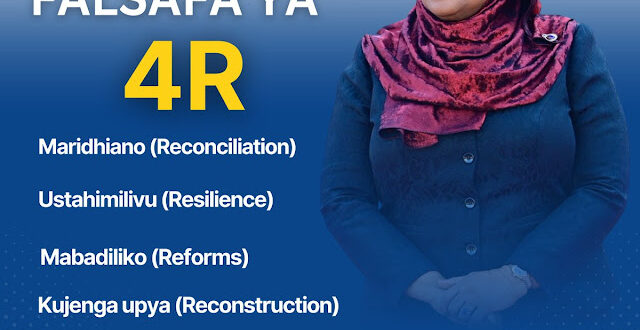
It is within this context that President Samia Suluhu Hassan’s 4Rs philosophy- reconciliation, resilience, reforms and rebuilding has taken on renewed significance. Introduced in 2021, the framework sought to restore trust, widen political space and strengthen institutions. In the current climate, however, many observers increasingly see it as essential to preserving national cohesion and preventing future instability.
ALSO READ: Facts first: Hard questions on 2025 Human Rights Report
In her national address following the unrest, President Samia Suluhu Hassan adopted a conciliatory tone, offering condolences to families affected by the violence while calling for national reflection and healing. As the country’s chief comforter during a moment of uncertainty, she stressed the importance of examining the root causes of the unrest, signalling a preference for evidence-based solutions rather than reactive responses.
The president also acknowledged that improvements were necessary, but insisted that reforms must remain nationally driven and grounded in Tanzania’s own realities. At the same time, she urged young people to avoid actions that could destabilise the country, describing them as central to Tanzania’s future.
Her message reflected the broader principles underpinning the 4Rs: stability through dialogue, reform through institutions and national healing through reconciliation. Economist and governance analyst, Prof Marcelina Chijoriga says moments of crisis often reveal the true importance of leadership.
“The true test of leadership emerges in times of crisis, when a nation faces uncertainty and stands at a crossroads,” she said.
“A capable leader demonstrates the courage to open space for dialogue, listen to all sides and prioritise national interests above personal gain.” The first pillar, reconciliation, has become particularly important. In political sensitive moments, societies often face a choice between deepening divisions or rebuilding dialogue.
Since 2021, efforts to reopen political and civic space, including the return of opposition leaders, the easing of restrictions on political activities and the revival of dialogue platforms such as the Tanzania Centre for Democracy (TCD), have aimed at reducing tension through engagement rather than confrontation.
Archbishop of the Anglican Church of Tanzania, Mahimbo Mndolwa, says such efforts reflect political maturity and strengthen national unity. “The formation of the commission signals hope and a clear constructive path for the nation,” he said.
He added: “Resolving internal conflicts through domestic mechanisms before seeking external assistance is a sign of national maturity.” Political analyst Kenneth Simbaya argues that reconciliation is essential in preventing divisions from weakening institutions and society.
“Reconciliation is not about pretending that differences do not exist. It is about enabling people with different histories, interests and grievances to work together towards a shared future,” he said.
He added: “Without reconciliation, even the best policies will struggle to succeed because mistrust, division and unresolved wounds weaken institutions and public confidence.”
Following the unrest, President Samia Suluhu Hassan pardoned some youths linked to the violence, reflecting an approach that balanced accountability with reconciliation. Archbishop Mahimbo Mndolwa stressed that dialogue remains central to peaceful conflict resolution.
“Conflict resolution should begin with direct, personal dialogue before involving others,” he said. Mr Simbaya added that reconciliation requires active participation across society.
“We must create spaces where people can speak honestly, listen to each other and confront difficult truths,” he said.
The second pillar, resilience, became equally critical after the unrest tested the country’s institutions and national cohesion. In response, the government relied largely on institutional mechanisms, including the establishment of a Commission of Inquiry led by former Chief Justice Mohamed Chande Othman.
Public hearings were conducted across the country, while cases linked to violence and destruction were processed through formal judicial channels. Mufti Sheikh Abubakar Zuber bin Ally said the process reflects both justice and reconciliation. “The commission is operating within a framework of justice and national reconciliation.
The commission marks the beginning of a healing process that will restore normalcy in the country,” he said. Prof Marcelina Chijoriga described the commission as an important sign of accountable leadership. “The establishment of commissions of inquiry is itself a positive step, as it creates an opportunity for citizens to be heard,” she said.
“Listening to the public is a critical step towards national progress and a clear indication of leadership maturity.” The third pillar, reforms, remains equally important. Political tensions often grow where institutions are perceived as weak or unresponsive. Since 2021, Tanzania has introduced reforms aimed at strengthening governance systems and improving public confidence in institutions.
Such reforms matter because trusted institutions reduce the likelihood that political disagreements will escalate into violence. Mr Simbaya described reconciliation as essential for long-term national development.
“Reconciliation stands out as a strategic national asset that underpins sustainable development. It enables peace, strengthens institutions and fosters shared responsibility among citizens,” he said.
Prof Chijoriga echoed this view, saying development depends on inclusion and cooperation. “Development transcends political affiliation and achieving the vision requires unity and cooperation among all citizens,” she said. The final pillar, rebuilding, focuses on restoring trust and strengthening long-term stability.
Following the unrest, attention increasingly shifted toward rebuilding confidence in institutions, strengthening social cohesion and expanding opportunities for young people. Mr Simbaya said reconciliation must extend beyond politics into everyday life. “Reconciliation must be experienced in everyday life; it begins in communities, families and institutions,” he said. Mufti Sheikh Abubakar Zuber bin Ally also stressed that lasting solutions must emerge from within society itself.
“Tanzanians are best placed to understand and resolve their own challenges,” he said. As Tanzania moves forward, many observers believe the continued relevance of the 4Rs lies in their ability to encourage dialogue over confrontation and unity over division.
Those principles reflect the vision long championed by Julius Nyerere, who consistently emphasised unity, dialogue and the spirit of ‘udugu’ as foundations of national stability. Prof Marcelina Chijoriga believes the country now faces an important choice.
“By choosing calm over confrontation and dialogue over division, the country can transform periods of uncertainty into opportunities for renewal,” she said. “This can strengthen unity, deepen trust and safeguard the country’s democratic future.”