Why public enterprises must outlive their leaders
DAR ES SALAAM: THE measure of a chief executive’s leadership may ultimately be found not only in the results recorded during their tenure, but in the strength of the institution they leave behind.
That idea is becoming increasingly important as Tanzania moves through the early stages of implementing Dira 2050, with public entities expected to deliver stronger performance, greater productivity, technological innovation and measurable results for the economy and citizens.
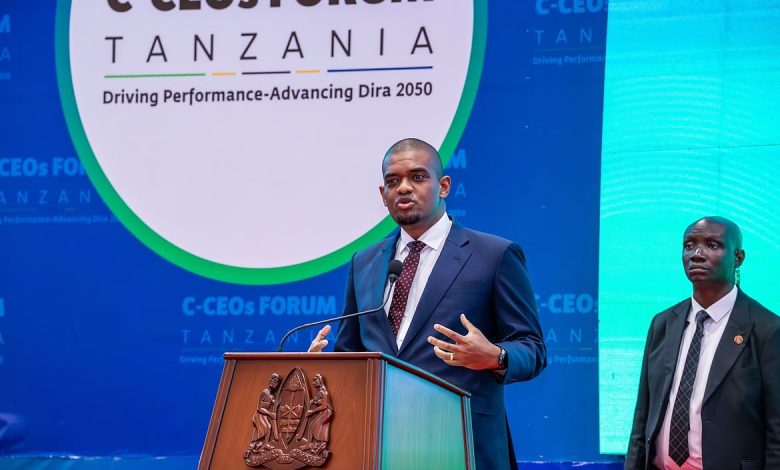
Opening the 2026 Chairpersons and Chief Executive Officers Forum (C-CEOs Forum) in Arusha, organised by the Office of the Treasury Registrar (OTR), Vice-President Mr Deogratius Ndejembi challenged chief executives to think beyond their individual tenures and focus on building institutions capable of sustaining performance over time.
The message goes to the heart of a challenge facing many large organisations: Leadership changes, but institutions must continue.
For Tanzania’s public enterprises, the issue is particularly significant because their responsibilities extend beyond individual commercial interests to include national development, public services, investment and economic transformation.
Dira 2050, which entered its implementation phase in July, provides a long-term framework against which that institutional capacity will increasingly be tested.
Mr Ndejembi said every public entity should be able to demonstrate what it is doing to implement the Vision, how its work contributes to national goals and what results it is producing.
He outlined five areas of focus: Creating greater value from government investments, strengthening competitiveness and productivity, reducing dependence on government support, accelerating technology and innovation and ensuring that performance produces visible results for citizens.
The directives place a new emphasis on what happens inside institutions between one leadership generation and the next.
A public entity can have a sound strategy, a capable chief executive and strong financial results, but its long-term value will depend on whether those gains can survive a change in leadership.
That is why Mr Ndejembi urged CEOs to prepare future leaders, nurture talent and build human capital capable of meeting the needs of the future economy.
Succession planning, in this context, is more than identifying who might occupy the chief executive’s office next.
It involves developing people who understand the organisation, strengthening management capabilities and ensuring that institutional knowledge is retained rather than concentrated in a few individuals.
It also places an important responsibility on boards.
The Vice-President said board chairpersons should concentrate on strategic matters, investment, risk management, good governance and accountability, while management should remain responsible for day-to-day operations.
A clear distinction between oversight and execution can help institutions maintain continuity while ensuring that those entrusted with management have the authority to deliver and are held responsible for the results.
Former African Development Bank Group President, Dr Akinwumi Adesina, reinforced this institutional approach, calling for stronger leadership pipelines, succession planning and systems capable of sustaining performance when individual leaders change.
“Institutions must outlive individuals,” Dr Adesina said, stressing the importance of systems, management capabilities and organisational cultures that can preserve institutional performance beyond particular personalities.
He also emphasised the need for clear accountability among the shareholder, boards and management, with boards providing strategic direction and oversight while executives retain the authority to implement and remain accountable for results.
The argument for stronger institutions becomes more compelling as the environment in which public enterprises operate changes.
Technology is rapidly altering production, service delivery and decisionmaking.
Mr Ndejembi called on public entities to adopt new technologies, including artificial intelligence and digital systems, to improve efficiency, reduce costs and enhance services.
Yet technology alone cannot transform an organisation. It requires people with the skills to use it, management systems capable of integrating it and a culture that encourages innovation.
The same principle applies to climate change, which the Vice-President said public entities must prepare for because of its potential implications for infrastructure, services and investment.
These challenges reinforce the need for organisations that can learn, adapt and retain institutional capacity even as their leaders and operating environments change.
The broader economic context makes that capacity equally important.
Minister of State in the President’s Office, Planning and Investment, Prof Kitila Mkumbo, said implementation of Dira 2050 requires close cooperation between the public and private sectors because each has a role in achieving Tanzania’s development goals.
“Implementation of Dira 2050 requires the public and private sectors to work closely together, given the role of each side in achieving the country’s national development goals,” Prof Mkumbo said.
He noted that Dira 2050 envisages the public sector contributing 30 per cent of the economy and the private sector 70 per cent, making a businessand investment-friendly environment essential.
“For the private sector to perform well, public institutions must create a conducive environment for business and investment,” he said.
This means the performance of public entities cannot be considered in isolation.
The quality of their services, efficiency of their operations and reliability of their decisions can influence investment, production and the cost of doing business across the economy.
Parliamentary oversight has also placed emphasis on continued reform.
Chairperson of the Parliamentary Standing Committee on Public Investments, Masanja Kadogosa, said the committee was satisfied with the pace of reforms undertaken and ongoing in public institutions, while noting that more work remains to improve performance.
“We must continue improving our production activities and creating a conducive environment for the private sector, but you must align your plans with Dira 2050,” he said.
His remarks underline that reform is not a one-off exercise. Public entities must continue improving production, strengthening operations and creating opportunities for greater private-sector tion while keeping their plans connected to the country’s long-term development direction.
For Treasury Registrar Nehemiah Mchechu, this also requires a broader definition of performance.
He said the performance of public entities should not be measured by dividends alone, but productivity, service quality, resource efficiency, financial sustainability, innovation, technology adoption, competitiveness and wider economic contribution should also form part of the assessment.
For commercial entities, the measures include productivity, profitability, financial sustainability and contribution to Government.
For public-service entities, performance can be reflected in citizens reached, services improved, lives saved, time and costs reduced, national capacity strengthened and resources used more efficiently.
Such measures shift attention from what an organisation does to what it achieves.
They also provide a more durable way of assessing leadership.
A chief executive may introduce a successful reform or deliver a strong financial result, but the deeper institutional achievement is creating systems and capabilities that allow the organisation to continue improving after that leader has left.
The scale of Tanzania’s public investment portfolio makes this increasingly important.
The value of government investments increased from 67.95tri/- in 2020/21 to 92.28tri/- in 2024/25.
At the same time, nontax revenue generated from government investments rose from 637.7bn/- in 2020/21 to 1.327tri/- in 2025/26.
As the portfolio expands and the financial contribution of public investments grows, the consequences of weak institutional capacity also become more significant.
The response is not simply to demand more from individual leaders. It is to build organisations with the systems, people and governance structures required to deliver consistently.
That is also where the C-CEOs Forum’s emphasis on measurable outcomes becomes important. The fourth C-CEOs Forum, coordinated by the Office of the Treasury Registrar and held in Arusha from September 28 to 30, brings together more than 700 participants under the theme “HighPerforming SOEs for a Competitive, Inclusive and Resilient Economy: Advancing Dira 2050.”
Its significance extends beyond the three days of discussion.
Dira 2050 sets a direction that will span decades, while individual CEOs and boards will serve for much shorter periods. The institutions they lead therefore need to be built for a longer horizon.
A CEO’s tenure will eventually end. So will the tenure of a board. Strategies will be revised, technologies will change and markets will evolve.
The institution, however, must continue.
For Tanzania’s public enterprises, building such institutions could become one of the defining leadership challenges of the Dira 2050 era.