Turning buried wealth into catalytic for Tanzania financial power
DAR ES SALAAM: GHANA’S GoldBod revolution offers valuable lessons for Tanzania on transforming mineral resources into a national financial asset. This is a crucial question for those who recognise gold’s potential in a country like Tanzania.
Why? Because a harmful misconception persists in Africa’s mining discussions: That increasing gold production directly leads to greater national wealth. However, this is not the case. A country can produce gold worth billions of dollars but still encounter issues like foreign-exchange shortages, limited industrial growth, fragile local supply chains and a lack of financing for its productive sectors.
The primary focus isn’t on how much gold Tanzania has underground or what’s purchased locally. Instead, it’s on the economic benefits Tanzania derives from each gram of gold exported. This makes Ghana’s GoldBod initiative a significant factor for Tanzania to consider carefully.
Ghana has made a major political move by reorganising its gold market to position the government as the central authority in transactions involving gold from artisanal and small-scale miners. The goal is to cut down on smuggling, formalise the industry, boost government revenue, enhance traceability and reinforce gold’s significance in foreign exchange and reserves.
Tanzania ought to examine this example carefully, not because Ghana’s method is perfect, but because it prompts a crucial question Tanzania can no longer overlook: Who really benefits from Africa’s gold? Gold is more than merely an export statistic.
Tanzania is adopting a strategic move akin to Ghana’s successful model: The Bank of Tanzania (BoT) has initiated a domestic gold purchase scheme. This programme enables the central bank to buy locally produced gold using Tanzanian shillings, with the goal of increasing its monetary gold reserves and strengthening the country’s foreign reserves. This marks an important policy change.
For years, African countries have mainly seen gold as an export commodity. They mine gold locally, sell it internationally, and earn foreign currency. Although the nation gains export revenue, taxes and royalties, much of the wider financial and industrial advantages occur outside the continent. This model requires further development.
Strategically, gold should do more than merely generate Tanzanian dollars; it should strengthen Tanzania’s financial stability. Gold ought to support the growth of reserves, deepen financial markets, improve access to capital, promote refining processes, strengthen the shilling and create productive opportunities within mining communities. This broader aim represents the larger opportunity.
Ghana challenges the conventional method. The GoldBod policy is significant because it rejects the idea that the government should merely supervise the gold market passively. Instead, Ghana intends to take a more proactive role in the entire gold value chain.
This reasoning is persuasive. Having detailed data on gold production, sources, buyers, sale prices and destinations significantly reduces the chances of gold entering informal or illegal markets. This is particularly crucial for Tanzania.
Why? Gold smuggling goes beyond just mining problems. It involves issues like foreign-exchange, tax evasion, governance struggles and national security risks. Every gram or kilogramme of gold leaving the official system could result in lost tax revenue, export earnings, financial activity and insights into the country’s mineral resources. Nonetheless, creating a government monopoly isn’t the answer and might do more harm than good.
Tanzania can draw lessons from Ghana by emphasising strategic coordination within the government rather than relying only on bureaucratic oversight. It should utilise current institutions instead of building new ones.
For example, the BoT already invests in domestic gold, the Mining Commission manages the sector and the Ministry of Minerals formulates policies. Moreover, commercial banks and development institutions like TIB Development Bank provide financial support to mining and private refineries are emerging.
After examining GhanaBod in detail, what is missing is a more integrated national gold strategy that connects these institutions into a unified economic framework. Instead of randomly targeting illegal traders or counterfeiters of the official gold-buying system, as recent media reports suggest, Tanzania should consider setting up a National Gold Value Chain Framework.
This approach does not necessitate forming a new government agency but focuses on establishing a coordinated policy system that connects mining, buying, refining, taxation, foreign exchange, finance and reserves. Building on experience in Ghana, Zimbabwe, and other regions, our primary goal is to shift Tanzania’s focus from simply producing gold to maximizing its value.
This distinction is crucial. Regardless of scale, miners need to be integrated into the financial system. Ghana teaches us that artisanal and small-scale miners are more than just producers to tax and regulate; they are vital economic players.
Supporting them requires providing access to finance, technology, geological data, equipment, stable markets and predictable prices. Although Tanzania is not yet fully developed in gold deposits across many regions, it should leverage formal gold buying as a means to promote financial inclusion.
ALSO READ: Charlene comes to Tanzania: Forget English, let’s speak Kiswahili
Imagine a small-scale miner who sells gold through a licensed system, keeping digital records of his output. His gold is independently tested for quality and payments are made via bank transfer. His production history is linked to his financial records.
After months of verified production, a bank or development finance institution can assess his eligibility for working capital, improving his financial outlook. Within this framework, miners of all sizes are incorporated into the formal economy, enabling them to access financing.
Development finance institutions could then provide funding for mining equipment, processing facilities, environmental technologies, laboratories, logistics and gold-service providers. This approach can turn gold into a genuine economic multiplier.
Refining, essential for a serial plating setup, is an area where Tanzania should aim higher. Simply extracting and exporting gold locally isn’t enough. Despite the challenging qualification process for the LBMA, Tanzania must maximise the value of its gold before selling internationally.
This requires refining; without it, selling at a discount could become routine, even if many industry players overlook this problem. The aim should be to establish Tanzania as a reliable regional hub for gold refining and trading. However, policymakers need to avoid a common misconception in Africa: thinking that government ownership alone ensures competitiveness. It does not.
Tanzania should promote increased credible private-sector involvement while upholding strict standards for assaying, responsible sourcing, traceability and international certification. The focus should be on fostering competition among refineries rather than shielding them from it.
A reliable Tanzanian gold-refining ecosystem with global recognition could generate jobs, foster skill development, boost tax revenues and draw in international financial institutions and bullion traders. This exemplifies a genuine path to industrialisation.
Ghana also issues a warning to Tanzania, emphasising that policymakers should avoid romanticising gold. While gold is valuable, buying gold carries risks and is not without danger. Ghana’s experience, after a careful study and analysis, shows that a government gold-buying programme can incur major costs if aspects like pricing, procurement, refining, inventory and reserve management are not carefully planned with a nationalistic mindset in place. This serves as a crucial warning for Tanzania.
The government should not assume that increasing gold prices automatically strengthen the national balance sheet. Transparency is crucial in economic matters.
Questions to consider include: Who is bearing the costs? At what price? Who is responsible for refining expenses? What happens if international prices drop?
ALSO READ: Marioo surfs with “Tete” as he combs the Azania coastline
How quickly can gold be converted into foreign currency? How is gold valued on the central bank’s balance sheet? What percentage should be held as reserves? What part should be sold? And what triggers a sale?
These questions are vital and extend beyond mere technical details. They ultimately decide whether Tanzania’s gold strategy succeeds or fails due to costly government interference. Consequently, Tanzania ought to require independent valuation, transparent procurement procedures, strong risk management and regular public reporting.
Gold can strengthen Tanzania’s financial system, with benefits extending beyond mining. The country might begin to view gold as a key element of its financial infrastructure. Maintaining a strong reserve of monetary gold can diversify official reserves and protect against global financial volatility.
Furthermore, creating a formal domestic gold market could boost activity in the financial sector. When appropriately regulated and risk-managed, gold-backed financial products could appeal to institutional investors. Verified gold production can improve access to credit and gold-related companies may be seen as viable investment options. Furthermore, a more transparent gold market could attract international investors seeking responsibly sourced African gold.
This process demonstrates how a mineral evolves into an economic ecosystem. The primary danger is complacency. Tanzania should not celebrate merely because gold exports rise, as increased export volumes do not signify economic transformation.
If the country boosts gold output but continues to import most machinery, exports raw materials, invests minimally in local mining and has few downstream activities, it remains trapped in the traditional commodity-export model.
This contradicts the statement made at the recent SADC Industrial Week in Durban, KwaZulu-Natal, South Africa. Such a scenario reflects resource extraction with improved statistics, not true resource transformation. The policy goal should be more comprehensive.
Tanzania ought to set specific national targets for the percentage of gold traded officially, domestically purchased gold volume, local refining levels, growth in monetary gold reserves, support for small-scale miners, efforts to reduce smuggling and job creation across the entire gold value chain. The country should routinely evaluate if Tanzania is increasing its gold-related benefits annually.
This is the right time to develop a comprehensive national gold strategy. Ghana’s GoldBod experience serves as a wake-up call, showing that African nations are starting to adopt new perspectives on natural resources. The traditional approach was to mine resources, export them and then collect taxes.
The proposed strategy involves formalising processes, securing strategic finance, strengthening and refining operations and then engaging in trade while building reserves and reinvesting. This is the approach Tanzania should adopt.
However, instead of simply copying Ghana, Tanzania should harness its own institutional strengths. The BoT’s domestic gold purchase programme is the foundation, supported by the Mining Commission’s regulatory framework. Funding comes from commercial banks and development finance institutions. The limited number of private refineries suggests the emergence of downstream infrastructure.
At this stage, what is essential are coordinated policies and a clear strategic vision. This is Tanzania’s golden moment. The global gold market is experiencing a significant shift. Central banks worldwide are increasingly prioritising gold as a reserve asset and investors still see it as a safeguard against uncertainty.
Economically and from an investment standpoint, this creates an opportunity for Tanzania that goes well beyond just the mining industry. The country can use gold to strengthen its external position, regulate artisanal mining, increase financial inclusion, improve refining capabilities, create industrial jobs and support long-term economic stability. Nevertheless, realising these benefits requires deliberate policy measures.
This involves establishing strong institutions for coordination, ensuring transparency, engaging the private sector actively and, crucially, changing the prevailing mindset. Tanzania should shift its focus from simply asking, “How much gold are we producing?” to considering, “How much financial, industrial and economic influence do we gain from the gold we extract?” This insight is the key takeaway from Ghana. Tanzania doesn’t necessarily require a GoldBod. Instead, Tanzania needs a more crucial approach: a comprehensive national gold strategy that transforms gold from merely an exported commodity into a key national asset.
The gold, opportunity and institutions are all in place. What Tanzania requires now is the political will to unite them and leverage the underground wealth to generate significantly more prosperity above ground.
Ghana’s creation of the Ghana Gold Board, known as GoldBod, highlights a key lesson. Ghana’s experience provides Tanzania with a valuable policy opportunity since the two countries share a strategic situation: they are both leading African gold producers with sizable artisanal and small-scale mining sectors. Additionally, both nations aim to bolster foreign-exchange reserves, boost government revenues and enhance the value captured from natural resources. Tanzania should avoid directly copying Ghana. Instead, it should analyse GoldBod’s goals, recognise effective institutional mechanisms, learn from existing risks and enhance its own domestic gold purchase programme. The ideal Tanzanian model should be led by the state yet remain market-disciplined, strategic yet transparent in commercial aspects, prioritising value creation over mere control. If executed effectively, Tanzania has the potential to turn gold from simply an extracted and exported commodity into a vital national asset. This shift could bolster the shilling, increase foreign reserves, fund productive investments, support miners and develop an industrial ecosystem centered around one of the country’s most valuable natural resources.
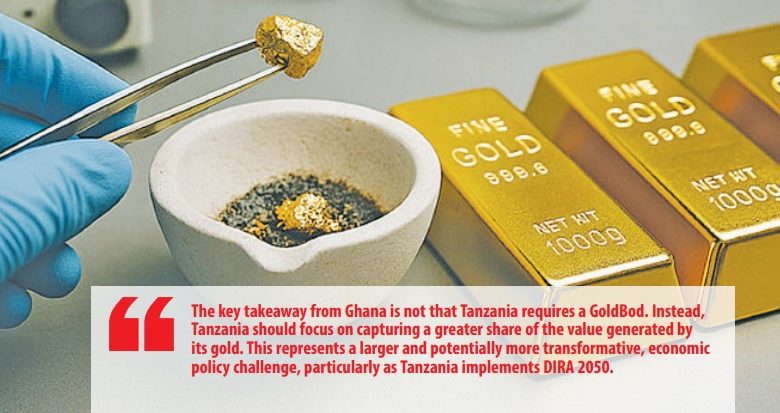
The key takeaway from Ghana is not that Tanzania requires a GoldBod. Instead, Tanzania should focus on capturing a greater share of the value generated by its gold. This represents a larger and potentially more transformative, economic policy challenge, particularly as Tanzania implements DIRA 2050.