Transport budget spurs growth
- Massive 2.9tri/- to enhance connectivity
DODOMA: THE government has tabled a 2.872tri/- budget for the Ministry of Transport for the 2026/27 financial year, with a strong focus on expanding strategic infrastructure and improving national and regional connectivity.
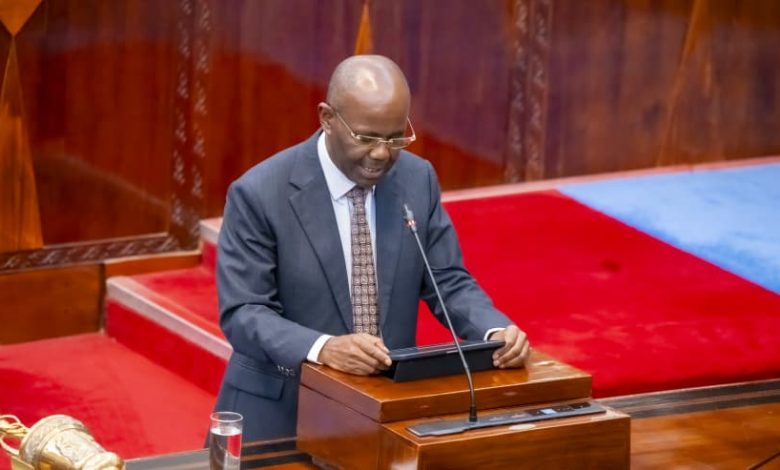
Presenting the ministry’s budget estimates be fore the National Assembly in Dodoma yesterday, Minister for Transport, Prof Makame Mbarawa said the spending will prioritise eight key areas aimed at accelerating flagship transport projects and strengthening Tanzania’s position as a regional logistics and trade hub.
The priority areas include continued construction of the Standard Gauge Railway (SGR), rehabilitation of the Meter Gauge Railway (MGR) and TAZARA lines, improvement of port infrastructure and services, enhancement of air transport and meteorological services, construction and rehabilitation of vessels, strengthening transport regulation and safety, as well as upgrading sector training institutions.
Of the total budget, 126.04bn/-, equivalent to 4.38 per cent has been allocated for recurrent expenditure, while 2.746tri/-, or 95.62 per cent will finance development projects.
Prof Mbarawa said development expenditure will be funded through 2.452tri/- from domestic sources and 294.184bn/- from external financing.
He noted that the proposed budget aligns with key national frameworks, including Vision 2050, the ruling party’s 2025 election manifesto, the Fourth Five-Year Development Plan (FYDP IV 2026/27–2030/31), the National Development Plan 2026/27 and the ministry’s strategic plan.
A large portion of the budget will go towards railway infrastructure, especially the SGR project, which the government views as central to boosting economic growth and regional trade integration.
For the SGR alone, the government has allocated 1.51tri/- in domestic funds and 61.84bn/- from external sources.
Planned works include routine maintenance of the Dar es Salaam–Makutupora section, completion of the Morogoro–Makutupora segment and continued construction of the Makutupora–Tabora, Tabora–Isaka, Isaka–Mwanza, Tabora–Kigoma and Uvinza–Musongati sections.
Prof Mbarawa also revealed that the government plans to conduct a feasibility study for a Dar es Salaam urban railway system aimed at easing congestion and improving urban mobility.
In addition, plans are underway to establish a modern railway training centre to build local expertise in railway operations and maintenance.
In the maritime sector, the minister said the government will continue implementing the Dar es Salaam Maritime Gateway Project (DMGP) and other initiatives aimed at modernising port infrastructure and improving efficiency.
The projects will include expansion of infrastructure, upgrading operational systems and procurement of modern cargohandling equipment such as cranes.
The government also plans to construct two access gates linking the Dar es Salaam Port with Nelson Mandela Road and invest in dry bulk cargo handling systems.
“These measures are expected to increase port handling capacity by 65 per cent to approximately 5.5 million tonnes,” Prof Mbarawa said.
ALSO READ: Transport Ministry names SGR, TAZARA the top priorities in its 2.872tri/- budget
Additional improvements financed through the Tanzania Ports Authority’s internal revenues will target Indian Ocean ports including Bagamoyo and Mtwara (Kisiwa Mbao), as well as Great Lakes ports such as Mwanza North, Mbamba Bay and Kigoma.
According to the minister, by 2028, Tanzania’s ports are expected to record major transformation through improved efficiency, increased cargo volumes and enhanced competitiveness globally.
In the aviation sector, the government has allocated 185.32bn/- in domestic funds to Air Tanzania Company Limited (ATCL) for aircraft acquisition, procurement of engines and rehabilitation of maintenance facilities.
The funds will facilitate final payments for two aircrafts and advance payment for two Dash 8 Q400 aircrafts.
Airport upgrades are also planned at Mwanza, Arusha, Mtwara, Serengeti, Kagera, Kilimanjaro International Airport and Julius Nyerere International Airport.
The ministry further plans to establish a new aviation training college to strengthen human resource capacity in the sector.
Prof Mbarawa said the government will also invest in transport training institutions, including infrastructure expansion and procurement of teaching equipment for the National Institute of Transport (NIT).
Plans are also underway to establish an NIT campus in Lindi focusing on maritime transport, oil and gas studies, alongside implementation of the East Africa Skills for Transformation and Regional Integration (EASTRIP) programme.
Meanwhile, presenting the report of the Parliamentary Committee on Infrastructure, it’s Chairperson Moshi Kakoso urged the government to speed up construction of the remaining SGR sections to ensure the railway becomes fully operational for passenger and cargo transportation.
He also recommended implementation of new port user charges effective July 1, 2026, saying the move would strengthen the Tanzania Ports Authority’s financial capacity to modernise port infrastructure.
Mr Kakoso further called on the government to facilitate the transfer of aircraft ownership from the Tanzania Government Flight Agency (TGFA) back to ATCL to improve operational efficiency and profitability of the national carrier.