Tanzania marks 62 years of unity, lasting union amidst challenges
DAR ES SALAAM: TANZANIA, a land celebrated for its breathtaking landscapes and rich cultural tapestry, today marks 62 years of a profound and enduring unity.
Beyond its visible natural and cultural diversity lies another layer of profound significance, its unique political architecture, the enduring Union between Tanganyika and Zanzibar.
This remarkable Union, a solitary success story in East Africa, is not an arbitrary arrangement forged in recent times.
Rather, it is evidence to the deep historical threads and common ambitions that have long bound the destinies of the Mainland and the isles, culminating in the unified nation we celebrate today.
This Union, conceived from a confluence of historical circumstances and pragmatic political necessities, has served as both a formidable source of strength and, at times, a point of contention throughout Tanzania’s modern trajectory.
The merger of Tanganyika and Zanzibar was not a spontaneous event but rather a carefully considered decision rooted in a complex interplay of shared heritage, intertwined aspirations and the compelling vision of a unified future.
The foundations of the Union were laid upon the bedrock of close historical ties and a shared heritage that transcended geographical boundaries.
For centuries, the peoples of Tanganyika and Zanzibar had engaged in vibrant exchanges, fostering familial bonds that crisscrossed the narrow channel separating the Mainland from the archipelago.
Trade routes, ancient and well-established, facilitated not only the movement of goods but also the exchange of ideas and cultural nuances.
Linguistic similarities further cemented these connections, creating a sense of shared identity and understanding.
Moreover, the political landscape of the pre-independence era witnessed a significant convergence, most notably in the strong affiliations between the Tanganyika African National Union (TANU) and the AfroShirazi Party (ASP), both pivotal forces in the struggle for self-determination.
Beyond these essential connections, the overarching vision of a united Africa played a pivotal role in shaping the aspirations of Tanzania’s visionary leaders, most notably the revered Mwalimu Julius Nyerere.
Even before Tanganyika achieved its hard-won independence, Nyerere and other prominent African liberation figures harboured a deep-seated desire for a broader African Union, a continental entity that would rise above colonial divisions and foster collective strength and progress.
Nyerere, in particular, passionately advocated for the establishment of regional federations as crucial stepping stones towards this grander continental unity.
He envisioned these regional blocs as building blocks, fostering cooperation and integration at a more localised level before culminating in a truly unified Africa.
These profound aspirations were deeply embedded in the historical context of the region, reflecting the shared experiences of colonial subjugation, the collective yearning for self-determination and an unwavering desire to forge a common destiny, free from external influence and driven by African agency.
Thus, the establishment of the union between Tanganyika and Zanzibar was not merely a pragmatic response to immediate political needs but also a powerful embodiment of broader PanAfrican ideals and the enduring historical connections that had long bound the peoples of these two distinct yet interconnected regions.
The formal genesis of the United Republic of Tanzania occurred on April 26, 1964, marking the culmination of a carefully orchestrated process that united the two newly independent states: the Republic of Tanganyika and the People’s Republic of Zanzibar.
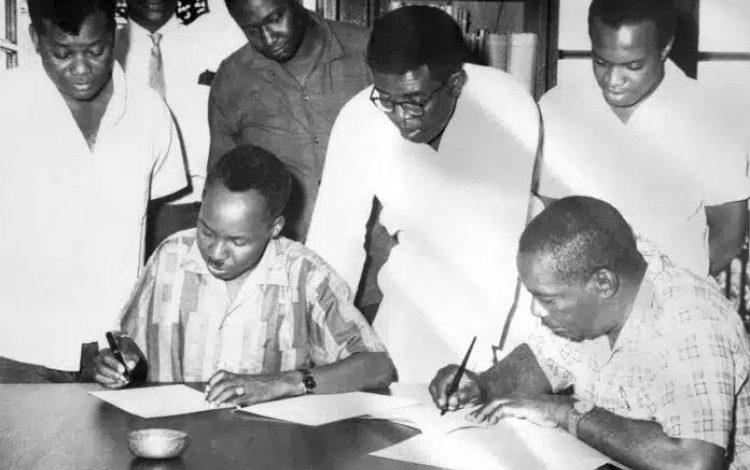
The foundational document of this historic union, the Articles of Union, was signed on April 22, 1964, in Zanzibar, by the esteemed leaders of both nations, the late Mwalimu Nyerere, the former President of Tanganyika and the late Sheikh Abeid Amani Karume, the former President of Zanzibar.
This momentous agreement was subsequently ratified with resounding approval by the Tanganyika Parliament and the Revolutionary Council in Zanzibar on April 26, 1964, solidifying the legal framework of the nascent union.
The symbolic exchange of the Articles of Union took place on April 27, 1964, when the leaders of both countries convened at Karimjee Hall in the bustling city of Dar es Salaam, marking a tangible manifestation of their commitment to unity.
The name of the newly formed nation underwent a slight modification later that year, on October 28, 1964, officially becoming the United Republic of Tanzania through the enactment of the Republic of Tanzania Act No. 61 of 1964. This renaming signified the consolidation of the two entities into a single, sovereign nation.
The formation of the Tanzania Union brought forth a multitude of benefits for both Tanganyika and Zanzibar, creating a synergistic relationship that fostered progress in various spheres.
Economically, the Union established a significantly larger domestic market, dismantling internal trade barriers and facilitating the seamless exchange of goods and services between the Mainland and the islands.
This expanded market spurred economic activity and created new opportunities for businesses and entrepreneurs on both sides.
Socially, the Union played a crucial role in promoting a stronger sense of national identity, fostering unity and cohesion among the diverse array of ethnic and religious groups that constitute the Tanzanian populace.
By exceeding historical divisions, the Union cultivated a shared sense of belonging and national pride.
Furthermore, the unified structure allowed for the more efficient and equitable sharing of vital resources and specialised expertise, particularly in critical sectors such as healthcare and education, leading to improvements in the quality of life for citizens across the nation.
Minister of State in the VicePresident’s Office (Union and Environment), Hamad Yusuf Masauni, said Tanzania is marking 62 years since the Union of Tanganyika and Zanzibar, calling for continued commitment to its preservation.
“This year, 2026, our Union marks 62 years since its establishment. You will all agree with me that we have a responsibility to protect, preserve and strengthen our Union,” he said.
He added that the country must continue building on political, economic and social gains, while promoting peace, unity, cooperation and mutual respect between both sides.
During the 2025/2026 financial year, the government reviewed and issued updated Joint Committee guidelines between the Union government and the Revolutionary Government of Zanzibar, expanding discussions to include broader shared interests.
ALSO READ: Union: Tanzania’s journey of shared prosperity
Efforts are also underway to strengthen public understanding of the Union, particularly among young people, through seminars, media programmes, competitions and outreach initiatives.
Looking ahead, the Office will continue coordinating Union matters, addressing pending issues and preparing for the 63rd anniversary of the Union.