

Tanzania’s shipping industry raises the anchor in style
MWANZA: FOR more than half a century, Tanzania’s national shipping company has ferried passengers and cargo across the country’s Great Lakes, quietly connecting communities, supporting trade and serving as a lifeline for millions. Today, however, the company is pursuing a far bigger ambition. It is preparing to sail beyond inland waters and compete on international ocean routes, marking one of the most significant transformations in its history.
That ambition became more visible in 2024 when Marine Services Company Limited (MSCL) officially rebranded as Tanzania Shipping Company Limited (TASHICO), reflecting a broader vision of expanding from inland maritime transport into international deep-sea shipping.
The name change was not merely cosmetic. It signalled a strategic shift aimed at positioning Tanzania as a stronger player in regional and global maritime trade while taking greater advantage of the country’s strategic location on the Indian Ocean and its growing transport infrastructure.
Throughout more than 50 years of service, TASHICO has played a vital role in connecting regions separated by Tanzania’s three Great Lakes of Victoria, Tanganyika and Nyasa by transporting both passengers and cargo while supporting commerce and regional integration.
Through Lake Victoria, the company links Mwanza, Mara, Kagera and Geita regions. On Lake Tanganyika, it connects Kigoma, Katavi and Rukwa, while Lake Nyasa serves Mbeya, Njombe and Ruvuma, ensuring that communities around these vast inland waters remain connected for both business and daily travel.
Its services extend beyond Tanzania’s borders as well. Through Lake Victoria, TASHICO operates international routes linking Tanzania with Uganda, Kenya and South Sudan. Lake Tanganyika provides connections to Burundi, the Democratic Republic of Congo (DRC) and Zambia, while Lake Nyasa links Tanzania with Malawi and Mozambique.
This extensive network has enabled the company to become one of East Africa’s key providers of inland water transport, supporting regional trade and facilitating the movement of goods and people across national boundaries. Currently, TASHICO operates a fleet of 19 vessels spread across the three lakes. Ten vessels serve Lake Victoria, four operate on Lake Tanganyika and five on Lake Nyasa.
Its fleet also includes two oil tankers, three cargo vessels, one tugboat, two self-propelled barges and a tourist boat operating within the Great Lakes system. Some of these vessels carry remarkable historical significance. Among the oldest is MV Liemba on Lake Tanganyika, whose origins date back to the early 20th century and which remains one of Africa’s most famous passenger ships. At the other end of the spectrum stands MV Mwanza, the company’s newest flagship on Lake Victoria. Construction of the vessel began in 2019, representing a major investment in modern maritime infrastructure.
MV Mwanza has quickly become a symbol of Tanzania’s maritime ambitions. Measuring 92.6 metres long, 17 metres wide and standing about 20 metres high, the vessel combines impressive engineering with practical utility.
Designed to carry up to 1,200 passengers alongside 400 tonnes of cargo, including 20 motor vehicles, MV Mwanza serves as an important commercial bridge across Lake Victoria while significantly improving passenger safety, comfort and transport efficiency.
Yet despite these achievements on inland waters, TASHICO has always harboured an even bigger dream—to venture into ocean shipping.
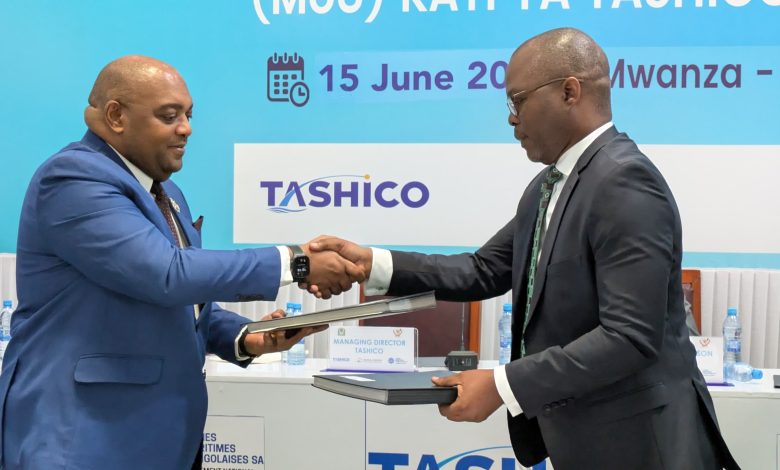
That vision took a decisive step forward on June 15 this year when TASHICO signed a Memorandum of Understanding (MoU) with Democratic Republic of Congo-based Lignes Maritimes Congolaises (LMC) during a ceremony in Mwanza.
The agreement is expected to pave the way for cooperation in international maritime transport, logistics, infrastructure development and investment between the two national shipping companies.
According to TASHICO Executive Director Eric Hamissi, the partnership will significantly accelerate Tanzania’s entry into global shipping because LMC already possesses extensive experience in ocean transport and cargo logistics connecting Central African markets with the Atlantic Ocean.
Rather than spending years learning independently, Tanzania will benefit from LMC’s operational experience, technical expertise and established maritime networks.
“Initially, we are starting with chartered ships for global routes, probably next month because we have nothing else to wait for after signing this memorandum,” Mr Hamissi explained.
Using chartered vessels allows the company to begin international operations immediately while preparing for more permanent investments. The cooperation does not end there.
Mr Hamissi revealed that both countries intend to jointly construct vessels specifically designed for international shipping. The partnership also includes shared use of maritime infrastructure, including shipyards, creating opportunities for technology transfer, skills development and reduced operational costs.
For Tanzania, the arrangement represents an important step towards building long-term capacity in ocean shipping while strengthening its domestic maritime industry.
Mr Hamissi said available cargo statistics clearly demonstrate why closer cooperation between the two countries makes economic sense.
By July 2025, the Port of Dar es Salaam had handled approximately 32.75 million tonnes of cargo. Of that volume, about 20.1 million tonnes served Tanzania’s domestic market, while roughly 5.9 million tonnes were destined for the Democratic Republic of Congo.
These figures illustrate the strong commercial relationship between Tanzania and the DRC and highlight how closely the two economies depend on efficient transport and logistics systems.
Given the magnitude of this trade, Mr Hamissi believes national shipping companies from both countries should participate more actively throughout the international cargo transportation value chain instead of relying heavily on foreign operators.
The three-year Memorandum of Understanding therefore aims to strengthen not only maritime transport but also trade, investment and broader economic cooperation between the neighbouring countries.
Mr Hamissi expressed appreciation to both governments for creating an enabling policy environment that allowed the partnership to emerge. “We express our gratitude to the two governments for creating the enabling environment. This cooperation originated from the institutional needs of both countries,” he said.
Through the agreement, Tanzania expects to maximise the advantages of its strategic geographical position by integrating the Port of Dar es Salaam, the Standard Gauge Railway (SGR), marine transport and regional markets into one efficient logistics system.
Such integration is expected to enhance Tanzania’s competitiveness, attract additional investment, generate employment, increase government revenue and create new opportunities for skills development among Tanzanians.
The agreement also supports TASHICO’s broader strategy of expanding cargo transportation through ocean shipping while strengthening national capacity in the maritime sector.
According to Mr Hamissi, the initiative aligns closely with Tanzania’s Development Vision 2050, which seeks to position the country as a commercial, logistics, transport and maritime services hub for East and Central Africa.
The partnership is also expected to increase national participation in international cargo transportation, reduce dependence on foreign shipping companies, retain more transport revenues within the region and build professional expertise across the maritime industry.
Additional anticipated benefits include strengthening the competitiveness of the Port of Dar es Salaam as Central Africa’s preferred maritime gateway while laying the foundation for integrated transport services linking ports, railways and shipping operations.
Representing LMC, Dr Frank Mukulu described the Memorandum of Understanding as much more than a routine administrative exercise.
He said the agreement marked an important milestone in strengthening economic and commercial relations between Tanzania and the Democratic Republic of Congo.
According to Dr Mukulu, the partnership reflects the shared determination of both countries to establish a strategic alliance covering maritime transport, inland waterways, logistics, regional trade and transport infrastructure development.
“Our companies share a common vision to build a modern, efficient and integrated transport system capable of meeting the growing needs of economic operators, lakeside communities and our region,” he said.



I do not even know how I ended up here, but I thought this post was good.
I do not know who you are but certainly you are going to a famous blogger if you aren’t
already 😉 Cheers!
Helpful info. Lucky me I found your site accidentally, and I’m stunned
why this accident did not happened earlier! I bookmarked it.
We stumbled over here by a different web page
and thought I might check things out. I like what I see
so i am just following you. Look forward to finding out about your web
page yet again.
With havin so much content and articles do you ever run into
any problems of plagorism or copyright infringement?
My site has a lot of exclusive content I’ve either created myself or outsourced but it seems
a lot of it is popping it up all over the internet without my authorization. Do
you know any techniques to help stop content from being stolen? I’d really
appreciate it.
Nice answers in return of this query with real arguments and describing everything on the topic of that.
I really like your blog.. very nice colors & theme.
Did you design this website yourself or did you hire someone to do it for
you? Plz respond as I’m looking to construct my own blog and would like to find out where u got this from.
cheers
Thanks for sharing your thoughts about parenting tips
berikan komentar. Regards
Hello There. I found your blog using msn. This is a very well written article.
I will be sure to bookmark it and return to read more of your useful information. Thanks for the post.
I’ll certainly comeback.
Pretty component to content. I just stumbled upon your weblog and in accession capital to
say that I get actually enjoyed account your blog posts.
Anyway I will be subscribing on your feeds or even I success you
get admission to persistently fast.
I was suggested this website by my cousin. I’m now not certain whether or not this post is written by way of him as nobody else realize such particular
approximately my trouble. You’re wonderful!
Thank you!
Thanks for every other informative site.
Where else may just I get that type of information written in such an ideal means?
I have a undertaking that I am just now operating on, and I’ve been at
the glance out for such information.
Excellent beat ! I wish to apprentice while you amend your web site, how could i
subscribe for a blog website? The account helped me a acceptable deal.
I had been a little bit acquainted of this your broadcast provided bright clear idea
An impressive share! I’ve just forwarded this onto a friend who was doing a little research on this.
And he in fact ordered me lunch simply because I stumbled upon it for him…
lol. So let me reword this…. Thanks for the meal!! But yeah, thanks for spending
the time to discuss this topic here on your web
page.
Good day! Would you mind if I share your blog with my twitter group?
There’s a lot of people that I think would really appreciate your content.
Please let me know. Thank you
I’m not that much of a online reader to be honest but your blogs
really nice, keep it up! I’ll go ahead and bookmark your website to come back later on. Many thanks
With havin so much content and articles do you ever run into any issues of plagorism or
copyright violation? My website has a lot of unique content I’ve either created myself
or outsourced but it seems a lot of it is popping it up all over the internet without my permission. Do you know any solutions to help
stop content from being ripped off? I’d truly appreciate it.
An impressive share! I have just forwarded this onto a coworker who had been doing a little homework on this.
And he in fact ordered me dinner due to the
fact that I discovered it for him… lol. So
let me reword this…. Thanks for the meal!! But yeah, thanx for
spending some time to talk about this matter here on your website.
whoah this blog is wonderful i really like reading your articles.
Keep up the good work! You already know, many individuals are looking around for this information, you can help them greatly.
Greetings I am so delighted I found your blog page, I really found you by error, while I was researching on Bing for something
else, Anyhow I am here now and would just like to say cheers
for a fantastic post and a all round interesting blog (I also love
the theme/design), I don’t have time to read through
it all at the minute but I have saved it and also added in your RSS feeds, so when I have time
I will be back to read a great deal more, Please do keep up
the great b.
I am genuinely pleased to glance at this blog posts which includes plenty of helpful data,
thanks for providing these data.
At this time I am ready to do my breakfast, afterward
having my breakfast coming over again to read additional news.
I was recommended this blog by my cousin. I’m no longer certain whether or not this put up is
written through him as nobody else know such unique about my difficulty.
You are wonderful! Thanks!
Thanks very nice blog!
Good info. Lucky me I came across your site by accident (stumbleupon).
I’ve saved as a favorite for later!
hello there and thank you for your information – I have definitely picked up something new from right here.
I did however expertise a few technical points using this web site, since I experienced to reload the website lots
of times previous to I could get it to load properly.
I had been wondering if your web host is OK? Not that I am complaining, but slow loading instances times will often affect your
placement in google and can damage your quality score if advertising and marketing with
Adwords. Anyway I am adding this RSS to my e-mail
and could look out for much more of your respective exciting
content. Make sure you update this again very soon.
What’s up everyone, it’s my first visit at this web page, and article is genuinely fruitful for me, keep
up posting these posts.
I visited many web sites except the audio quality for
audio songs present at this web page is genuinely superb.
Pretty great post. I simply stumbled upon your
weblog and wanted to say that I’ve truly enjoyed surfing around your weblog posts.
In any case I will be subscribing on your rss feed and I hope you write again soon!
Thank you for the auspicious writeup. It in fact
was a amusement account it. Look advanced
to far added agreeable from you! By the way, how could
we communicate?
I feel this is among the most significant information for me.
And i am satisfied reading your article. But want to statement on few
normal things, The site style is wonderful, the articles
is in point of fact excellent : D. Good job, cheers
For most recent information you have to visit web and on internet I
found this web page as a best web site for hottest updates.
Asking questions are actually good thing if you are not understanding anything completely,
however this piece of writing presents nice understanding even.
When someone writes an paragraph he/she maintains the image of a
user in his/her mind that how a user can be aware of it. So that’s why this piece of writing is perfect.
Thanks!
Thanks very nice blog!