Regional value chains offer new trade growth path
DAR ES SALAAM: FOR decades, the economic relationship between Tanzania and Malawi has been driven largely by the movement of agricultural produce, manufactured goods and consumer products across their borders, with bilateral commerce providing an important foundation for businesses and consumers in both markets.
But the growing scale of trade is creating an opportunity to reshape that relationship from one centred on finished goods into a more integrated model in which investment, production capacity, technology and raw materials move across borders to build regional value chains and enable both countries to capture greater economic value from their respective resources.
Such a shift could allow businesses in both countries to capture a larger share of the value generated from their resources while creating industries, jobs and markets beyond the two neighbouring economies, making cross-border trade not merely a channel for exchanging products but a platform for industrialisation and deeper regional integration.
The opportunity is becoming increasingly evident in the growth of bilateral trade. Tanzania’s exports to Malawi increased from about 64.05 million US dollars in 2021 to 89.47 million US dollars in 2025, while Tanzania’s positive trade balance rose from approximately 41.58 million US dollars to 74.30 million US dollars over the same period.
The figures demonstrate that Malawi is already an important market for Tanzanian businesses, but they also point to a larger question for policymakers and the private sector: How much more value could both economies generate if growing trade were matched by cross-border investment, manufacturing and stronger links between producers in the two countries?
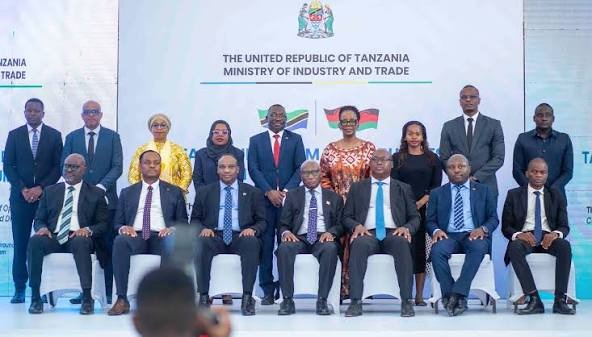
That question was central to the Tanzania-Malawi Trade and Investment Forum 2026 in Dar es Salaam, where government institutions and businesses from the two countries explored ways of converting existing commercial links into investment, manufacturing and value addition.
For Tanzania Trade Development Authority (TANTRADE) Director General Ephraim Mafuru, the next stage should be measured not by the number of meetings held, but by what happens after them, including contracts signed, investments mobilised and new business partnerships established.
The shift represents a move from simply asking what Tanzania can sell to Malawi or what Malawi can sell to Tanzania to a more strategic question: What can the two countries produce together?
Malawi’s Minister for Industry, Business, Trade and Tourism, Itaye Simon, proposed a valuechain approach that illustrates this thinking. Under the model, Malawi could supply agricultural raw materials such as soybeans, Tanzania could process them into products such as poultry feed and Malawi could subsequently supply finished poultry products back into the Tanzanian market.
Such arrangements could allow businesses in both countries to participate in different stages of production while creating opportunities for investment, employment and industrial development, particularly if the model is expanded to other products where each country has a comparative advantage.
The opportunity extends beyond agriculture. Malawi has identified Tanzania as an important source of manufactured products, while Tanzania sees potential for expanding exports in areas including ceramic tiles, paving products, vegetable seeds, soap and detergents, sanitary products, furnishing articles and flat-rolled iron and steel products.
Deputy Minister for Industry and Trade Denis Londo said Tanzania has about 6 million US dollars in untapped export potential in the Malawian market, indicating that the existing trade relationship captures only part of the commercial opportunity between the two economies.
Logistics is another major part of the equation because the ability to move raw materials, intermediate goods and finished products efficiently will determine whether proposed value chains can compete on cost and reliability.
As a landlocked country, Malawi depends heavily on transport infrastructure linking its producers and businesses to international markets, making Tanzania’s transport corridors strategically important to the country’s economic integration.
Mr Londo said Tanzania, through the Port of Dar es Salaam and its road and rail networks, provides Malawi with an important gateway to global trade, while Tanzania can benefit from Malawi’s position within the Southern African Development Community (SADC).
“This gives the relationship a strategic dimension beyond bilateral commerce. Tanzania is positioning itself as a gateway for Malawian producers seeking wider markets, while Malawi offers Tanzania an entry point into the Southern African Development Community (SADC),” he said.
Mr Londo said Tanzania provides access to both SADC and the East African Community (EAC) markets, potentially giving businesses established within the bilateral relationship a much larger consumer base than either domestic market alone.
Tanzania Investment and Special Economic Zones Authority (TISEZA) Director of Investment Promotion George Mkono said Tanzania wants Malawian producers to consider processing raw materials in Tanzania and using the country’s wider market connections to reach regional consumers.
“The two countries are also looking to strengthen the infrastructure that makes such ambitions possible,” Mr Mkono said. He highlighted continued efforts to improve roads, railways, ports and transport corridors, including the Kasumulu and Songwe corridors, while simplifying cross-border trade through the Simplified Trade Regime (STR). The latter is particularly important for small traders, women and young entrepreneurs who depend on cross-border commerce.
The forum attracted significant private-sector interest, bringing together government agencies and businesses, with 51 exhibitors and 104 participants from Malawi, according to TANTRADE. More than 80 exhibitors were also referenced in the forum’s broader participation.
That participation matters because officials are increasingly placing the private sector at the centre of the next phase of cooperation. Governments can provide infrastructure, policy and a predictable business environment, but companies must ultimately make the investment decisions that turn identified opportunities into factories, processing facilities, supply chains and jobs.
The potential also extends across multiple sectors, including agriculture, manufacturing, mining, energy, tourism, information and communications technology, and logistics, creating scope for cooperation that is broader than conventional merchandise trade.