From Saba Saba to Maputo: How a TZ innovation is turning waste into regional opportunity
MAPUTO: WHAT if something that is swept away every day from salons and barbershops could become an agricultural resource and, at the same time, open doors to new markets across Africa?
That is the question behind the journey of CutOff Recycle, a Tanzanian enterprise turning discarded human hair into an input for sustainable agriculture. What began as an innovative idea in Tanzania has now found its way from the 50th Dar es Salaam International Trade Fair, Saba Saba, to the 61st Maputo International Trade Fair, FACIM 2026.
The journey is more than a story about recycling. It is increasingly a story about African innovation, entrepreneurship, regional market access and the emerging role of economic diplomacy in helping Tanzanian businesses connect with opportunities beyond the country’s borders.
CutOff Recycle describes its model as collecting and recycling human hair waste into organic fertiliser, linking waste management with sustainable agriculture and environmental conservation. The company says its journey began in 2018.
Seeing value where others see waste. Human hair is one of those forms of waste that attracts little attention. It is cut, swept away and discarded every day. But circular economy thinking starts with a different question: What if waste is not really waste?
For CutOff Recycle, discarded hair represents a potential resource. By processing it into an agricultural input, the company is attempting to create a value chain around a material that would, otherwise, have little economic value.
This is the essence of the circular economy, keeping materials in productive use for longer, reducing waste and finding new economic value in resources that are normally discarded.
For Africa, the concept has particular relevance. The continent needs to address environmental challenges while simultaneously creating jobs, supporting entrepreneurship and building productive industries.
Businesses that can connect those objectives have the potential to become part of a new generation of African enterprises.
From Saba Saba to FACIM
The story took an important step when CutOff Recycle participated in the Saba Saba trade fair in Dar es Salaam.
Trade exhibitions are often viewed primarily as places where companies display and sell products.
But for smaller enterprises, their value can be much greater.
They can provide access to customers, investors, government institutions, distributors and business partners, all within a relatively short period.
For CutOff Recycle, Saba Saba provided an opportunity to demonstrate that an innovation developed in Tanzania could respond to a problem with relevance far beyond Tanzania.
The next opportunity came in Maputo. At FACIM 2026, CutOff Recycle joined other Tanzanian companies and institutions under the Tanzania Pavilion, which was coordinated by the Tanzania High Commission in Maputo in collaboration with TANTRADE. Tanzania’s participation brought together businesses and institutions from sectors including agriculture, tea, energy, technology, recycling and manufacturing.
But the significance of FACIM for CutOff Recycle was not simply the exhibition of a product. It was the access to a regional network.
When business meets diplomacy
One of the most interesting developments came during Tanzania Day at FACIM on September 2.
Through the platform created around Tanzania’s participation, CutOff Recycle established contacts with the ambassadors of Mauritius, Rwanda and South Africa, as well as a prominent stakeholder from Kenya.
The stakeholders showed interest in understanding the company’s work.
For the company, these engagements provide possible avenues for future conversations around markets, partnerships, technology and investment. But there is an important distinction. Interest is not yet a contract. A contact is not yet a customer. And a promising conversation is not yet an investment.
The value lies in what happens next. This is precisely where economic diplomacy can make a difference. Diplomatic missions cannot manufacture commercial success for a private company.
What they can do is help create access. They can introduce businesses to relevant institutions and potential partners, provide information about markets, facilitate contacts and help create an environment in which commercial relationships can develop. Once the door is opened, the company must walk through it.
From visibility to business
CutOff Recycle’s experience illustrates a simple economic-diplomacy chain: Visibility → Engagement → Lead → Follow-up → Partnership → Economic Outcome.
The first stages can happen at an exhibition. The final stages happen afterwards.
This distinction is important because the success of FACIM should not ultimately be measured by the number of visitors who pass through a Tanzanian stand.
It should be measured by what those encounters produce after the exhibition.
For CutOff Recycle, the next step is, therefore, systematic follow-up with the regional contacts it has established. Potential markets need to be assessed, technical questions need to be answered, business models need to be discussed and potential distributors and partners need to be identified.
And, where there is a viable commercial case, negotiations can begin. That is how an exhibition becomes an economic pipeline.
Why circular economy matters to Africa
The CutOff Recycle story also points to a larger opportunity. Across African cities, waste is growing alongside population and economic activity.
At the same time, countries are looking for ways to create jobs, strengthen local manufacturing and reduce pressure on the environment.
The circular economy offers one possible bridge between these objectives.
Instead of seeing environmental protection as separate from economic growth, circular businesses attempt to make environmental challenges part of the economic solution. Waste can become raw material, recycling can become an industry and environmental innovation can become a business. And, local problems can become opportunities for African entrepreneurs.
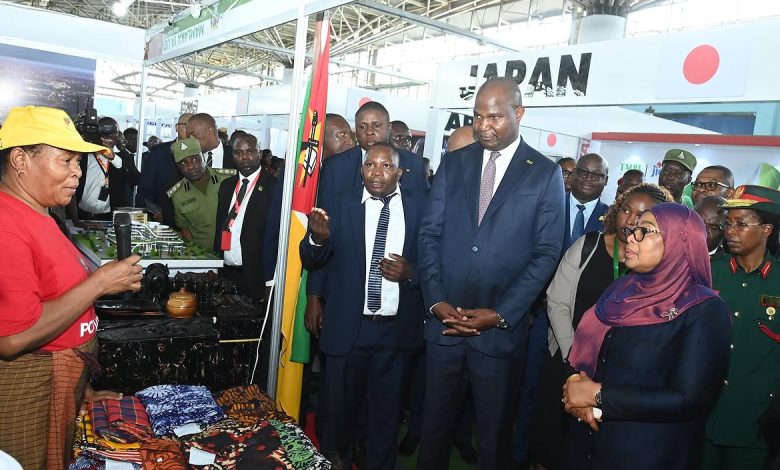
This is why a Tanzanian company working with human From Saba Saba to Maputo: How a TZ innovation is turning waste into regional opportunity PRESIDENT Dr Samia Suluhu Hassan, accompanied by the President of Mozambique, Mr Daniel Chapo, visits exhibition booths during the 50th Dar es Salaam International Trade Fair (Saba Saba) at the Mwalimu Julius Nyerere Exhibition Grounds in Dar es Salaam on July 3, 2026. (File photo) hair waste can potentially find relevance beyond Tanzania.
The underlying challenge is how to turn waste into value exists in many African markets.
The regional opportunity
The contacts established at FACIM also illustrate another important point. Tanzanian companies do not necessarily have to approach regional markets one country at a time.
Regional trade fairs can provide a platform from which businesses can begin building relationships across several markets. For an emerging enterprise, this can be especially important.
A company may have a strong product but limited resources for international market development.
A trade fair can reduce that barrier by bringing markets, institutions and businesses together in one location. The role of economic diplomacy is then to help Tanzanian enterprises make the most of that platform.
The opportunity extends beyond Mozambique.
The interest shown by stakeholders from Rwanda, South Africa, Mauritius and Kenya demonstrates the possibility of building a wider regional conversation around Tanzanian innovation.
Whether those conversations eventually become commercial partnerships will depend on the quality of the follow-up. There is, therefore, a bigger story behind CutOff Recycle’s journey from Saba Saba to FACIM.
It is a story about the kind of Tanzania that is increasingly seeking to promote itself internationally not only as a market for investment and not only as a producer of traditional commodities. But also as a source of innovation, technology, entrepreneurship and locally developed solutions.
The “Made in Tanzania” message becomes more powerful when it includes not only physical products, but also Tanzanian ideas and technologies capable of addressing African challenges.
CutOff Recycle is one example. Its story suggests that innovation does not have to originate in a large corporation or a sophisticated industrial economy.
Sometimes it begins with an entrepreneur looking at an everyday problem and asking a simple question: Can this be done differently? The real test begins after Maputo.
FACIM 2026 has eventually closed and the exhibition stands came down as delegations have l returned home. But for businesses such as CutOff Recycle, the most important part of the journey may only be beginning. The new contacts created in Maputo now need to be nurtured. Potential partnerships need to be tested, markets need to be researched and commercial opportunities need to be converted into measurable results.
That is the difference between participating in an exhibition and using an exhibition strategically. For Tanzania, this is also the deeper meaning of economic diplomacy. It is not diplomacy for visibility alone.
It is diplomacy that helps connect people, ideas, businesses and markets.
From Saba Saba in Dar es Salaam to FACIM in Maputo, CutOff Recycle offers a small but powerful example of that journey. A material normally treated as waste becomes a resource, a Tanzanian innovation becomes a regional conversation, trade fair becomes a network and a network creates the possibility of new markets.
ALSO READ: Dar, Maputo deepen health diplomacy
The next chapter will be determined not by what happened at the exhibition, but by what the company and those supporting Tanzania’s economic diplomacy do with the opportunities created there.
For CutOff Recycle, the journey from Dar es Salaam to Maputo has already demonstrated one important lesson:
Sometimes, the road to a new African market begins with seeing value where others see waste.