DSE turnover surges amid foreign selling
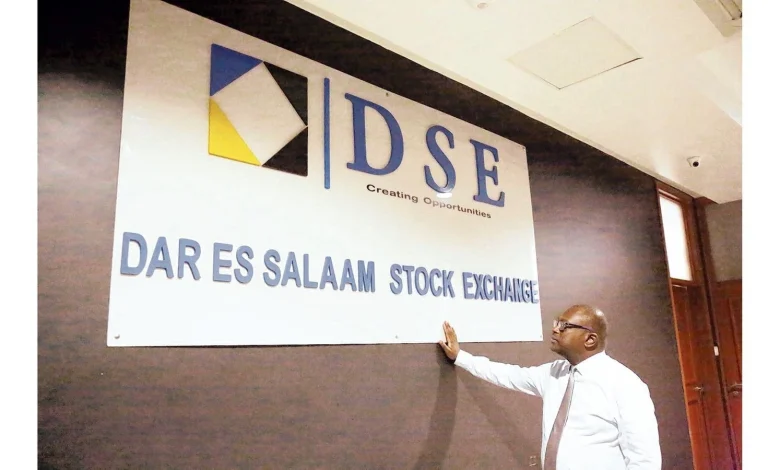
DAR ES SALAAM: THE Dar es Salaam Stock Exchange (DSE) recorded a notably stronger trading week, with market activity accelerating significantly compared to the previous week.
Total market turnover surged by 155.5 per cent to 64.53bn/- while the volume of shares traded more than doubled, rising 119.8 per cent to 15.88 million shares.
The sharp increase in trading activity reflects improved investor participation, supported primarily by large institutional transactions in banking and telecommunications counters.
Despite the robust trading activity, the market experienced a substantial reversal in foreign investor participation.
The market recorded a net foreign outflow of 11.89bn/-, compared with a modest net inflow of 124.86m/- in the preceding week, indicating that foreign investors were predominantly on the selling side of transactions while domestic investors absorbed much of the supply.
Market valuations continued to edge higher during the week. Total market capitalisation increased by 0.97 per cent to 36.53tri/-, while domestic market capitalisation posted a stronger gain of 2.53 per cent to 25.05tri/- reflecting positive price movements among locally listed companies.
The ETF segment also registered steady growth, with ETF market capitalisation rising 1.10 per cent to 199.47bn/-.
Trading activity remained highly concentrated among a few blue-chip counters.
TBL emerged as the most actively traded stock, accounting for 41.2 per cent of total market turnover with trades worth 26.59bn/-.
NMB followed closely, contributing 34.4 per cent of turnover (22.22bn/-), while CRDB, VODA and NICO accounted for 9.9 per cent, 8.5 per cent and 2.1 per cent, respectively.
Collectively, these five counters represented over 96 per cent of total market turnover, underscoring continued investor preference for highly liquid large-cap stocks.
On the price performance front, TCCL led the gainers after appreciating 33.5 per cent to close at 4,340/- per share.
VODA gained 21.2 per cent, supported by sustained investor demand, while USL, SWIS and NMB advanced by 16.7 per cent, 12.7 per cent and 5.0 per cent, respectively.
Conversely, the week saw notable declines in several counters. MCB recorded the steepest loss, falling 53.0 per cent to 310/-, followed by KA, which declined 38.9 per cent to 110/-.
PAL, MUCOBA and TTP also closed lower, shedding 11.1 per cent, 8.6 per cent and 8.5 per cent, respectively.
Market news round up IFC Celebrates First Tanzanian Shilling Bond Issuance at London Stock Exchange.
The International Finance Corporation marked its inaugural Tanzanian shilling bond issuance today at the London Stock Exchange.
The 262.5bn/- (100 million US dollars equivalent) 5-year bond is the largest TZS-denominated issuance to date in international capital markets.
The bond carries a 7.60 per cent coupon and was placed with European institutional investors. Goldman Sachs International acted as dealer for the transaction.
The issuance supports a 100 million US dollars equivalent Tanzanian shilling loan to NMB Bank Plc to expand financing for micro, small and medium-sized enterprises (MSMEs) across Tanzania, with 20 per cent dedicated towards women-owned MSMEs.
The financing will help businesses access long-term local currency funding, reducing foreign exchange risk while supporting investment, growth and job creation.
The Capital Markets and Securities Authority (CMSA) approved a 1:10 share split for NMB Bank Plc ordinary shares on July 24, 2026.
The official public announcement issued on Monday, July 27, 2026. Under the terms of the corporate action, each issued and paid-up share will be subdivided into ten ordinary shares, increasing the bank’s total outstanding shares listed on the Dar es Salaam Stock Exchange (DSE) tenfold from 500,000,000 to 5,000,000,000 shares.
ALSO READ: DSE turnover surges almost four times in seven days
The primary objectives of this corporate action are to enhance the affordability and tradability of NMB Bank shares while broadening retail investor participation across the capital markets.
Shares begin trading at cum-split status as of Monday, July 27, 2026, last day of cum split trading August 19, 2026. Trading will be suspended from August 20, 2026, to August 21, 2026, updating of register of members ahead of the August 21 Record Date.
Post-split trading will officially commence on the effective date of Monday, August 24, 2026.
On Wednesday 29th July 2026, the Central Bank was in the market offering 111.15bn/- in the competitive window and 27.800 billion in the non-competitive to investors for a new 2-Year Treasury bond offering a 9.5 per cent coupon rate annually.
The auction was oversubscribed receiving 394.16 per cent subscription rate, the auction received bids totalling 438.109bn/- and accepted bids worth 111.15bn/-.
This auction marks the second issuance of the 2-year Treasury bond under the new calendar for the second half of the 2025/26 fiscal year. In this round, the Bank of Tanzania (BoT) increased the amount on offer to 111.15bn/-.
Investor demand strengthened significantly, with the auction recording an oversubscription rate of 394.16 per cent. The Bank accepted bids exactly equal to the amount offered, resulting in an acceptance rate of 25.37 per cent.
The coupon rate was maintained at 9.5 per cent. The weighted average yield increased slightly by 4.09 basis points to 8.4033 per cent, down from 8.3624 per cent in the previous auction, in line with the lower coupon rate.
Meanwhile, the minimum successful price was maintained at a premium level of 101.1680, slightly up from 101.0956 in the early March auction.
Trading turnover in the secondary government bond market contracted by 20.11 per cent week-on-week, falling from 105.42bn/- to 84.22bn/-.
Total deal count experienced a steeper decline of 39.22 per cent (dropping from 255 to 155 trades), reflecting a broader shift toward larger block trades rather than retail/fragmented activity.
Larger Block Deal Execution: Despite fewer overall transactions, average ticket size expanded significantly by 31.43 per cent to 543.35m/- per trade (up from 413.41m/- previously).
Institutional investors prioritised sizable block transactions, notably in Bond 698 (20.50bn/- across just 3 deals) and Bond 710 (21.88bn/- across 75 deals).
Secondary market trades 27th July to 31st July. Looking into the weeks ahead, financing conditions are likely to stay firmer following the Bank of Tanzania’s decision to raise the Central Bank Rate to 6.25 per cent for the third quarter, a move taken to keep inflation anchored within the 3–5 per cent target band as elevated global energy, fertiliser and freight costs linked to the Middle East conflict continue to filter through the economy.
With the policy stance now tighter than it has been since late 2025, we expect short- and medium-tenor yields in the secondary bond market to stay firm over the coming weeks, even as appetite for duration persists among institutional players.
Attention now turns to the Bank of Tanzania’s reopening of the 25-year Treasury bond (Bond No. 695) on 5th August, an auction opened to investors across the EAC and SADC region as well as the Tanzanian diaspora; given that Bond 695 already featured among the more actively traded lines in this week’s secondary market, its weighted average yield outcome should help set the tone for long-end pricing into the rest of August.
More broadly, we expect this week’s pattern of fewer but larger trades to persist, as institutional investors continue to favour block execution over smaller, retail-sized tickets in a higher-rate environment.
On the equities side, the momentum built this week is likely to carry into the first half of August, but we expect market attention to increasingly center on NMB Bank ahead of its 1:10 share split.
With cum-split trading running until 19th August, dealing suspended between 20th and 21st August for the register update, and post-split trading resuming on 24th August, we anticipate elevated interest and positioning in the counter over the next two to three weeks, particularly as the lower post-split nominal price should broaden retail participation once trading resumes.
Turnover is likely to remain concentrated among the same handful of blue-chip counters that drove over 96 per cent of this week’s activity, and the sustainability of recent index gains will depend partly on whether foreign investors return to the buy side after this week’s reversal to a net outflow position; continued net selling would be worth monitoring, even though resilient domestic demand should keep providing a cushion.
Overall, we expect a market that stays broadly constructive in the near term, supported by resilient economic growth and deepening capital markets, illustrated by IFC’s inaugural shilling bond issuance in London, but one that will likely track global risk sentiment and the trajectory of the Middle East conflict more closely than it has in recent months.