DSE closes week with slight increase
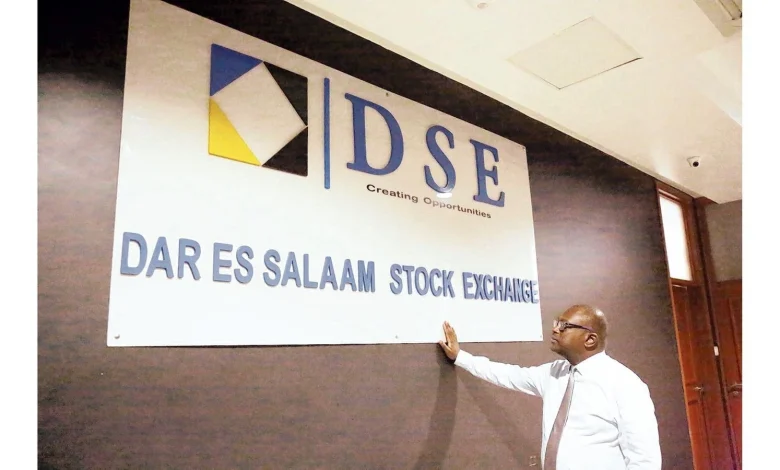
DAR ES SALAAM: THE Dar es Salaam Stock Exchange (DSE) closed the week with market activity showing a slight increase in activity compared to the previous trading week. Total turnover for the week increased to 29.1bn/- from 20.4bn/-, representing a 42.42 per cent increase.
CRDB emerged as the dominant player, contributing 87.21 per cent of the total market turnover chasing, behind was NICO which accounted for 2.66 per cent, MKCB contributed 2.34 per cent of the total turnover. On the price movement front, MBP stood out as the week’s top gainer. Its share price appreciated by 52.242 per cent, closing at 1,890/- per share.
TCCL followed, recording a 23.60 per cent increase, closing the week at 3,300/- per share. SWIS closed the week at 3,200/- being 18.52 per cent jump, VODA eclipsed its IPO price to end the week at 885/-, equal to a 17.22 per cent weekly increase. On the loser’s side PAL and DSE dropped by 5.08 per cent and 0.27 per cent, closing the week at 280/- and 7,460/- per share respectively.
In terms of market valuation, the exchange registered an increase in both total and domestic market capitalisation. Total market capitalisation is up by 4.75 per cent, to 26.4tri/-.
Similarly, domestic market capitalisation is up by 4.9 per cent, closing the week at 17.86tri/-.
DSE investors gain 6tri/- as banks go top
Investors at the Dar es Salaam Stock Exchange (DSE) added 6.12tri/- in paper wealth in 2025 after the market’s capitalisation expanded by more than 34 per cent, rising from 17.8tri/- in December 2024 to 23.95tri/- by the end of December 2025.
Market data show that NMB Bank Plc, KCB Group and CRDB Bank Plc closed the year as the three largest listed firms by market capitalisation, marking a sharp departure from December 2024, when brewers and consumer stocks dominated the top tier.
ALSO READ: Bibi Titi, the woman who shook the colonialists
By the close of trading on December 31, 2025, NMB Bank Plc had emerged as the most valuable company on the exchange, with a market capitalisation of 4.2tri/-. The ranking was underpinned by a strong rally in its share price, which climbed from 5,350/- to 8,410/- over the year.
CRDB Bank recorded one of the most striking reratings on the bourse. Its valuation jumped from 1.74tri/- to 3.99tri/-, lifting it from fifth to third position within a single year. Over the same period, the lender’s share price surged from 670/- to 1,530/-.
BoT holds policy rate at 5.75pc
The Bank of Tanzania (BoT) maintained its central bank rate (CBR) at 5.75 per cent for the first quarter of 2026, marking the third consecutive hold, thanks to stable inflation and robust growth.
The BoT Governor, Emmanuel Tutuba, said during the week the decision to keep hold of the rate followed Wednesday’s meeting of the Monetary Policy Committee (MPC) and is intended to support robust domestic expansion amid cooling global headwinds.
Real gross domestic product (GDP) continues to track favourably against projections, supported by increased public infrastructure investment alongside strong performance in agriculture and mining. Economic growth for 2025 is estimated at 5.9 per cent, broadly in line with the annual projection of six per cent.
On Wednesday 14th January 15, 2026, the Central Bank was in the market offering 115. 64bn/- to investors for the 10-Year Treasury bond offering 11.75 per cent coupon rate annually. The auction was subscribed to 165.04 per cent, the auction received bids totalling to 190.85bn/- and accepted bids worth 115.640bn/-.
This auction marks the first auction of the second half of the 2025/26 financial year and reflects the Bank of Tanzania’s continued move toward lower coupon rates. The 10-year Treasury bond, which previously offered a coupon of 13.5 per cent, was issued at a reduced coupon rate of 11.75 per cent. Despite the lower coupon, investor appetite remained strong, with the auction recording an oversubscription rate of 165.04 per cent.
However, the Bank of Tanzania accepted only 60.59 per cent of the bids submitted. The amount offered was reduced to 115.64bn/- from 146.48bn/- in the previous auction, while total bids declined significantly to 190.85bn/- from 543.73bn/- recorded in the early October auction.
The minimum successful price declined to par (100.00) from 106.8301 in the previous issuance. Meanwhile, the weighted average yield to maturity fell to 11.3021 per cent from 12.4457 per cent, representing a decline of 114.36 basis points, largely driven by the reduction in the coupon rate. Inflation for the month of December was 3.6 per cent.
The near-term outlook for Tanzania’s capital markets remains positive, supported by improving equity valuations, stable macroeconomic conditions and strong investor demand for government securities. Equity market momentum is expected to continue, following broad-based gains across all major indices and a notable expansion in market capitalisation.
Banking stocks are likely to remain the primary drivers of activity, underpinned by strong investor preference for fundamentally solid counters.
However, after the sharp price appreciation recorded in some stocks, selective profit-taking may emerge, resulting in more stockspecific performance rather than uniform market gains. The macroeconomic environment remains supportive.
The Bank of Tanzania’s decision to maintain the Central Bank Rate at 5.75 per cent, alongside stable inflation and economic growth estimated at 5.9 per cent, provides a conducive backdrop for sustained capital market participation. In the fixed income market, investor appetite for government securities is expected to remain strong, particularly for longer-dated bonds.
The oversubscription of the recent 10-year Treasury bond auction, despite a lower coupon rate, signals ample liquidity and growing acceptance of a lower-yield environment.
This trend may continue to support secondary market activity, especially in long-tenor instruments. Overall, while short-term volatility and profit-taking may occur, underlying market fundamentals remain favourable, supporting a constructive outlook across both equity and debt markets.