EAC summit signed off as bold leap toward borderless East Africa
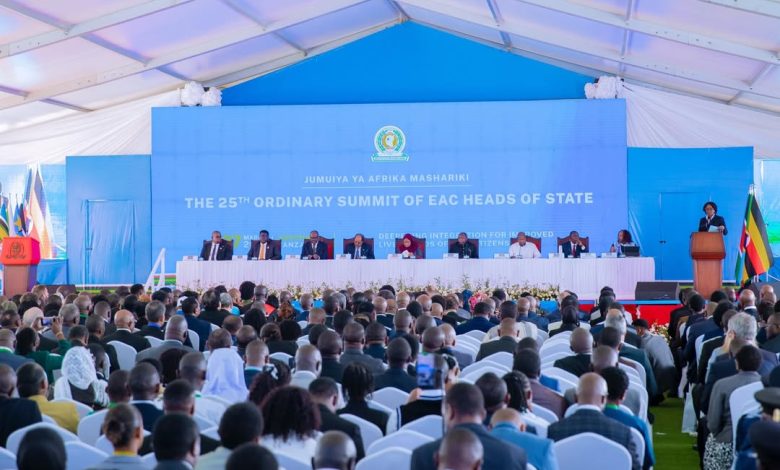
ARUSHA: THE 25th Ordinary Summit of the East African Community (EAC) Heads of State, held yesterday in Arusha, may well be remembered as the moment the bloc transitioned from aspirational rhetoric to practical, high-velocity integration.
Under the theme ‘Deepening Integration for Improved Livelihoods of EAC Citizens,’ the summit delivered two landmark tools designed to dismantle the ‘invisible walls’ that have long hampered regional trade and development.
For years, the Achilles’ heel of East African trade has been the suffocating web of non-tariff barriers (NTBs) and the prohibitive cost of transit.
The launch of the EAC Customs Bond is a surgical strike against this inefficiency. Previously, a hauler travelling from the Port of Dar es Salaam to Goma or Bujumbura was forced to navigate a labyrinth of multiple national bonds— one for every border crossed.
This ‘death by a thousand stamps’ increased compliance costs, tied up capital for clearing agents and created notorious bottlenecks at frontier posts.
The new single regional customs guarantee fundamentally changes the game. By ensuring that one bond is recognised across all eight Partner States, the EAC has successfully linked customs administrations, insurers and financial institutions under a unified framework.
This isn’t just a technical fix; it is a massive dividend for the private sector that will slash compliance costs for small and large-scale traders alike, reduce border dwell times which will ensure perishables reach markets faster, and protect government revenue through a more secure, digitised tracking system.
Complementing this immediate trade win was the unveiling of the 7th EAC Development Strategy (2026/27–2030/31). This strategy is the bridge between our current reality and the ambitious EAC Vision 2050.
By aligning with the African Union’s Agenda 2063 and the Sustainable Development Goals (SDGs), the strategy focuses on accelerating socioeconomic transformation.
It recognises that for integration to be sustainable, it must be felt in the pockets of the 331 million citizens of the Community, from the smallholder farmers in rural Tanzania to the tech entrepreneurs in Nairobi and Kigali.
ALSO READ: Arusha AICC braces for EAC’s Heads of State Summit
With a new funding model approved, moving away from equal contributions to a GDP-weighted formula, the EAC finally has a sustainable financial path to match its lofty ambitions.
As Arusha fades in the rearview mirror, the message is clear: East Africa is no longer just talking about unity; it is actively building the sophisticated infrastructure of a burgeoning super-state. This transformation is being cemented across three critical layers that redefine our regional identity.
First, we see the rise of a hard physical infrastructure, the steel and asphalt of the Standard Gauge Railway and the interconnected regional power pools that serves as the literal backbone of our shared economy.
Parallel to this is the development of a digital nervous system, where harmonised mobile money platforms and the ‘One Network Area’ for telecommunications are quietly erasing borders for every citizen with a smartphone.
Finally, the institutional plumbing, exemplified by the new Regional Customs Bond and the 7th Development Strategy provides the essential legal and administrative pressure required to keep the gears of a single market turning.
With President Yoweri Museveni assuming the Chairmanship and Ambassador Stephen Patrick Mbundi taking the helm at the Secretariat, the EAC has moved beyond the era of diplomatic handshakes.
We are now witnessing the birth of a functional, integrated entity where the tracks are laid, the systems are linked, and the vision of a borderless East Africa is finally becoming an operational reality.