Zero waste turns rubbish into a harvest of opportunities
DAR ES SALAAM: FOR many years, organic waste was widely regarded as a nuisance, clogging drains, filling dumpsites and polluting the environment.
Today, however, the growing adoption of the Zero Waste approach is transforming that perception, with communities converting organic waste into compost that is improving agricultural productivity, enhancing food security and creating economic opportunities.
ALSO READ: Child upbringing determines nation’s future, Minister says
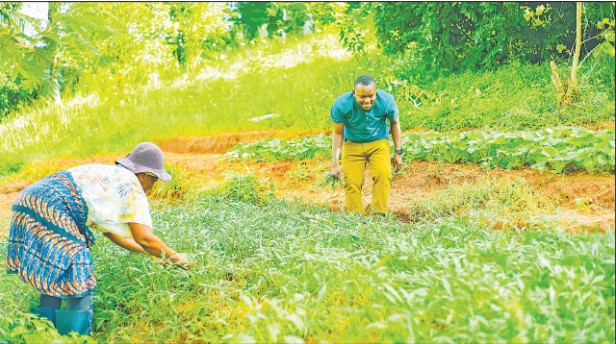
A visit by daily news reporter to some of the beneficiaries of compost produced from organic waste revealed inspiring stories of how what was once discarded as rubbish has become a valuable resource. Ms Amina Thobias, a resident of Bonyokwa in Dar es Salaam, said the initiative has significantly improved both farming and household livelihoods.
“The biggest change is seeing waste transformed into something useful. The compost has improved the quality of our vegetables and reduced the amount of money we spend on farm inputs,” she said. She added that compost production has demonstrated that waste can support environmental conservation while strengthening household food security.
“It has shown us that waste is not something to throw away but a resource that can benefit our families and our environment.” Ms Thobias is among many residents in Bonyokwa who are now enjoying the benefits of compost made from biodegradable waste.
Another resident, Mr Thabit Rajabu, said converting organic waste into compost has enabled neighborhoods to establish vegetable gardens, improving access to fresh and affordable food. “As cities continue to grow rapidly, food security challenges are becoming more serious.
This approach helps communities build resilience from the grassroots level,” he said. He said that composting returns valuable nutrients to the soil, improving soil fertility, increasing crop yields and reducing farmers’ dependence on costly commercial fertilisers.
“This creates a direct link between proper waste management and agricultural development,” he added.
Echoing the same, Ubungo Municipal Agricultural Officer, Ms Editha Godfrey, said municipal reports indicate that more farmers are increasingly embracing organic compost.
She said the growing use of compost is strengthening household food security, particularly among urban and peri-urban farming communities that depend on local food production.
According to her, composting contributes directly to food sovereignty by enabling communities to have greater control over how food is produced and distributed. She observed that although organic waste has traditionally been viewed as a problem because it accumulates in streets and dumpsites, growing awareness of the Zero Waste concept is changing that mindset.
“Using compost produced from organic waste not only keeps our cities clean but also creates jobs, reduces greenhouse gas emissions and strengthens food sovereignty,” she said.
According to the World Bank (WB), organic waste accounts for between 60 and 70 per cent of all municipal solid waste generated in Tanzania, making it the country’s largest waste stream.
Meanwhile, Nipe Fagio Zero Waste Community Mobilisation Officer, Marco Dotto, said organic waste that is dumped without being recycled decomposes and releases methane, a greenhouse gas that is far more potent than carbon dioxide.
“The Zero Waste approach offers an alternative solution by encouraging waste separation at household level, efficient collection systems and community-based composting facilities that return nutrients to the soil,” he explained. Mr Dotto said the impact of the initiative is already evident.
“Through Zero Waste programmes implemented in Tanzania, more than 3.5 million kilogrammes of waste have been managed, with nearly 2.8 million kilogrammes consisting of organic waste. This demonstrates how large quantities of biodegradable waste can be returned to the soil instead of ending up in landfills,” he said.
He added that the figures show organic waste is not a minor waste category but the backbone of sustainable waste management, accounting for nearly 80 per cent of all waste collected under the programme.
According to him, communities in Bonyokwa and Simu 2000 Market in Dar es Salaam, Kijitoupele and Chumbuni in Zanzibar, as well as Chumbageni in Tanga, have established composting systems with encouraging results. He said the projects demonstrate that Zero Waste solutions can succeed in densely populated urban settlements, island communities and smaller towns alike.
“When households separate waste and communities invest in composting, we reduce methane emissions and dependence on landfills. At the same time, we create a local resource that improves soil health, supports food production and strengthens people’s livelihoods,” he noted.
Mr Dotto attributed the programme’s success largely to behavioural change among community members. He said more than 133 waste collectors are currently supporting daily operations by ensuring waste is properly separated, collected and transported to processing centres.
“Their work not only improves environmental outcomes but also creates decent employment opportunities within the growing circular economy,” he said.
He added that Material Recovery Facilities (MRFs) further strengthen the system by providing centres where waste is sorted before processing. Mr Dotto said laboratory analysis has confirmed that compost produced from organic waste contains essential nutrients, including nitrogen, phosphorus, potassium, calcium and magnesium.
He explained that these nutrients improve soil fertility, increase water retention and enhance soil structure, making the compost suitable for a wide range of crops, including maize, cassava, bananas, sunflower, coconuts, papaya, mangoes, avocados and vegetables commonly grown in urban and peri-urban areas.
His remarks are supported by research conducted by Dr Agnes Mwang’ombe, Professor of Soil Science at the University of Nairobi, published in the African Journal of Agricultural Research (Vol. 4, 2009).
ALSO READ: Why joint accountability matters in protecting public resources
The study found that compost produced from market waste contains between 1.5 and 2.5 per cent nitrogen, one to 1.8 per cent phosphorus and 1.5 to two per cent potassium. It also established that compost improves the soil’s waterholding capacity by between 30 and 40 per cent compared to untreated soil.
Mr Dotto further said composting reduces pressure on municipal waste management systems by diverting waste away from landfills, thereby lowering waste collection, transportation and disposal costs.
“Because the Zero Waste model relies on decentralised, community-owned infrastructure rather than expensive centralised facilities, it is costeffective and easily scalable,” he said.
He revealed that more than 150 farmers and urban gardeners in Dar es Salaam and Zanzibar have already been trained in compost use and sustainable farming practices.
“The demonstration farms in Bonyokwa and Chumbuni clearly prove that compost produced from organic waste can improve agricultural productivity and enhance household incomes,” he added.
For his part, Minister of State in the Vice-President’s Office (Union and Environment), Eng Hamad Yusuf Masauni, said waste should no longer be regarded as a burden but as an economic opportunity.
“Materials such as organic and recyclable waste can be transformed into compost, animal feed and other commercial products through the circular economy,” he said, stressing the need to accelerate efforts to turn waste into wealth.
The government’s commitment is also reflected in the proposed 2026/27 budget for the Vice-President’s Office. According to a report submitted to Parliament’s Standing Committee on Water and Environment on April 21 this year, the office has requested 99.8bn/- for the 2026/27 financial year, representing an increase of nearly 47 per cent compared to the 2025/26 allocation.
The increase is intended to finance the National Waste Management Strategy and strengthen environmental monitoring under the Blue Economy agenda. Of the proposed budget, 76.6bn/- under Vote 31 (Environment) has been earmarked for waste control, protection of water sources and implementation of the National Waste Management Strategy (2025–2030).
The report further states that the funds will support stronger management of hazardous and plastic waste through the National Environment Management Council (NEMC) while coordinating implementation of the 3Rs principle, Reduce, Reuse and Recycle.
As Tanzania advances its transition towards a circular economy, the Zero Waste approach is increasingly proving that organic waste is no longer a liability but a valuable resource capable of improving food security, protecting the environment and creating sustainable livelihoods.