Women lead climate fight as Kigoma builds disaster resilience
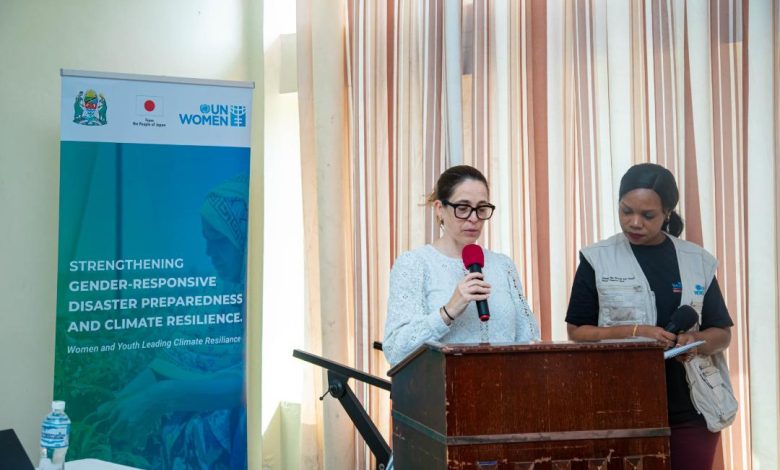
DODOMA: A new initiative launched in Kigoma Region is seeking to change how communities prepare for disasters and respond to the growing impacts of climate change, with women and young people placed firmly at the centre of the solution.
The project, titled Strengthening Gender-Responsive Disaster Preparedness and Climate Resilience, is being implemented by UN Women with funding from the Government of Japan and in close collaboration with the Kigoma Regional Authority. It forms part of a broader regional programme covering Tanzania, Rwanda and Malawi, aimed at strengthening disaster preparedness, climate resilience and early warning systems.
The initiative comes at a critical time. Across Tanzania and much of sub-Saharan Africa, climate-related shocks are becoming more frequent and severe, disrupting livelihoods, threatening food security, damaging infrastructure and straining essential services.
Launching the project in Kigoma, UN Women Representative in Tanzania, Katherine Gifford, said climate change is far more than an environmental challenge.
“Climate change and disasters are not gender-neutral. Women and girls often face the greatest risks, yet they are also at the forefront of resilience and recovery,” she said.
According to Ms Gifford, the project seeks to ensure that women and youth are not viewed merely as recipients of assistance but as key actors in designing and implementing solutions.
“Through this partnership, we are investing in stronger institutions, local leadership and climate-resilient livelihoods so that women and youth are not only protected from disasters but are empowered to shape the solutions,” she said.
Her remarks underscore a reality increasingly supported by global and national data. Under a worst-case climate scenario, climate change could push an additional 158.3 million women and girls into extreme poverty by 2050, with nearly half of them living in sub-Saharan Africa. An estimated 236 million more women and girls could also face food insecurity.
The situation is particularly relevant in Tanzania, where women play a major role in farming, water collection and household food security. Yet, according to the 2025 Gender and Environment Survey, women are less likely to receive early warning information and remain significantly underrepresented in water management committees.
For development experts, this illustrates how climate change often magnifies existing inequalities. Those with the least access to information, resources and decision-making opportunities frequently face the greatest consequences when disasters strike.
Kigoma Region has experienced many of these challenges firsthand.
Flooding, damage to infrastructure, declining agricultural productivity, loss of property and disruptions to income-generating activities have increasingly affected communities across the region. While the impacts are widespread, not everyone experiences them equally.
Women, youth, female-headed households, persons with disabilities and other vulnerable groups often face greater difficulties because of limited access to productive resources, technology, financial services and information.
Speaking on behalf of the Kigoma Regional Commissioner, Regional Administrative Secretary for Public Service Zabibu Mkamba said the region recognizes both the vulnerabilities and the strengths that exist within these groups.
“Women and youth should not be viewed merely as beneficiaries of assistance. They should be recognized as active participants, leaders and innovators in disaster preparedness, response and recovery efforts,” she said.
She noted that women and young people possess valuable knowledge, experience and leadership potential that can significantly strengthen resilience efforts within families and communities.
The newly launched project is designed to translate those principles into practical action.
The first component focuses on strengthening Kigoma’s disaster risk reduction systems through the development of a gender-responsive framework that will guide planning and implementation at regional and local levels. The framework is expected to ensure that the needs, experiences and priorities of women, youth and vulnerable populations are fully reflected in disaster preparedness and climate adaptation strategies.
The second component centres on capacity building.
Local government officials, frontline responders, disaster management committees and community leaders will receive support to improve their ability to prepare for and respond to disasters in ways that are inclusive and responsive to the needs of all citizens.
Particular attention will be paid to preventing and responding to gender-based violence, a risk that often increases during disasters, displacement and disruptions to social services.
“Preparedness and response systems must therefore include clear referral pathways, trained frontline responders, strong community awareness and accessible survivor-centred services,” Ms Gifford emphasized.
The third component seeks to strengthen livelihoods in flood-affected communities, particularly among women and youth.
Beneficiaries will receive climate-resilient agricultural inputs, technologies and training aimed at helping them withstand climate-related shocks, recover more quickly and build sustainable sources of income.
After all, resilience is not simply about surviving a flood. It is about ensuring that families can rebuild, farmers can return to productive work and communities can continue moving forward. As many rural residents know, crops do not pause for climate conferences.
The initiative will focus on flood-prone areas of Kigoma Region, particularly communities vulnerable to recurring climate shocks. Target groups include women smallholder farmers, young women and men, community leaders, frontline responders and local government authorities, including ward and village disaster committees.
The project is expected to directly reach 700 people, including 570 women, while indirectly benefiting approximately 3,500 people.
The programme is also closely aligned with Tanzania’s policy and development priorities, including the National Gender Policy 2023, the National Action Plan on Women, Peace and Security 2025–2029, the National Disaster Management Strategy 2022–2027 and broader commitments to ending violence against women and girls.
Both UN Women and regional authorities stress that successful implementation will depend on strong local ownership.
Ms Mkamba said the project would be anchored within existing government and community structures, including local government authorities, disaster committees, villages, wards and community leadership systems.
“The success of this project will not depend on the efforts of a single institution,” she said.
Instead, she called for close collaboration among government agencies, development partners, civil society organizations, religious leaders, women’s groups, youth groups, the media and local communities.
Regional authorities have also committed to strengthening coordination among key sectors, including agriculture, environment, health, education, water, planning, social welfare and disaster management.
Another priority will be improving data collection and analysis.
Officials say information should be disaggregated by sex, age and disability status to ensure that interventions accurately respond to the needs of different groups. Early warning systems must also be designed to reach women, youth, persons with disabilities and residents of remote communities through channels they can easily access and understand.
Equally important is ensuring that women have meaningful representation in disaster management committees and climate-risk planning structures at regional, district, ward and village levels.
“Recovery cannot be sustainable if women’s livelihoods, safety and participation in decision-making are not prioritized,” Ms Gifford said.
The launch event brought together regional and district authorities, development partners, community leaders and other stakeholders to strengthen coordination and identify practical pathways for implementation.
Participants shared a common understanding that disaster preparedness is not solely about responding when emergencies occur. It is about building stronger institutions, empowering communities and creating systems capable of anticipating risks before they become crises.
For Kigoma, the project represents more than another development intervention. It is an opportunity to address climate risks while simultaneously advancing gender equality, social inclusion and sustainable development.
As climate-related challenges continue to grow, both UN Women and regional leaders believe solutions must be equally ambitious. By investing in local leadership, strengthening institutions and supporting climate-resilient livelihoods, the initiative aims to create communities that are better prepared, safer and more capable of withstanding future shocks.
The message from the launch was clear: women and youth are not simply among those most affected by climate change. They are among the most important drivers of the solutions needed to confront it. And in Kigoma, that belief is now being translated into action.