Vision 2050 to take off with 86.3tri/- national plan

DODOMA: THE government has unveiled an 86.3tri/- National Development Plan for 2026/27, marking the first phase of implementing Tanzania’s Vision 2050 through the Fourth Five-Year National Development Plan (2026/27–2030/31).
Presenting the Report on the State of the National Economy for 2025 in the National Assembly yesterday, Minister of State in the President’s Office (Planning and Investment), Professor Kitila Mkumbo, said the plan adopts the objectives, targets, interventions and key performance indicators outlined in the Fourth Five-Year National Development Plan, which carries the theme: “Transformation for Inclusive Economic Growth and Employment Creation.” Prof Mkumbo said the estimated 86.3tri/- cost of implementing the 2026/27 Development Plan represents 18.1 per cent of the total projected cost of 477.747tri/- for implementing the Fourth Five Year National Development Plan.
Prof Mkumbo said the implementation of the 2026/27 Development Plan will focus on five priority areas: strengthening good governance, democracy, peace and stability; building a strong, inclusive and competitive economy; enhancing human capital and social development; strengthening environmental conservation and climate resilience; and accelerating key transformation drivers, including energy, transport infrastructure, research and development and digital transformation.
He said resources for implementing the plan will be mobilised through three key stakeholders, the central government and local government authorities, the private sector and public institutions. According to the minister, the private sector is expected to contribute 60.1tri/-, equivalent to 69.6 per cent of the total implementation cost, while the public sector will contribute 26.2tri/- (30.4 per cent).
ALSO READ: Growth-focused 62.33tri/- budget
Of the public sector contribution, public institutions are expected to provide 5.5tri/-, while the government will contribute 20.8tri/- .
To achieve the plan’s objectives, the government intends to implement 38 flagship sub-projects drawn from 51 projects under seven flagship programmes identified in the Fourth Five-Year National Development Plan
. The programmes include the Bagamoyo Maritime Ecology City and Integrated Transport Programme, comprising 10 sub-projects; the Mchuchuma Coal and Liganga Iron Integrated Complex Programme, with seven sub-projects; and the National Irrigation and Agroprocessing Industrial Transformation Programme, which consists of eight sub-projects.
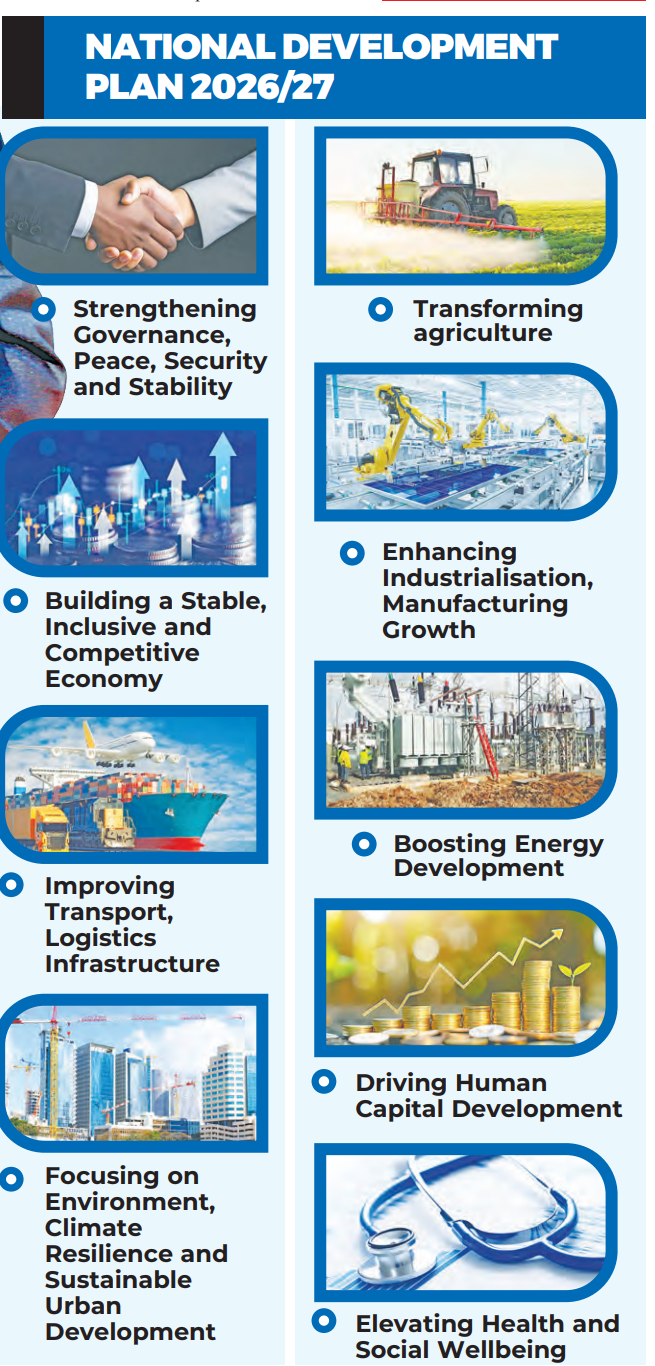
Other flagship programmes are the Rare Earth Technology and Processing Hub–Dodoma Programme, which includes seven sub-projects; the Liquefied Natural Gas (LNG) Processing Plant–Lindi Programme, with three sub-projects; the Modern Industrial and Blue Economy Hub in the Great Lakes Region Programme, comprising seven sub-projects; and the Integrated Urban Development Programme, which includes nine sub-projects.
The minister further noted that successful implementation of the plan will depend on eight key foundations, including continued democracy, peace, security and both domestic and regional stability to support economic activities and investment.
Other foundations include adherence to good governance and the rule of law; continued development of energy, port, road and railway infrastructure; advancement of innovation and digital technologies in service delivery and production; and further improvement of the business and investment environment to stimulate private sector participation.
He also cited strengthening resilience to climate change and disasters, including droughts, floods, conflicts, disease outbreaks and global economic shocks, as critical to the plan’s success. Additionally, he said sustained global economic recovery, stability in financial and commodity markets and continued improvements in food availability and food security will be essential for achieving the plan’s objectives.