Twiga model endures as North Mara licence renewed for 15 years
MARA: FOR the people of Tarime, the renewal of Barrick’s mining licences for another 15 years is more than an extension of a commercial arrangement. It offers a test of whether a mining model built on government participation, community investment and shared economic interests can sustain a more constructive relationship between a major gold mine and its neighbours.
For Diana Marwa, the change is tangible.
For years, access to clean water meant walking long distances under the equatorial sun and competing with neighbours for scarce, unreliable supplies. Today, water flows from a tap at home.
That everyday convenience reflects a broader transformation around North Mara Gold Mine, where community development projects have helped reshape relations between the operation and surrounding villages.
From confrontation to cooperation
The journey has not been straightforward. Since commercial production began in 2002, North Mara has experienced years of tension involving local communities and people entering the mine illegally to search for gold-bearing waste rock. Clashes with security personnel were frequent and sometimes deadly.
Tarime District Commissioner Major Edward Gowele recalls the difficult relationship. “Initially, some residents viewed the mine as an enemy,” he says. “There were daily incursions. The relationship was adversarial.” A major shift came in 2019, when Barrick assumed operational control and established Twiga Minerals in partnership with the Tanzanian government. Under the arrangement, the government holds a 16 per cent free-carried interest, while the partners share economic benefits equally.
The structure changed the relationship between the mine and the state, giving the government a direct financial stake in the operation’s performance. It also created an opportunity to align commercial interests with community development and greater local participation.
From intrusion to participation
One measure of the change is the decline in illegal entries into the mine. According to figures cited by the company, an average of about 100 people entered the site illegally each day in 2020.
By 2026, the figure had fallen to approximately one a day. The response has extended beyond security measures to include development initiatives and alternatives to dangerous, illegal prospecting. Community Development Committees (CDCs) identify and prioritise local projects financed through royalty dividends and corporate social responsibility budgets.
Bogomba Rashid, a councillor for Kemabo ward who chairs the committee, says attitudes have changed. “Before, young people saw the mine as something to raid. Now they see it as something that builds their village,” he says.
Water changes daily life
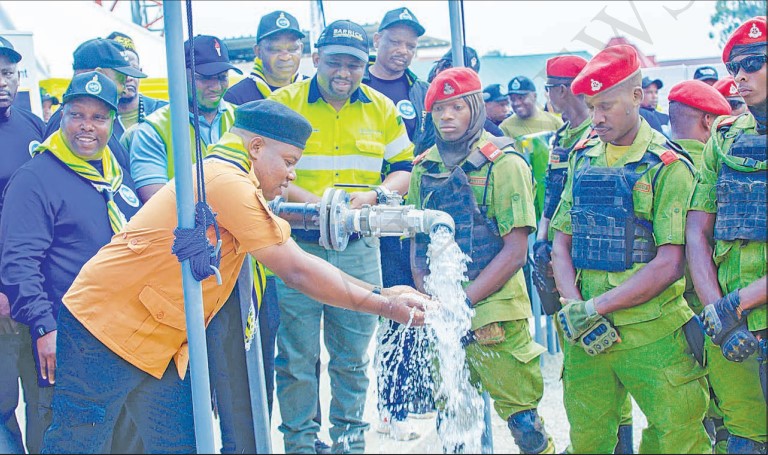
Among the most significant investments is the Nyamongo water expansion, a Sh2.665 billion project completed in late 2025. Initially designed to serve fewer than 28,000 people in four villages, the expanded system now reaches 125,566 people across ten villages, according to project figures.
ALSO READ: Govt calls Tanzanians to support local industries
The project involved laying 5.5 kilometres of main pipeline and 8.6 kilometres of distribution lines, extending clean water access to communities that previously depended on seasonal streams and distant wells. The benefits extend beyond convenience. Reliable water supplies can free women and girls from hours of collection, giving them more time for education, income-generating activities and family responsibilities.
“The water project changed everything. Our daughters can study and women can spare time for more productive duties for their families,” says Mariam Mkono, a special-seat councillor for Nyamwaga ward.
Royalties put villages in control
Alongside corporate social responsibility spending, a separate revenue stream is financing local development: the one per cent royalty dividend allocated to communities around the mine. Between June 2023 and May 2025, North Mara disbursed Sh8.383 billion in royalty dividends to five villages: Genkuru, Nyangoto, Kerende, Nyamwaga and Kewanja. Village authorities use the funds to finance priorities identified through community consultations, bringing decisions about local development closer to residents.
In Genkuru, more than Sh2 billion has been committed to rehabilitating two roads, purchasing medical equipment for a health centre and building accommodation for health workers and teachers. Kewanja has spent Sh280 million on staff housing at its primary school and dispensary. Nyamwaga is constructing seven classrooms at a new primary school, together with an administration block and teachers’ accommodation. “We decide what we need,” says Genkuru village chairman Juma Kegoye.
“The money is ours to use, and we use it for what matters most.” The projects illustrate how direct community financing can translate mining revenues into services and infrastructure.
Their long-term value, however, will depend on transparent spending, sound project selection and proper maintenance.
Jobs and local businesses
The mine’s economic contribution also extends to employment and procurement. Barrick employs approximately 3,000 people in Tanzania, of whom 96 per cent are Tanzanian nationals and 47 per cent come from communities surrounding its mines, according to company figures.
More than 90 per cent of procurement is sourced from Tanzanian-registered companies, the majority of them locally owned, the company says. Since 2019, Barrick reports contributing approximately US dollar 5.3 billion to Tanzania’s economy through taxes, royalties, salaries, dividends and local procurement, including US dollar 1.2 billion in 2025.
The company says it was the government’s leading dividend payer and largest revenue contributor that year. These figures point to the scale of the mine’s economic footprint. The wider test is how much of that activity generates lasting local capabilities, sustainable businesses and opportunities beyond the life of the mine.
Dialogue and accountability
Financial investment alone cannot guarantee lasting trust. North Mara also holds regular grievance clinics in all eleven surrounding villages, providing residents with a formal channel to raise concerns, including road conditions and compensation disputes.
Such forums can help address misinformation and suspicion by allowing residents to seek explanations and follow up on complaints. Their effectiveness ultimately depends on whether grievances receive timely, transparent responses and meaningful remedies.
ALSO READ: Fisheries sector targets commercial growth
“Relations have strengthened,” says Gowele. “Residents now really view the mine as a community partner.” The North Mara experience suggests that the Twiga model’s significance lies not simply in joint ownership or the money spent on community projects, but in the mechanisms linking mining operations to public revenue, local investment and dialogue with affected communities.
The renewal of the licence for another 15 years extends the period in which that relationship can be tested. Sustaining progress will require more than investment announcements: communities must continue to see tangible benefits, grievances must be addressed fairly, and public revenues must translate into lasting improvements in living standards.
For Marwa, the transformation begins with something simple: water flowing from a tap at home. For North Mara and its neighbours, the bigger challenge is to ensure that such gains endure, opportunities expand and the relationship remains one of partnership rather than confrontation.