Tanzania decorates Eng Waziri as its Water Sector heroine

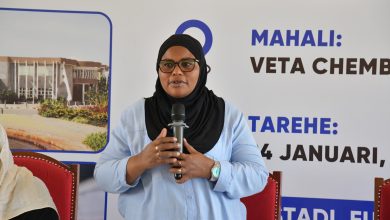
DAR ES SALAAM: FROM supervising water projects in remote parts of Tanzania to becoming the Permanent Secretary in the Ministry of Water, Engineer Mwajuma Waziri has emerged as one of the country’s most influential public servants, earning recognition as the “Strong Queen” in the Water Sector 2026.”
Eng Waziri, who is a mother of five and a seasoned water engineer, has built a reputation for professionalism, resilience and leadership in a sector traditionally dominated by men.
Since March 2024, she has served as Permanent Secretary in the Ministry of Water, overseeing the implementation of key programmes aimed at expanding access to clean and safe water across the country. Her appointment followed years of service in various senior positions, including Deputy Permanent Secretary in 2023 and Assistant Director for Water Supply and Sanitation between 2020 and 2023.
Born in Tabora Region in September 1984, the Permanent Secretary began her journey in public service in 2013, steadily rising through the ranks on the strength of her technical expertise and commitment to delivering results.
Holding both Bachelor’s and Master’s degrees in Civil and Water Resources Engineering from the University of Dar es Salaam, she is a registered professional engineer with extensive experience in water systems design, project management, procurement processes and engineering software applications.
Her public service career started at Masasi District Council, where she worked on water projects at a time when many still viewed engineering fieldwork as a male domain.
ALSO READ: Mining Commission showcases strategic investment opportunities in Dar, Coast
Speaking to the Daily News in Dar es Salaam, Eng Waziri revealed that it was through determination and hard work that she challenged those perceptions and proved that women can excel in demanding engineering roles.
Elaborating, she stated that over the years, she has played a key role in the design, supervision and implementation of several strategic water projects, including the water supply project for 28 towns, the Farkwa Dam project, the Same-Mwanga-Korogwe Water Project and the Simiyu Climate Resilience Project.
According to her, some of these projects have significantly improved access to clean and safe water for thousands of Tanzanians, while others resolved long-standing implementation challenges that had stalled progress for decades.
“In many parts of the country, I see the impact of my contribution as an engineer. This work is not easy; it requires commitment and teamwork, but it is rewarding to see communities benefiting from improved water services,” she said.
Additionally, she said she believes leadership is defined by competence rather than gender and has consistently advocated for greater participation of women and girls in science and engineering fields.
“We should encourage girls to pursue science subjects and seize opportunities with confidence. Women can succeed in any position and contribute meaningfully to national development,” she said.
She noted that female representation in water engineering remains low, recalling that fewer than 10 women were enrolled in her university engineering class.
Despite the challenges, she says women should never allow stereotypes to limit their ambitions.
Beyond her national responsibilities, Eng Waziri has represented Tanzania on global platforms, including the United Nations Climate Change Conference (COP28) in Dubai in 2023 and the 10th World Water Forum in Bali, Indonesia, in 2024, where she contributed to discussions on water security, climate resilience and investment in the water sector.
Under her leadership, the ministry continues to implement the National Water Grid Strategy while working to extend clean water services to the remaining 1,575 villages yet to be officially connected.
She expressed pride in the sector’s achievements, noting that access to clean and safe water has reached 93.5 per cent in urban areas and 85.3 per cent in rural areas.
“Water has no substitute. Without water, there is no life. Every new water connection means improved lives and greater opportunities for Tanzanians,” she said.
As Tanzania advances its development agenda under President Samia Suluhu Hassan, Eng. Waziri stands out as one of the country’s leading female professionals, whose expertise, dedication and leadership continue to shape the future of the water sector and inspire the next generation of women engineers.