

Tanzania completes key marine sciences facility after decades

ZANZIBAR: ON a humid January morning in Buyu, on the western edge of Zanzibar, history arrived without theatrics.
There were no grand proclamations, no booming rhetoric, no sense of political performance.
Instead, there was the quiet satisfaction of something long delayed finally finding its moment. Coconut palms barely stirred.
The Indian Ocean kept its steady rhythm. And an unfinished chapter, left open for nearly two decades, was at last being closed.
And when former President Dr Jakaya Mrisho Kikwete, the Chancellor of the University of Dar es Salaam, rose to speak at the inauguration of the new Academic and Administration Building of the Institute of Marine Sciences (IMS), his words carried the weight of time.
They spoke of waiting, of patience tested, and of the relief that comes when responsibility is finally discharged.
Presiding over the occasion was Dr Samia Suluhu Hassan, the President of the United Republic of Tanzania herself, whose presence transformed what could have been a routine institutional ceremony into a moment of national symbolism.
This was not merely the unveiling of a building. It was the visible end of a stalled dream and a reaffirmation of a governing philosophy that places higher education, science and research at the centre of Tanzania’s development story.
Dr Kikwete’s tone was characteristically measured, warm and deeply personal.
He spoke not as a distant dignitary revisiting past authority, but as a custodian entrusted with guiding an institution through unfinished business.
For the Institute of Marine Sciences, the moment on that Thursday January 8, 2026, was emotional.
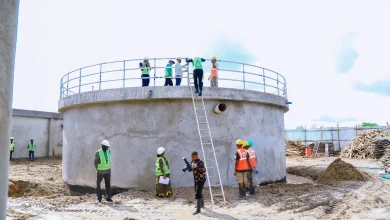
The building being opened had existed for almost twenty years as an unfinished foundation, a slab of concrete that became an uncomfortable landmark.
Construction had stalled in August 2006, leaving behind a structure that aged into embarrassment, its exposed base slowly blending into the landscape as a symbol of ambition frustrated by circumstance. Students passed it daily. Lecturers learned to explain it away.
Visitors asked questions that had no satisfying answers. Many institutions would have quietly learned to live with it. IMS did not.
What ultimately changed the story was political will aligned with strategic financing. Under President Samia’s leadership, Tanzania entered the Higher Education for Economic Transformation project, known as HEET, implemented in partnership with the World Bank.
While the programme spans multiple institutions and regions, the University of Dar es Salaam became one of its most active beneficiaries, using the opportunity not only to expand infrastructure but to rethink its national footprint.
Dr Kikwete reminded the audience that President Samia had issued three clear directives on the use of HEET funds. One was to complete the long-abandoned IMS building in Buyu.
The other two were to establish new public university campuses in Lindi and Kagera, regions that had never hosted government universities before.
In Tanzania’s geography of opportunity, that omission mattered. Those instructions were not rhetorical.
They were executed. By December 2025, foundation stones had been laid in Bukoba and Lindi, with the Vice President Dr. Emmanuel Nchimbi and the Prime Minister Dr. Mwigulu Lameck Nchemba officiating respectively. By October 2026, the first cohort of students is expected to be admitted.
For communities long accustomed to being peripheral to higher education, the arrival of a university is not simply institutional expansion; it is recognition.
Dr Kikwete illustrated this with a story told gently, almost affectionately.
In Bukoba, an elderly man lamented the President’s absence at the ceremony — not as a complaint, but because he wished he could physically carry her on his back to express his gratitude.
The anecdote drew smiles, but its meaning ran deeper. Universities, after all, do not only educate students.
They validate regions. Back in Buyu, that sense of fulfilment was tangible.
The Institute of Marine Sciences now stands complete, as originally envisioned more than twenty years ago.
The new Academic and Administration Building, together with the women’s hostel inaugurated the same day, represents more than functional space. It signals permanence.
It tells students, researchers and international partners that marine science is not an afterthought in Tanzania’s development planning, but a pillar.
This matters deeply in a country whose economic future is increasingly tied to the ocean.
From fisheries and coastal livelihoods to climate resilience and the emerging blue economy, the work done at IMS has implications far beyond Zanzibar.
As Dr Kikwete noted, the Institute is unique not only in East Africa but across much of southern Africa.
“There is no other institution like this,” he said, “in mandate, in location, or in responsibility.”
President Samia reinforced that message in her own address. “These oceans are not just water,” she told the gathering.
“They are a strategic national asset. Their sustainable use must be guided by science, research and professionalism.”
Her words landed with particular force in Buyu, where fishing, tourism and marine resources shape daily life. She was equally clear that research must not remain abstract.
“Knowledge must not stay on shelves,” she said.
“It must translate into jobs, skills, income and better lives — especially for our coastal and island communities.”
The Institute, she stressed, has a duty not only to generate knowledge, but to ensure that innovation reaches the people whose lives depend on the sea.
The impact of the new facilities is already measurable. Student intake capacity has expanded dramatically, from 172 to 472 students, significantly improving access to specialised marine science education.
For young people from Zanzibar and coastal regions, this means opportunity closer to home, without the cost and disruption of long-distance study.
For Tanzania, it means accelerated human capital development in a sector where skilled professionals are essential for productivity, competitiveness and resilience.
Looking ahead, the Institute plans to introduce six new academic programmes, expand student exchange initiatives and deepen research in emerging blue-economy fields.
President Samia also directed the development of short-term professional courses aimed at equipping surrounding communities with practical, market-ready skills.
“Education must reach the people,” she said.
“Knowledge should improve daily life.” Yet the day was marked as much by honesty as by celebration.
Dr Kikwete spoke candidly about what remains unfinished. Student accommodation is still insufficient.
The current women’s hostel houses only forty students, while male students are accommodated off campus in Mazizini and transported daily by bus, being a logistical compromise rather than a solution.
More critically, the Institute lacks a marine research vessel.
For an institution dedicated to ocean sciences, this absence is not minor; it is structural.
Without a vessel, practical training and field research are constrained, limiting academic depth and international competitiveness.
“For a marine sciences institute,” Kikwete said plainly, “not having a vessel is a serious gap.”
The hope is that a second phase of the HEET project will address these needs, allowing development to proceed in logical, sustainable stages rather than stalling at symbolic milestones.
Development, in this telling, is not episodic. It is cumulative.
Dr Kikwete was also deliberate in acknowledging Zanzibar’s leadership.
President Hussein Ali Mwinyi was credited for facilitating land ownership, enabling construction to proceed, and for approving the tarmacked access road that now links the Institute more seamlessly to surrounding communities.
Infrastructure, Kikwete reminded the audience, is not only about buildings. It is about access. There was, too, a quiet nod to continuity across administrations.
The former President referenced his predecessor the late John Magufuli’s directive to relocate the School of Health and Allied Sciences from the Mwalimu Nyerere Campus, a task still underway.
Governance, the day suggested, is not about erasing what came before, but completing it.
As the ceremony drew to a close, the emotional register softened further. Dr Kikwete spoke of waiting, of listening, and of decisions taken at the right moment.
After twenty years of standing still, the foundation at Buyu had finally risen into form.
The once-awkward slab of concrete had been transformed into a functioning centre of learning, research and administration.
In thanking President Samia, he reached for a phrase that resonated across the gathering: “Hakika, wewe ni Samia Suluhu.” It was not flattery.
It was recognition of a leadership style that privileges completion over announcement, substance over spectacle. As applause filled the air, the message was clear.
This was not simply a university milestone. It was a lesson in what happens when political intent, institutional patience and development finance align.
In Buyu, on that January morning, Tanzania did not just open a building. It closed a long chapter of waiting — and quietly opened another of possibility.
Overlooking the ocean that has shaped Zanzibar’s history for centuries, the Institute of Marine Sciences now stands defined not by what it once lacked, but by what it is ready to deliver — for Zanzibar, for Tanzania, and for the wider Indian Ocean region.

На данном веб-сайте удастся отыскать важную информацию.
https://ivecodom.ru/home/istoriya-sozdaniya-onlayn-kazino-sweet-ot-idei-do-globalnogo-brenda-163/