President Ruto in Dar: A tale of two countries strategic connection
DAR ES SALAAM: Of all governments in Africa, few have cultivated a diplomatic corps as intellectually storied, and as quietly influential and grounded in expertism, as that of the Republic of Kenya. From the early 1970s through the turn of the millennium, Kenya’s Ministry of Foreign Affairs and International Cooperation stood apart: It is a citadel of elite training, and strong Ministry, populated by scholars, strategists, and practitioners of uncommon depth, which most are foreign educated and very well experienced. It was not unusual to find PhDs occupying relatively junior desks Assistant Secretaries performing roles equivalent to Third Secretaries in diplomatic missions men and women whose intellectual discipline translated into a formidable presence in international engagements.
This tradition, as captured in Chapter 35 of 54 Years of Corruption and Plunder by the Elite (1963–2017) by Joe Khamisi, reflected more than bureaucratic prestige. It signaled a philosophy that diplomacy, at its highest level, is not improvisation but preparation an orchestration of history, law, and persuasion. Kenyan presidential entourages and foreign delegations became extensions of that philosophy, carrying with them a quiet but unmistakable assertion of intellectual authority.
It is against this backdrop that one must recall November 27, 2019, when Professor Palamagamba Aidan Mwaluko Kabudi as Tanzanian Minister for Foreign Affairs and East Africa Cooperation, rose before a Kenyan audience and delivered what can only be described as a masterclass in diplomatic rhetoric. He spoke not merely as Tanzania’s Foreign Minister, but as an expert historian of the region’s soul. Invoking the shared legacies of colonial partitions including the Heligoland Treaty he framed Tanzania and Kenya as brotherly nations, bound by culture, ethnicity, and an intertwined economic destiny. It was a speech that transcended protocol, it was, in essence, an argument for memory as a tool of diplomacy.
Professor Kabudi’s diplomatic footprint and speech performance did something else. It projected Tanzania’s own foreign policy establishment as an intellectual force one capable of matching, and perhaps even rivaling, Kenya’s long-celebrated diplomatic tradition. In that moment, diplomacy ceased to be transactional. It became civilizational.
And yet, history rarely moves in straight lines. By 2021, the region found itself in what might fairly be called an annus horribilis a year of recalibration, tension, and quiet redefinition and a covid 19 pandemic.
Two siblings are worth eight cousins: Ruto and Samia Presidential addresses in history:
When President Samia Suluhu Hassan addressed the Kenyan Parliament on May 5, 2021, she was not merely delivering a speech; she was resetting a relationship. Her arrival in Nairobi marked a deliberate departure from the frictions that had come to define the immediate past. It was, in tone and substance, an act of diplomatic restoration.
Within the eight-member East African Community, the Tanzania–Kenya axis occupies a peculiar, almost gravitational position. Among our East African eight regional partners, no country invests more in Tanzania than Kenya. No intellectual rivalry among elites is as pronounced or as productive as that between these two nations. Within Tanzania’s legal fraternity, few judicial traditions command as much respect as those of Kenya’s High Courts, whose precedents often travel across borders in both influence and argument.
To say that “two siblings are worth eight cousins” is not to diminish the importance of Uganda, Rwanda, Burundi, the Democratic Republic of the Congo, Somalia, or South Sudan. It is to recognize a hierarchy of proximity. Kenya is not simply a neighbor; it is a mirror sometimes cooperative, sometimes competitive, always consequential in the tapestry of our regional foreign affairs engagement.
Siblings, after all, are bound by more than affection. They are bound by inevitability. They quarrel, they reconcile, they test each other’s limits but they cannot disengage. Tanzania and Kenya exist in precisely this dynamic: a relationship defined by strategic interdependence, where economic complementarity, regional mobility, and shared geopolitical interests create a partnership that is at once competitive and mutually reinforcing.
Shared economic destiny and border bonds:
The evidence is not abstract. Kenyan firms dominate regional investment flows into Tanzania, particularly in banking through institutions such as KCB, Equity, and NCBA—alongside insurance, telecommunications partnerships, manufacturing, and the vast ecosystem of fast-moving consumer goods. These investments are not merely commercial; they are infrastructural, embedding Kenya into Tanzania’s economic bloodstream.
Trade between the two countries has surpassed the $1 billion mark, yet its true potential remains constrained by familiar obstacles: non-tariff barriers, regulatory inconsistencies, and episodic political tensions. The paradox is striking. Two of East Africa’s most interconnected economies continue to underperform relative to their combined capacity.
What does the public expect to hear from President Ruto:
There is, in the Tanzanian public imagination, a certain expectation of President William Samoei Ruto, an expectation shaped as much by narrative as by policy. Here is a leader who has traveled an improbable distance: from the margins of informal enterprise to the apex of state power. The “Hustler” story is not merely political branding; it is a claim to experiential authority.
Ruto arrives in Dar es Salaam not as an untested figure, but as a political survivor. A very resilient Statesman. He has navigated domestic unrest, generational dissent, sometimes international scrutiny, and the relentless pressures of high office. He has been labeled a populist, a pragmatist, and, by some, a disruptor of entrenched political orders. Yet he endures.
What, then, is expected of him? At minimum: Clarity, composure, and conviction. A face political tolerance, a face of a statesman that has known to balance realism in foreign policy and democracy at home, in the Kenyan homeland. Or as our Kenyan brothers like to put it, “amekua tested kwa ground” Meaning, he has practically been tested in the pressures of walking the walk of political tough experience and majority.
The Tanzanian public expects a speech that does more than rehearse diplomatic niceties. It expects substance, an articulation of how Kenya and Tanzania can move from episodic cooperation to sustained trade integration. It expects, in short, not cabbages and pumpkins, but oxygen.
There is also an expectation of intellectual generosity. President Samia’s governing philosophy, the 4Rs of reconciliation, resilience, reforms, and rebuilding, invites proper practical interpretation. Can it evolve into a more grounded ethic of “Kazi na Utu” dignity and responsibility not as slogans, but as lived administrative practice? Ruto, a master of coalition politics, is uniquely positioned to engage this question.
The Tanzanian advantage of Ambassador Thabit Kombo Minister for foreign affairs:
I had the honor to see and hear our top diplomat and foreign policy guru Minister Kombo give remarks and addresses at few diplomatic invitations. He is a master of charisma, one who speaks by engaging the audience emotionally with wonderful examples that make the audience laugh and get connected to the talk. Like Baraka Obama, Ambassador Kombo’s height is an exceptional gait in international affairs. And he is excellent and combining both body language and excellent communication skills.
In this Kenyan Presidential visit, the role of our Minister for foreign affairs and East African cooperation becomes quietly diplomatically valid and positively consequential. His stewardship signals a generational shift from rhetorical diplomacy to structured engagement, where bilateral goodwill is translated into enforceable agreements, trade engagements, economic corridors, and institutional continuity.
In this sense, Minister Kombo’s contribution is not merely administrative, it is conceptual, anchoring Tanzania’s foreign policy within a pragmatic order that recognizes that in a region bound by proximity, cooperation is not idealism, but necessity.
He embodies a very humble character which can talk to anyone regardless of position or power, a rare gift seen in diplomats that are educated at Ivy league schools.
In essence, when Kenya’s chief of State and president visits our Parliament to address it, he becomes the Speakers Chief guest and foreign dignitary in chief, but in the language of international relations, one must know in that success, our Minister for foreign affairs is the significant anchor for this visit.
As partner States the United Republic of Tanzania and Kenya relationship is less a contest of power, but an exercise in calibrated interdependence. It reflects a liberal tradition in diplomacy one that privileges cooperation over confrontation, institutions over improvisation, and mutual gain over zero-sum rivalry.
On the future of Constitutionality:
If there is one domain where Kenya’s experience commands regional attention, it is constitutional reform. The Tanzanian legal community, cautious by design, does not anticipate abrupt structural overhauls. Constitutional change, after all, demands deliberation referenda, parliamentary consensus, and institutional patience.
Yet Kenya’s 2010 Constitution remains a landmark in East African jurisprudence. It represents an attempt, imperfect but instructive to constrain executive overreach and embed accountability within the architecture of the state. For Tanzania, and indeed for the region, the lesson is not to replicate, but to reflect.
A visit that is more than a visit:
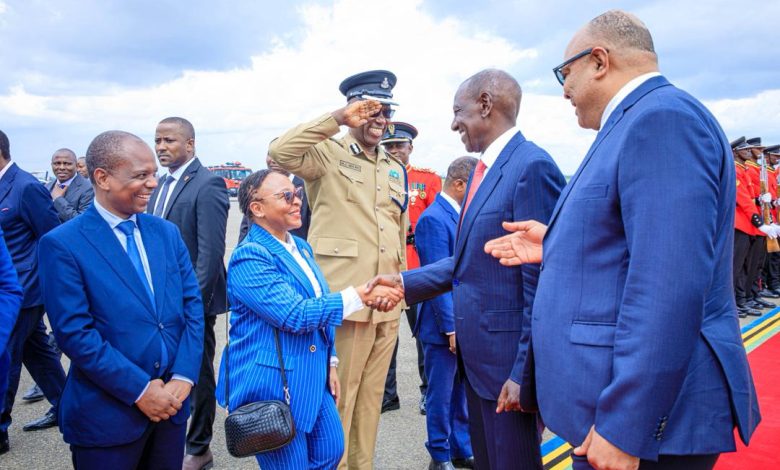
President Ruto’s itinerary in Tanzania is diplomatically simple, bilateral talks with President Samia Suluhu Hassan; the witnessing of the signing of agreements; participation in a Tanzania–Kenya business forum, and an address to the Parliament of Tanzania. Yet within these engagements lies a deeper logic.
Bilateral talks are the grammar of diplomacy, but agreements are its syntax turning intent into structure. The business forum shifts the center of gravity from state to market, recognizing that integration is ultimately driven not by communiqués but by capital, logistics, and enterprise. And to address Parliament is to speak not only to a government, but to a people to enter, however briefly, the civic imagination of another nation.
Taken together, these moments suggest a recalibration. Kenya and Tanzania are not merely managing a relationship; they are renegotiating its terms. In a region of eight nations, their partnership remains the hinge upon which much else turns.
The question, then, is not whether the visit will succeed in the narrow diplomatic sense. It almost certainly will. The question is whether it will move the relationship from familiarity to intentionality from shared borders to shared purpose.
Because in the end, East Africa’s future may well depend on whether its two closest siblings can learn not only to coexist, but to cohere.
Novatus Igosha is an Advocate of the High Court of Tanzania and a seasoned columnist for the Daily News, specializing in international affairs.
Mobile: +255 747 130 688
Email: norvum728@gmail.com