Performance in Beijing revives forgotten masterpiece
BEIJING: IN the late 1990s or early 2000s, many of us watched a wide range of films centred around combat — I, for one, was among them.
At the time, I was young. Some of the films were Asian, some specifically Chinese. I remember names like Bruce Lee, Jackie Chan, and Jet Li.
Naturally, I wanted to learn Taekwondo or Kung Fu. I gave it a go once during secondary school, but I can’t quite recall if I even lasted a full month. It demanded commitment, discipline, and time — all of which I struggled to give.
What I’m trying to say is: achieving such things is hard. Pain is part of the process. The names that stood out to me did so for good reason, and I respect that.
Though I didn’t witness martial arts or the figures I once admired during my visit to China, I did experience a different form of expression.
At the National Centre for the Performing Arts in Beijing, I had the chance to watch a two-hour performance — a poetic dance titled The Journey of a Legendary Landscape Painting.
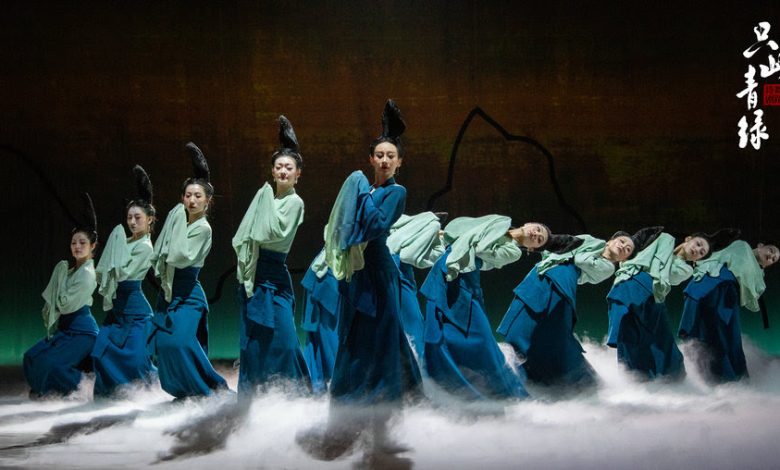
The China Oriental Song and Dance Troupe performed the choreographed portrait of a Panorama of Mountains and Rivers.
It was a stage performance that left me with a lasting impression. That night’s stage performance told a story about a man who painted a landscape of Chinese mountains in such a way that one could gaze at it and appreciate the art.
The painting had been there for years, and no one knew who drew it; the only thing one could do was to appreciate his or her creation.
Because no one knew who drew the painting or how was it done, or if it was he or she, no one knew because there was no painter’s signature to tell the story or claim credit; all that was left was for the painting to be referred to as a masterpiece created by an unknown person.
When the act took the stage at 8:00 p.m., the audience’s voices could be heard muttering and small laughter as well as friendly gestures after a long day.
However, the audience’s voices were cut off when the light went out, leaving the entire theatre dark and alerting the audience that the performance would soon start.
Eyes wide open, the curtains rise, and the stage moves to reveal a woman touched by the stage light, standing like a statue in a certain style. Her dress was blue, and she didn’t move.
As the show began, I found myself completely focused on the woman on stage. I didn’t even notice the other people near the front at first. Maybe it was the lighting—they were hidden in the shadows, barely moving. But then, as the light slowly touched them, they came to life. They started moving in slow, careful steps, like they were waking up from a dream. It took my breath away. All I could think was: Wow.
The performance told a story about a man and his struggles—how he worked day and night to create something important. Two main characters led the way: one dressed in modern clothes, the other in old, traditional robes. The woman who had introduced the play also wore traditional clothing, tying the whole scene together like a thread through time.
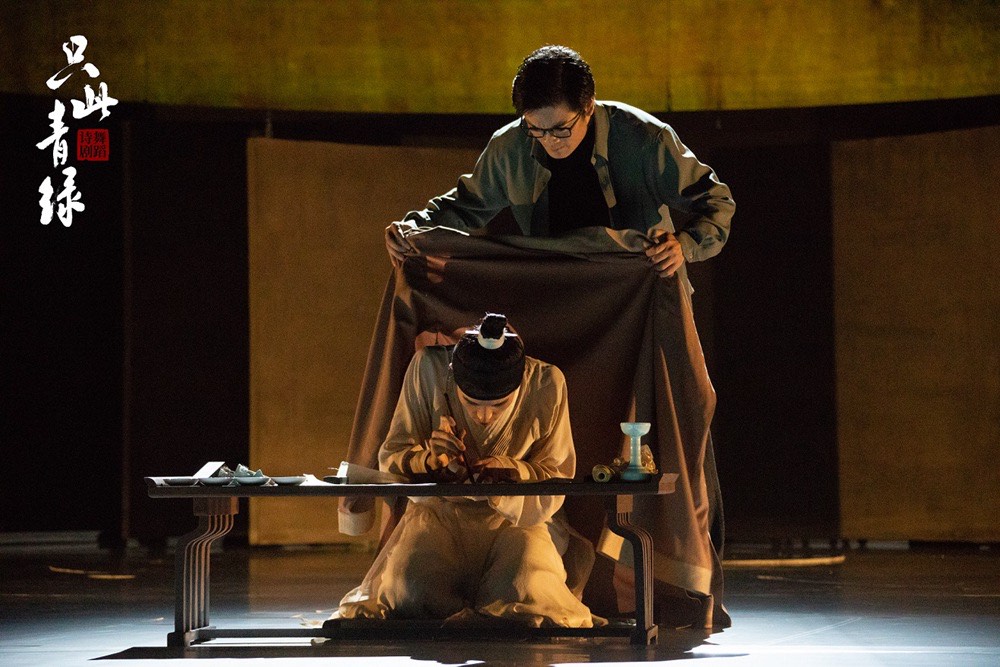
The story unfolded in pieces, showing how the man made a brush, painted on a scroll, and climbed a mountain in search of something. Each part was filled with feelings—excitement, confusion, joy. It wasn’t just a play—it felt like watching someone’s inner world come to life.
There was music throughout—sometimes soft, sometimes dramatic—but always there, like a heartbeat under the story. People spoke and moved constantly, with big gestures that pulled the audience in. It wasn’t the kind of play where you just watch; it made you feel like you were part of it.
Sometimes they danced, sometimes they played music. One moment, the stage showed mountains and birds flying across the sky. Next, it turned into a quiet living room with a stove. Everything flowed like a dream—full of colour, movement, and meaning.
The performance was not merely a spectacle of music and dance, nor a conventional display of dialogue—it was a living canvas, painted with movement, gestures, and expressive silence. Words were few, but emotions ran deep.
Laughter rippled through the audience at unexpected moments; a playful gesture, a clever joke, a comic stumble all choreographed with precision. There were scenes so tender, so stirring, that had I been more prone to tears, I might have wept. Yet I simply sat there—watching, smiling, laughing—completely immersed.
The stage itself became a character, breathing and shifting as scenes unfolded. After an opening led by graceful women in sweeping motion, the floor beneath them began to rotate, drawing us into a new world.
At the centre now stood a contemporary man, poised beside a scroll spread on a table.
As the lights dimmed and then flared, the stage spun in circles—perhaps four or five—each rotation revealing a fresh layer of the story. It was all in rhythm: lights, music, motion—each one intentionally illuminating what needed to be seen, and it was utterly captivating.
From this emerged the ancient man, seated with his own scroll. His joy in painting was evident in every line of his face, his quiet focus magnetic. Sometimes he walked alone, other times he painted in solitude at the centre of the stage. Around him, the world moved: women by the river, going about their daily chores, frozen at times like statues, then slowly coming to life as the stage revolved. The simplicity of their actions—drawing water, conversing in mime—became moments of profound connection.
Though the story was steeped in Chinese tradition, the lack of spoken language dissolved any cultural barriers. Gestures, expression, and atmospheric sound carried the tale. You heard the river’s murmur, the whistle of wind, the hum of daily life—each sound timed with precision to evoke place and emotion. At times, it felt less like watching a performance and more like stepping into it.As the action rose, so did the tension. The painter—once calm—became overwhelmed. Frustration boiled over. He struck his head, staggered in confusion; we felt his torment. A contemporary man in a costume made of grass entered, attempting to offer comfort, but the weight of creation had already begun to consume the painter. The heat of it—the pressure—was palpable even from the seats.
And then the release.
Dancers appeared—women in elegant flow, men with ancient gravitas—each bringing their own rhythm and energy. The stage divided, scenes played out simultaneously across different layers, creating a tapestry of old and new. The painter returned to the centre, this time with renewed energy. The stage turned again, but now it showed a world transformed: carpenters at work, builders, men and women in modern dress.
Time had shifted; the ancient had quietly given way to the present.
As the performance edged towards its end, a quiet murmur began. It wasn’t from the audience—it was part of the piece. After long stretches of silence and movement, these were the first human voices we heard. Then came a group of young people, approaching the front of the stage from all directions. They gathered around a display—was it a museum exhibit? A university showcase? It was unclear, but one thing was certain: they were learning, admiring, connecting with a work of art by a nameless painter.
ALSO READ: Russian-Tanzanian concert envisions the power of global artistry
The murmuring stopped. The two main characters reappeared—one ancient, the other contemporary in grass. They looked on, stunned, as the youth admired the painting. It was a moment heavy with meaning. You could feel their awe, their quiet joy. At last, their work—once hidden, once unrecognised—was being seen, valued, and loved by the future. Tears welled in the painter’s eyes. Tears of joy.
And then, the final reveal.
The painting unfolded: mountains, rivers, forests in brilliant greens—breathtaking in its detail and emotion. It was a landscape not just of nature, but of time, of labour, of legacy. I, too, found myself caught in admiration. The performance closed, but the feeling lingered—of beauty witnessed, of stories told in silence and of art that transcends generations.