

JK nails GPE’s 329.9m US dollars support for Tanzania’s quality education with school infrastructure a key priority
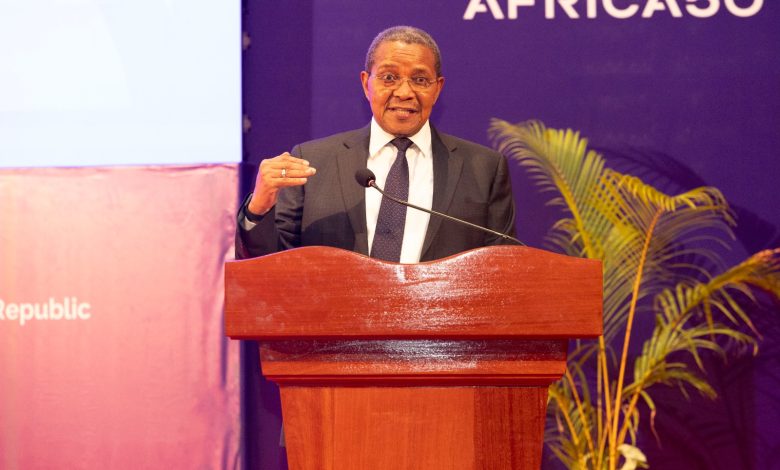
DAR ES SALAAM: THE former Tanzanian President, Dr Jakaya Kikwete, has stressed that access to quality education is the most critical investment for preparing Africa’s youth for future jobs, entrepreneurship and economic transformation.
Speaking at the Africa50 Annual General Meeting held at the Julius Nyerere International Convention Centre (JNICC) in Dar es Salaam, Dr Kikwete said Tanzania’s expansion of secondary education during his presidency was driven by the need to ensure that children who completed primary school could continue learning and acquire relevant skills.
“When I became president, only six per cent of children who completed primary school were able to join secondary school,” he said.
He explained that previous efforts had focused mainly on universal primary education, which increased enrolment to more than 98 per cent of school-age children, but secondary education had not expanded at the same pace to absorb the growing number of pupils completing primary school.
“We had to undertake the big task of making sure that these boys and girls who finish primary school and pass their examinations have a place in secondary school. But it is not only about being in school; it is about learning through quality education,” he said.
ALSO READ: Tanzania, Uganda sign MoU to bolster cooperation in energy sector
Dr Kikwete said the same conviction continues to guide his work as Board Chair of the Global Partnership for Education (GPE), where he is constantly reminded that building a productive workforce begins with strong foundational learning in pre-primary, primary and secondary education.
He noted that 270 million children worldwide are currently out of school, with 110 million of them in Africa.
“Of all the continents, Africa contributes the largest number of children who are not in school. And among those who are in school, many do not complete primary education or fail to acquire the skills expected at their level of education,” he said.
He called for stronger investment in science, technology, engineering and mathematics (STEM), modernization of technical and vocational education, and entrepreneurship training.
“Formal employment alone will not absorb all the young people entering the labour market,” he said.
Dr Kikwete recalled that when he graduated from university in 1975, employers came to recruit students directly, but today many graduates struggle to find jobs.
“That is the reality now. Entrepreneurship training is critical so that young people can establish their own businesses and earn a living,” he said.
He warned that Africa risks missing opportunities linked to the estimated 230 million jobs that will require digital skills by 2030 if education systems do not adapt quickly enough.
“Technology is changing rapidly. Jobs are being created, transformed and displaced at the same time. We must equip our young people with the skills that the job market requires,” he said.
According to Dr Kikwete, education systems should produce critical thinkers, problem solvers, innovators, teachers and entrepreneurs, while lifelong learning and adaptability have become essential in a fast-changing economy.
ALSO READ: Tanzania sees the signed energy MoU as strategic milestone to rake in 20bn US dollars investment
He said GPE supports low-income and lower-middle-income countries, including 44 African nations, by helping them integrate school infrastructure into broader education sector plans.
The support includes construction and rehabilitation of classrooms, provision of water and sanitation facilities, and development of climate-resilient and inclusive learning environments, particularly for girls, children from disadvantaged backgrounds and learners with special needs.
Dr Kikwete said GPE has committed 329.9m US dollars to support improvements in the quality of education in Tanzania since 2019, with school infrastructure remaining a key priority.
He commended the Sixth Phase Government under President Samia Suluhu Hassan for its continued commitment to expanding access to education and improving learning outcomes.
He said that in the 2024/25 and 2025/26 financial years alone, the government constructed 277 new secondary schools, 2,429 primary school classrooms, 930 pre-primary classrooms and 64 classrooms for learners with special needs.
More broadly, between 2021 and 2025, Tanzania built 2,441 new schools nationwide, including 1,399 primary schools and 1,042 secondary schools.
Dr Kikwete also noted that GPE has contributed to the provision of 36 million textbooks in Tanzania and emphasized that the partnership works according to priorities identified by the government rather than imposing external conditions.
“We do not dictate. Countries tell us the areas where they need support, and we work with them to deliver that support,” he said.
Отличная статья! Давно искал надёжного мастера, чтобы поменять проводку в квартире.
Как раз вовремя наткнулся на
ваш разбор услуг вызвать электрика недорого
— очень помогли советы по выбору
специалиста и расчёту стоимости.
Спасибо за полезный материал!