How SITT model is transforming education standards in schools
DAR ES SALAAM: THE School In-Service Teacher Training (SITT) model being implemented in several primary schools in the country has been commended by the government as a game-changer in helping pupils understand complex topics.
SITT model has 9 key elements, namely use of local materials, practice based learning, team teaching, peer learning, model lesson, pupil participation, health and environment, inclusiveness and formation of a SITT team at school.
This model is being applied to soften difficult topics in Mathematics, Science and Life Skills under the “Strengthening Teacher Professional Development and Mentorship (STPDM)” project which is simultaneously running in Tanzania, Kenya and South Sudan.
With funding from the International Development Research Centre in collaboration with Global Partnership for Education – Knowledge and Innovation Exchange (GPE KIX), the project is registering success on the ground as evidenced by performance improvement in project schools since the roll out of the initiative.
In Tanzania, the Dar es Salaam University College of Education (DUCE) is a leading partner of the project alongside HELVETAS Tanzania, while in Kenya, it is being implemented at Kibabii University and at the University of Juba in South Sudan.
The project aims at enhancing teachers’ capacity by generating and applying knowledge on effective teacher professional development, agency, and well-being, drawing on the SITT model.
It is a 30-month research initiative (July 2024 – 31st December 2026) targeting 21 Teachers’ Colleges (7 in Tanzania, 7 in Kenya, and 7 in South Sudan) and 105 Primary Schools (35 in Kenya, 35 in Tanzania, and 35 in South Sudan): each Teachers’ College has to mentor 5 primary schools.
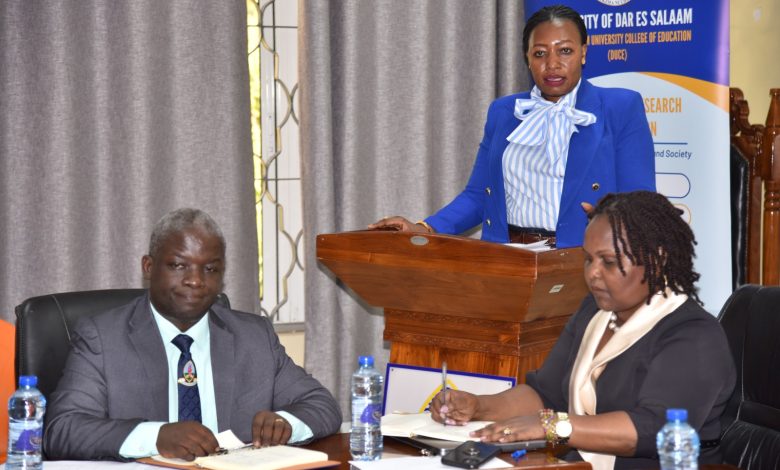
However, as part of assessing the project’s efficiency, the Dar es Salaam University College of Education (DUCE) recently organised a fruitful one day Learning and Sharing Workshop that was aimed at hearing from teachers picked from five primary schools located within Temeke District in Dar es Salaam on how they have been implementing the project.
In his opening remarks, DUCE Acting Principal Prof Amani Lusekelo commended the college’s staff members who are part of the team implementing STPDM project in the country.
“What you are doing on the ground is great… continue to work hard to fulfill the objectives of this project and be assured that we will always be available for any support or collaboration from us.
“We have gathered here to hear from teachers on how they have been implementing the project in schools. We also want to hear from Ward Education Officers (WEOs) and other Local Government Authorities (including school quality assuarers) about how they have been supervising the project’s implementation.
“Project members will also present the midline evaluation findings as part of follow up on how the project is implemented. They will deliberate on the way forward, including the reporting formalities, the need to scale the project to other schools, and how to ensure its sustainability after the project timeline.
“They conducted the baseline study and provided training to tutors, local government authorities, Five Heads, and 15 teachers from the five project schools (Madenge Primary School, Temeke Primary School, Kibasila Primary School, Chang’ombe Primary School, and Mgulani Primary School) in May 2025,” Prof. Lusekelo said.
On her part, Assistant Director Planning and Budgeting in the Ministry for Education, Science and Technology and GPE Focal Person (Tanzania), Ms Upendo Sianga urged teachers who have benefited from the project to expand it.
“I am happy to see that this project is stamping success on the ground but unfortunately, only few teachers have been reached as such, those who are beneficiaries should think of expansion by training their colleagues in nearby schools.
“This will help many teachers to learn the fundamentals of the project (SITT model) hence helping pupils to do well in their classes…this is what the government would like to see happening,” she said.
She also insisted that government will continue to play a pivotal role in advancing quality education in the country and that projects like STPDM have to be fully supported in order to bear tangible results.
STPDM Principal Investigator (PI) Dr Katherine Fulgence revealed that many positive impacts are being recorded as the project continues to be implemented in project schools.
For instance, she said the teaching confidence of many teachers has been improved, a thing she said is leading to high performance rate among pupils.
“The level of performance of pupils in project schools is going up in comparison with the period before the project and this is a clear indication that progress is being made.
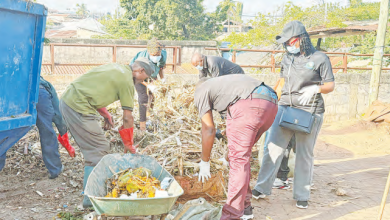
“Also, the SITT model is supporting to upgrade school environment as pupils engage in cleanliness activities that lead to good looking of the surrounding environment hence, in regard of this, we have no other option other than calling it a big success,” she said.
She further pointed out that in the project schools, teachers are liking much their profession as teaching has been simplified with the use of the model while, at the same time, pupils attendance at school is encouraging.
Moreover, the PI noted that they are urging teachers who have benefited from the project to find amicable ways to expand its scope in order to equip more teachers with the game changing model.
STPDM’s Gender Equality and Social Inclusion (GESI) and Advocacy (Focal Person) Prof. Florence Kyaruzi reiterated that SITT model intends to capacitate teacher competency in teaching using local available resources through promoting peer and collaboration learning.
He added that DUCE being the leading partner of the project is a testimony that they implement several interdisciplinary projects aimed at addressing societal challenges.
“We are inviting other partners to team up with DUCE to curb national and international problems…like in this project, we are partnering with a university from Kenya and the other in South Sudan…this is how being multidisciplinary college looks like,” he said.
Furthermore, he seized the moment to request stakeholders, donors and funders to partner with DUCE researchers and academicians for the same of accelerating together different projects and solve problems in the process.
In another development, the STPDM Project Communication Officer, Dr. Patrick Kavenuke called on the government to consider the possibility of integrating SITT model into the national curriculum.
ALSO READ: Govt advances education reforms
He also insisted on the project schools to ensure that they put practicable mechanisms such that when the project’s timeline is over, they should continue implementing its objectives without seizing.
“I was impressed with one of the presenters [teacher] who said they have compiled a project file at their school, meaning that if the current Head of the school is transferred to the other school, then the new one will find the project file on the table and continue implementing the project.
“As project members, we have already done our part, of course, we will continue doing the mentorship to these project schools. As we mentor them, we are now requesting project schools to scale it to nearby schools for the sake of sustainability and increasing beneficiaries,” he said.
One of the beneficiaries, Kakolwa Mteza, a teacher at Madenge Primary School in Dar es Salaam labeled the project as impactful saying it has equipped them with modern teaching techniques that makes it easy for pupils to understand.
“Before the project, we lacked some critical methods of simplifying teaching but now, after the training, we have acquired important skills that are making us to teach at ease and pupils are enjoying the lessons,” he said.