How lunar eclipse unfolds today
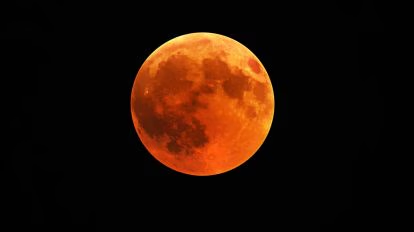
TANZANIA: TANZANIANS will today join billions of people worldwide in witnessing a rare total lunar eclipse that will begin at sunset, with residents across the country expected to see the Moon gradually darkening and turning red.
Astronomers describe the phenomenon as one of the most remarkable celestial events, noting that more than 80 per cent of the world’s population will have the opportunity to observe it simultaneously.
The next comparable spectacle is not expected for another seven years.
Speaking exclusively to the Sunday News, Tanzanian astronomer Dr Noorali Jiwaji explained that while the eclipse will be most dramatic along the coast, residents in the country’s interior will also enjoy a clear view.
Dr Jiwaji, a senior lecturer in Physics at the Open University of Tanzania (OUT), said the timing of the event is favourable, taking place in the evening under expected clear skies.
“This is a unique opportunity for Tanzanians to observe the Moon completely covered, glowing in a dark red colour. Such favourable conditions will not occur again until October 18, 2032,” he said.
He emphasised that no special equipment is required to witness the eclipse. “Everyone should step outside their homes and watch with the naked eye. It is safe and spectacular,” he encouraged.
Explaining the science, Dr Jiwaji said a lunar eclipse occurs when the Moon passes through the Earth’s shadow. The darkest part of the shadow, known as the umbra, creates the total eclipse, when the Moon appears completely covered.
According to astronomical projections, the event will unfold in several phases. The penumbral phase, where a faint shadow appears, begins at 6:28 pm.
A partial eclipse will follow at 7:27 pm, leading to the full eclipse at 8:31 pm. The maximum eclipse, when the Moon is entirely covered, will occur at 9:12 pm and last until 9:53 pm.
ALSO READ: Tanzania to experience total lunar eclipse on Sunday
Thereafter, the shadow will gradually fade, with the partial eclipse ending at 10:56 pm and the penumbral phase concluding at 11:55 pm. Dr Jiwaji encouraged the public, particularly young people, to observe and appreciate the natural spectacle, noting that astronomy helps inspire scientific curiosity.