From midfield war to last-gasp penalty: Derby settled late
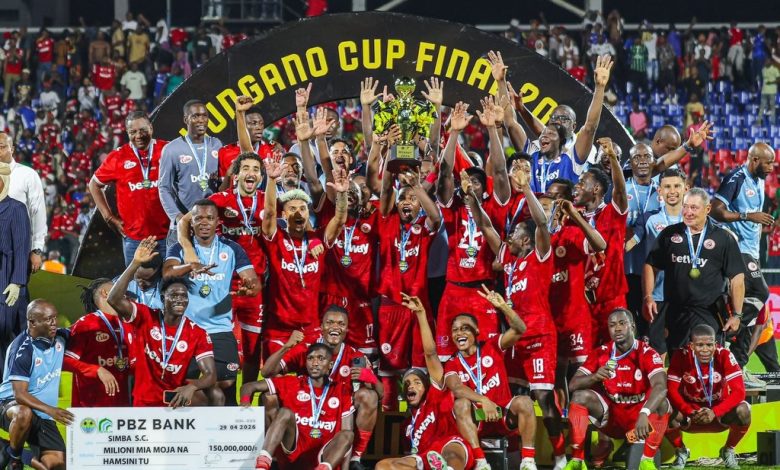
DAR ES SALAAM: THE Union Cup did not offer a gentle path to its final. From the opening round, it demands immediacy. Each match is an elimination, each performance a statement that must stand on its own. There is no second leg, no gradual correction, only progression or exit.
By the time Simba SC and Young Africans SC arrived at the final, they had already revealed much about themselves, not through declarations but through patterns of play established under pressure. Simba’s journey had been one of patience and delayed assertion. Their opening encounter against Mafunzo remained unresolved until the second half, when structure gave way to incision and a single goal from Selemani Mwalimu proved sufficient to earn a 1-0 win.
That same rhythm carried into their meeting with Mlandege, where a restrained first half gave way to a more decisive second period that produced three goals. Every goal Simba scored on their route to the final arrived after the interval. It wasn’t just a statistical quirk, but a window into their approach.
Simba were a side that preferred to let matches unfold before asserting control. Their tactician, Steve Barker, often started games with a false nine, while rotating his lineup, frequently leaving regular starters on the bench to be introduced in the second half.
The final, however, proved an exception to that pattern. Young Africans travelled along a different line. Their opening performance against Mwembe Makumbi City FC was decided early, three goals arriving before the break and a fourth reinforcing control later.
Against Azam, they again shaped the match in the first half, scoring twice before the interval and managing the remainder with composure. Where Simba preferred patience, Young Africans preferred immediacy. The final, however, refused both identities.
Where the final was truly played
If the narrative of the final appears to rest on a late penalty, the reality is that it was shaped much earlier, in a space that rarely produces headlines.
The midfield became the true site of the contest, not simply as a channel of transition but as a zone of control where both sides attempted to impose their identity. At the centre of this were Mohammed Damaro and Yusufu Kagoma, whose performances redefined the rhythm of the match. Their presence did not allow the game to breathe.
Every attempt to construct an attack was met with immediate resistance and every forward pass was questioned before it could develop. What emerged was not fluid football, but a contest of interruption, where progress depended less on creativity and more on persistence.
The scale of physical engagement reinforced this. With more than forty fouls committed, the match carried a level of intensity that bordered on constant disruption.
Yet the referee’s decision to issue only a single yellow card, shown to Prince Dube, ensured that the physical nature of the game remained largely unchecked. This approach did not diminish control, but it encouraged confrontation.
Players committed to challenges, knowing that the threshold for punishment remained high, and the result was a midfield battle that functioned as both shield and barrier for each side. Within such a structure, clear chances were always likely to be rare, which is why the moments that did emerge carried such weight.
Structure without flow
Both sides attempted to impose their attacking patterns, yet neither was able to sustain them. Simba sought to expand the field before narrowing their approach, while Young Africans alternated between controlled build-up and moments of acceleration. Each method encountered the same obstacle: a defensive structure that remained compact and responsive. The match progressed in fragments. A forward movement would begin, only to be halted by a well-timed challenge. A pass would approach its target, only to be intercepted at the moment it seemed most promising. Shots, when they came, were often delayed just enough to be blocked or redirected. This was not a match lacking effort, but one in which effort rarely translated into continuity.
Moments that carried the weight of the final
Within a match defined by interruption, individual moments assumed greater significance. They appeared briefly, often without warning and disappeared just as quickly. In the nineteenth minute, Simba appeared to have found a breakthrough. The movement developed quickly, creating a pocket of space inside the penalty area where Ancient Oura positioned himself to strike. For a brief instant, the sequence seemed complete.
The preparation was right, the angle inviting, the expectation immediate. Yet the moment did not belong to the attacker. Yao Kouassi intervened with precision, closing down the space and executing a challenge that denied the shot at the point of release. It was not merely a defensive action; it was a reassertion of control in a match where control was constantly contested.
Such interventions defined the defensive discipline of both sides. When opportunities did arise, they were often met by equally decisive responses.
This was evident when Maxi Nzengeli struck a low volley that carried genuine threat. The attempt demanded accuracy in response and Mahamadou Djibrilla Kassali provided it. His save was measured rather than dramatic, but within the context of the match, it carried significant value. In a game where chances were limited, each one became critical.
As the match moved towards its closing stages, the tension shifted from control to anticipation. It was no longer a question of whether chances would come, but whether one would be taken. In the eightyseventh minute, Young Africans were presented with that possibility. A direct ball from Bakari Mwamnyeto bypassed the congested midfield and found Laurindo Aurélio (Depu) in space inside the penalty area.
The situation was as clear as the match had allowed. Unmarked, balanced and with time to choose his finish, he represented the moment where control could finally turn into outcome. The shot went wide. It was not simply a missed opportunity; it was a shift in the emotional direction of the match. For a brief moment, it felt as though the final had revealed its conclusion, only to withdraw it again.
ALSO READ: Makonda calls for fairness and efficiency in officiating Tanzanian football matches
In contests of this nature, such moments do not disappear. They remain, shaping the perception of everything that follows. What this sequence of events ultimately revealed was a match defined not by sustained attacking play, but by isolated incidents that carried disproportionate significance.
The midfield battles limited creation, the defensive organisation restricted space and the few chances that emerged required precision that neither side consistently delivered. In that sense, the final was always moving towards a conclusion that would come from a moment rather than a pattern. The structure of the match made that outcome almost inevitable.
The moment that decided everything
For long periods, the final seemed destined to remain unresolved by open play. It required a different kind of moment, one shaped not by construction but by incident. That moment arrived deep into extra time. Clatous Chama moved into the penalty area with intent, drawing a challenge from Edmund John that proved mistimed.
The contact was enough. The referee pointed to the spot and in a match defined by restraint, the decision introduced sudden clarity. Responsibility fell to Selemani Mwalimu. He had scored in every round leading to the final, each goal contributing directly to Simba’s progression. Now, he faced Djigui Diarra, with the outcome of the final resting on a single strike. There was no hesitation in the approach.
The run was measured, the contact clean, and the direction precise. The ball beat the goalkeeper and settled beyond reach. After a match built on denial, interruption and resistance, it was a moment of execution that finally separated the two sides.
The referee’s line and its consequences
The officiating added another layer to a match already defined by confrontation, the force that was led by the Kenyan referee Dickens Nyagrowa. With over forty fouls committed and only a single caution shown to Prince Dube, the referee set a high threshold for physical engagement. Rather than fragment the game through frequent disciplinary action, he allowed challenges to stand, shaping a contest where contact became part of the rhythm rather than a disruption to it.
This approach had a direct impact on the midfield battle, particularly in the exchanges involving Mohammed Damaro and Yusufu Kagoma, where repeated duels were permitted to continue without escalation. There were moments that might, under a stricter interpretation, have resulted in fouls or cautions, yet the consistency of the referee’s tolerance ensured that players adapted quickly.
The result was a match that operated on the edge of physicality without tipping into disorder, though not without leaving questions about where exactly the line had been drawn.
Recognition beyond the result
Simba’s victory did more than secure the trophy; it brought them level with Young Africans on seven Union Cup titles, reinforcing the enduring balance between the two rivals. Individual recognition followed performances that had shaped the competition. Steve Barker was named best coach, his management reflecting the structured progression that defined Simba’s campaign.
Hussein Mbegu was recognised as the tournament’s best young player, while Selemani Mwalimu claimed the golden boot with three goals, each scored in separate matches. Rushine De Reuck was awarded the most valuable player, his influence extending across defensive and transitional phases in a manner that shaped outcomes beyond visible statistics.
A final defined by margins
In tactical terms, the final presented consistency without culmination. Simba maintained their measured approach, yet required a set-piece moment to translate control into victory. Young Africans demonstrated their ability to create decisive situations, but not the execution required to complete them. Beyond tactics, the psychological dimension shaped the closing stages.
Familiarity reduced unpredictability and with it came caution. Decisions became measured, risks were managed and the emphasis shifted subtly from creating a defining moment to avoiding a decisive mistake. What remained was a match built on control and contact, where midfield determined territory and defence ensured survival.
It was not defined by continuous action, but by isolated moments that carried disproportionate weight. In the end, the Union Cup final was decided not by a sequence, but by a single action. A challenge, a whistle, a strike. And where so much had been resisted, one moment was finally allowed to stand.