NEVER AGAIN: Five days of chaos, years of recovery, lesson well learnt

DAR ES SALAAM: SUSTAINABLE development cannot take root in an atmosphere of fear and disorder. Peace and stability are the foundation upon which citizens build livelihoods, businesses invest with confidence, and institutions function effectively.
When violence erupts, normal life grinds to a halt, and people are driven from productive pursuits to mere survival. The events of October 29, 2025, illustrate the steep cost a country bears when unrest takes hold. The disturbances paralysed key sectors of the economy, disrupted transport services, discouraged investment and led to the destruction of valuable assets.
Several workers lost their sources of income after their vehicles were set ablaze, while businesses incurred substantial losses as properties and investments were damaged.
Some Dar es Salaam residents who spoke to the ‘Daily News’ explained why Tanzanians should always protect the country’s peace and refuse to be drawn into violence again.
Mr Deodatus Kajilo, a minibus driver, said he was unable to operate for a week following the unrest in the city. Mr Kajilo, who plies the Mbezi Mwisho– Bagamoyo route, explained that remaining indoors for seven days severely affected his financial situation and that of his family.
He noted that the disruption dealt a heavy blow to his livelihood, as he could not work or earn income to support his household.
“Drivers make money when they are on the road. Being forced to stay at home made it extremely difficult for me to provide for my family and meet our daily needs,” he said.
He added that businesses were slow to recover, as vehicle owners and other investors became increasingly cautious about the safety and security of their assets.
“The October 29 violence affected us deeply. My coaster was locked in the yard, making it very difficult for me to work and earn a living,” he said.
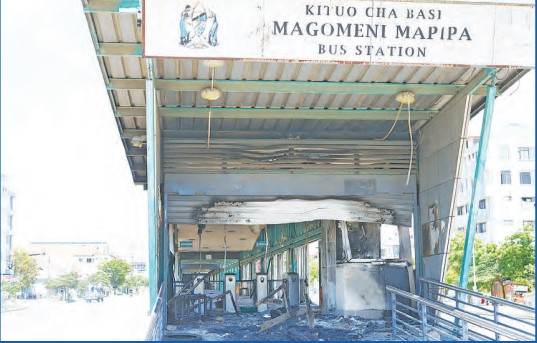
damaged and burned during the unrest on 29 October 2025.
He explained that the chaos left a trail of devastation for local entrepreneurs, bringing many businesses to an abrupt halt. Shops, markets and small enterprises that normally buzzed with activity and commerce were suddenly silenced, leaving owners helpless as days of hardearned income vanished.
Mr Juma Fungo, a daladala driver operating between Tandika and Tabata, explained that his business was disrupted for almost five days due to the unrest. He said there were no passengers on the roads, forcing the daladala to remain idle until life returned to normal.
“As a daladala driver, there was no business for almost five days. Even the daladala owners were hesitant to let their vehicles operate,” he added.
From drivers, poultry farmers to fruit vendors, butcher shop owners to market traders, countless businesspeople faced losses that ran into millions of shillings, as the uncertainty and unrest made it impossible to operate.
For many, the dream of steady earnings and financial stability turned into a nightmare of empty shelves, unsold stock and mounting debts. Most of these entrepreneurs, who were servicing loans, found themselves at a crossroads when they were unable to operate as planned.
ALSO READ: 20bn HEET project: UDOM pushes for early completion
The situation was particularly severe for poultry farmers, butcher shop owners, fruit vendors and others dealing in perishable goods. Mr Dismas Sanga, a poultry farmer, told the ‘Daily News’ that within just five days, he had suffered losses worth millions of shillings.
Appearing visibly distressed, Mr Sanga said the October 29 unrest would remain unforgettable in his entrepreneurial journey. He explained that poultry farming often comes with the usual challenges that farmers have learned to manage over time.
However, he said that what happened in October last year was unprecedented, and no one was prepared to deal with such a situation.
“I remember I was supposed to start selling my chickens on October 30, but suddenly the unrest broke out on October 29. My customers, who had already planned to pick up the chickens early in the morning of October 30, could not do so, and I was left with all my chickens,” Mr Sanga said.
He added, “Those who keep chickens will understand me better, they need to be fed and taken care of. So, when the time to sell passes, it directly translates into financial losses. That is exactly what happened to me.” Mr Sanga explained that keeping the chickens that were supposed to have been sold cost him around 300,000/- per day.
Fortunately, he had a stock of chicken feed, but it was intended for new chicks he planned to bring in after selling the existing stock. Because he couldn’t sell the chickens on time, he had to continue feeding the adult birds, which represented a significant financial loss.
He said the situation got so dire that he started calling relatives to see if they wanted to buy chickens, but most were unwilling to place orders.
“The situation was very bad people were afraid to go outside. Even if they wanted to buy, transporting the chickens was extremely difficult as there was no road transport and people feared venturing out,” he said.
He added that many of his regular customers were unreachable by phone, and those who answered said they could not collect the chickens because their workplaces were closed at the time.
“All bars, nightclubs, cafeterias and restaurants were closed, which meant losses for most of us,” he said. He further explained that most of his customers normally collect chickens using motorcycles, but during the unrest, all of them were too afraid to go out.
On his part, Mr Benard Mcharo, who ran a fish butchery at Mbezi Mwisho, described how the violence following the October 29 election completely destroyed his business, wiping out his capital after the fish he had brought in from Mwanza was left unsold for five days. He recounted how his entire investment vanished almost overnight.
“When the violence broke out, we had to flee for our lives. Some of us didn’t even have a chance to leave the butchery in good order. I left fishes on the table because there was no time, and you can imagine how tense and chaotic the situation was. Five days later, I returned to find fishes completely rotten,” he said.
Mr Mcharo said the financial impact was devastating. He is now facing enormous debts after being unable to repay loans, compounded by the total loss of his business stock. The experience, he said, was a harsh reminder of the fragility of livelihoods in times of unrest.
He emphasised that the October violence should never be repeated and called on all Tanzanians to recognise that peace is the foundation of everyday life and progress.
“I am asking my fellow Tanzanians to avoid such kind of incidents in future, let this never happen again. Let all of us say ‘never again’ to violence. No one can engage in productive work or drive progress when the country is unsettled and peace is absent. I have learned many lessons from last year’s unrest, and I believe most of us have. We must all become vigilant guardians of peace in our country,” he said.
He called on leaders at all levels to strengthen their engagement with citizens, particularly young people, by giving serious attention to their grievances. Many Tanzanians continue to grapple with pressing challenges such as unemployment, poverty and inadequate access to basic services, including reliable water supply.
Mr Mcharo stressed that these concerns must be addressed proactively to prevent growing frustration from escalating into instability, as witnessed last October. He further appealed to young people to exercise restraint and think critically before taking action, emphasising that the events of October last year yielded no meaningful gains but instead resulted in tragic loss of life and widespread destruction of property.
ALSO READ: Name, shame corrupt officials stealing our future
“We lost our brothers and sisters. Our businesses were destroyed, our capital wiped out and our sources of income severely affected. Meanwhile, financial institutions continue to demand loan repayments. Many of us are no longer able to support our families as we once did. Recovery will be a long and difficult process, and for some, the losses may never be fully restored,” he said.
Moreover, Ms Asia Rashid, a fruit vendor at Buguruni, said the violence that erupted on October 29 last year completely wiped out her business, leaving her without any capital to restart.
She explained that the unrest came at the worst possible time, as she had just received a large consignment of fresh fruits including watermelons and tomatoes, from her suppliers, stock she had purchased through borrowed funds and personal savings. Ms Rashid said she had not planned to operate on October 29, believing it would be a quiet day.
As a result, on October 28 she carefully packed and stored her fruits, intending to reopen her stall on October 30. However, her plans were abruptly disrupted when violence broke out, making it impossible for her to leave her home. Roads were blocked, movement was restricted, and the security situation became dangerously tense.
“I only managed to return to the market after five days, and honestly, I could not believe what I saw,” she recalled. She added: “Everything had rotted. All the fruits were spoiled, and the entire market was filled with a terrible smell. I couldn’t bear the sight. I went back home crying. Up to now, I am struggling, moving from place to place, trying to find capital so that I can stand on my feet again.” She said the experience was not only financially devastating but also emotionally draining, as her livelihood depended entirely on daily sales.
Without income during those days, basic household needs became difficult to meet. Ms Rashid urged Tanzanians to ensure that the events of October 29 are never repeated, emphasising that low-income earners and small traders suffer the most whenever peace is disrupted.
“Some of us survive by going out every single day to earn just enough to buy food and take care of our families, when chaos erupts, there is no movement and no business. That simply means starving,” she said.
She added that women entrepreneurs were among the hardest hit by the unrest, noting that many food vendors lost their entire capital and were forced to shut down their businesses.
As a result, many are now burdened with debts owed to savings groups and financial institutions, with little hope of immediate recovery. “We are appealing to all Tanzanians to come together and say no to violence. Peace is the only foundation on which small businesses like ours can survive and grow,” she said.
Earlier, speaking to the ‘Daily News’ some community leaders and social political analysts warned that unrest undermines both social cohesion and economic development.
The Coordinator of the Tanzania Human Rights Defenders Coalition (THRDC), Mr Onesmo Olengurumwa, said the country should avoid a repeat of the violence and unrest witnessed on October 29, highlighting that lasting solutions require dialogue, accountability and respect for the law. Mr Olengurumwa said that all political parties, both in government and in opposition, have a crucial role in ensuring peace and political stability.
“Those in power have a responsibility to strengthen systems, uphold justice and create platforms for dialogue. Opposition parties have a duty to demand rights through legal means and guide their supporters to follow the law.
Parties are not enemies; they are political competitors who must coexist for the benefit of the nation,” he said. He also stressed that Tanzania’s Constitution recognises the right of citizens to demonstrate, but this right must be exercised within legal frameworks, peacefully and responsibly. “Global experience shows that when protests are properly led and managed, they promote accountability without disturbing peace,” he added.