Empowering women and advancing sustainability
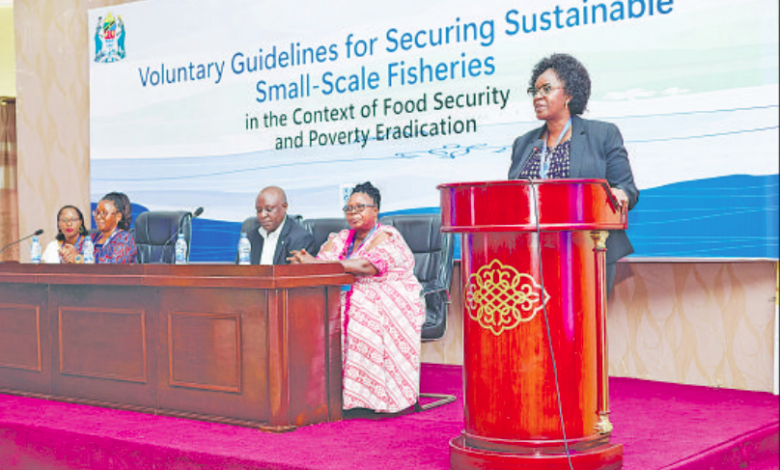
DAR ES SALAAM: TANZANIA has once again positioned itself as a regional leader in sustainable fisheries and gender inclusion by hosting a high-level international learning exchange on the implementation of the Food and Agriculture Organisation Small-Scale Fisheries (SSF) Guidelines.
The event, organised in collaboration with the Ministry of Livestock and Fisheries, brought together experts, policymakers and fisherfolk from across Africa and Asia to share practical experiences and scalable solutions.
Delegations from Ghana, Uganda, Namibia, Madagascar and the Philippines joined Tanzanian stakeholders in Mwanza, a city strategically located along Lake Victoria, one of Africa’s most productive inland fisheries.
The exchange aimed to deepen knowledge on sustainable fisheries management while highlighting the importance of empowering women, who form a significant portion of the sector’s workforce but have historically faced systemic barriers.
The SSF Guidelines, formally known as the Voluntary Guidelines for Securing Sustainable Small-Scale Fisheries, were endorsed in 2014 by FAO member states to promote food security, poverty eradication and sustainable resource management.
According to the Food and Agriculture Organisation (FAO), small-scale fisheries contribute nearly half of global fish catches and employ more than 90 per cent of the world’s capture fisheries workforce, with women playing a critical role particularly in post-harvest activities such as processing and trading.
Opening the forum, Permanent Secretary in the Ministry of Livestock and Fisheries, Agnes Kisaka Meena, reaffirmed the government’s commitment to transforming the sector through evidencebased policies and inclusive partnerships.
She said Tanzania has made deliberate efforts to domesticate and implement the SSF Guidelines, working closely with FAO, non-governmental organisations and development partners.
She pointed to the establishment of the Tanzania Women Fish Workers Association (TAWFA) in 2019 as one of the country’s most notable milestones.
The association, launched by the ministry with financial and technical support from the Food and Agriculture Organisation, was created to address long-standing inequalities faced by women in fisheries.
“The creation of TAWFA was a major step forward in recognising and supporting the vital contribution of women in fisheries. Today, TAWFA has grown into a powerful voice for women, improving livelihoods and strengthening resilience across communities,” she said.
Globally, FAO data shows that women account for about 21 per cent of fishers and over 50 per cent of workers in the post-harvest sector.
In many developing countries, including Tanzania, women dominate fish processing and marketing but often lack access to finance, modern technology and decision-making platforms.
Tanzania’s approach, participants heard, is helping to close these gaps. Among the key achievements highlighted during the exchange is the government’s institutional commitment to gender equality within the fisheries sector.
The establishment of a dedicated Gender Desk within the ministry has ensured that women’s needs are systematically integrated into policy development and implementation.
This aligns with FAO recommendations that call for gender-responsive governance structures to enhance equity and sustainability. TAWFA’s rapid growth since its inception has also attracted international attention.
The association has expanded across multiple regions, supporting thousands of women through training programmes on improved fish handling, value addition and entrepreneurship.
These interventions are consistent with FAO findings that capacity-building in post-harvest processes can significantly reduce losses, which in sub-Saharan Africa are estimated to reach up to 30 per cent of total fish production due to poor handling and preservation methods.
The introduction of improved, energy-efficient technologies has further transformed the sector.
Modern fish smoking kilns and solar drying systems introduced under FAO-supported initiatives have improved product quality, reduced health risks associated with traditional smoking methods and minimised environmental degradation caused by excessive use of firewood.
FAO studies indicate that such technologies can cut fuel consumption by up to 50 per cent while increasing profitability for small-scale processors.
Financial inclusion has also improved significantly, particularly for women engaged in fisheries-related businesses.
Through Village Community Banks (VICOBA) established under various programmes, women are now able to access savings and credit services that were previously out of reach.
Access to finance remains one of the biggest challenges in small-scale fisheries globally, with FAO noting that limited collateral and formal banking barriers often exclude women from financial systems.
In addition to economic empowerment, Tanzania has strengthened community based governance systems.
Beach Management Units (BMUs), which are community-led institutions responsible for co-managing fisheries resources, have been equipped with skills and tools for monitoring, enforcement and sustainable practices.
According to FAO, comanagement approaches like BMUs are essential for ensuring compliance with regulations and promoting longterm resource sustainability.
FAO Assistant Representative Charles Tulahi commended Tanzania for its progress, noting that the country’s experience offers valuable lessons for other nations seeking to operationalise the SSF Guidelines.
“Tanzania’s experience demonstrates the strength of community-driven action backed by government leadership and development support,” he said.
ALSO READ: Empowering women with ECP knowledge
TAWFA Chairperson Beatrice Mbaga shared testimonies of change from women on the ground, saying the interventions have improved both livelihoods and dignity.
“We have improved fish quality, reduced post-harvest losses and increased our income. Through VICOBAs, we now have financial independence and stronger economic resilience,” she said.
The broader impact of such initiatives extends beyond income generation. Fisheries remain a critical source of nutrition, particularly in developing countries where fish provides essential proteins and micronutrients.
FAO highlights that sustainable management of small-scale fisheries is vital for achieving global goals such as food security, poverty reduction and climate resilience.
Participants at the Mwanza forum also discussed emerging challenges, including climate change, overfishing and pollution, which continue to threaten aquatic ecosystems.
Lake Victoria, for instance, has experienced declining fish stocks due to a combination of environmental and human pressures, underscoring the need for coordinated regional responses.
As the learning exchange concluded, stakeholders expressed optimism that the knowledge shared would inspire similar initiatives in their respective countries.
The forum is expected to strengthen South-South cooperation and accelerate the adoption of inclusive, sustainable fisheries practices globally.
By placing women at the centre of fisheries transformation and embracing community-led governance, Tanzania is demonstrating that sustainable development is achievable when policies, partnerships and people are aligned.
The lessons from Mwanza not only highlight national progress but also contribute to a growing global movement to ensure that small-scale fisheries are both equitable and resilient for generations to come.