DSE records weekly decline amid foreign investor selling
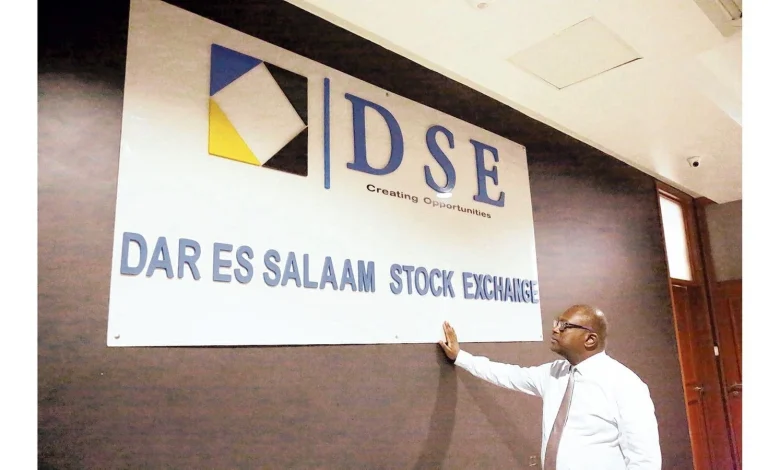
DAR ES SALAAM: THE DSE recorded a relatively subdued performance during the week ended November 13th this year, with key market indicators registering declines compared to the preceding week.
Total equity market turnover declined by 3.76 per cent, reaching 36.02bn/- from 37.43bn/- recorded in the week ended 6th November this year.
Similarly, the volume of shares traded decreased by 10.21 per cent to 17.80 million shares, down from 19.82 million shares in the previous week.
The decline in both turnover and trading volume points to a moderation in market activity.
Foreign investor activity continued to reflect net selling pressure, with the market recording a net foreign outflow of 13.44bn/- during the week, compared to an outflow of 18.50bn/- in the preceding week.
This represents a 27.36 per cent reduction in the magnitude of net foreign outflows, indicating some moderation in foreign selling activity.
Nevertheless, the continued negative net flow highlights the persistence of foreign investor divestment from the market, which remains an important factor influencing overall liquidity and price movements in selected counters.
The overall market capitalisation declined slightly by 1.10 per cent, closing the week at 37.72tri/- compared to 38.14tri/- recorded in the previous week. Domestic market capitalisation also registered a decline of 1.86 per cent, settling at 25.88tri/- from 26.37tri/-.
The relatively larger decline in domestic market capitalisation suggests that domestic-listed counters experienced some downward price adjustments during the period.
Meanwhile, ETF market capitalisation remained relatively stable, recording a marginal decline of 0.12 per cent to 233.76bn/- from 234bn/-.
Foreign investor activity continued to reflect net selling pressure, with the market recording a net foreign outflow of 13.44bn/- during the week, compared to an outflow of 18.50bn/- in the preceding week.
VODA emerged as the leading counter by turnover during the week, accounting for 37.70 per cent of total turnover, with transactions valued at 13.57bn/-. CRDB with 10.03bn/-, representing 27.87 per cent of market turnover.
On the performance front, MBP emerged as the best-performing counter, appreciating by 5.26 per cent to close at 2,000/- per share. NMG followed with a gain of 7.75 per cent to close at 290/- per share, while VODA advanced by 1.59 per cent to 1,280/-.
Conversely, TTP recorded the largest decline, shedding 17.57 per cent to close at 305/-Vodacom Tanzania Profit Surges 183 per cent to 117.8bn/-.
Vodacom Tanzania recorded a significant improvement in financial performance, with net profit increasing by 182.7 per cent to 117.8bn/- for the six months ended September this year.
The growth was supported by a 20.8 per cent increase in service revenue to 1.067tri/-, with M-Pesa revenue rising 26.2 per cent to 443.3bn/- and mobile data revenue growing 24.6 per cent to 319.2bn/-.
EBITDA increased by 33.1 per cent to 425.8bn/-, while the EBITDA margin improved to 39.5 per cent. The company also declared a final dividend of 23.91 per share, amounting to approximately 53.6bn/-.
The strong earnings performance highlights the growing contribution of digital financial services, mobile money and data consumption to Vodacom’s profitability.
Improved earnings and cash generation strengthen the company’s capacity to reward shareholders through dividends while continuing to invest in network infrastructure and business expansion.
ALSO READ: DSE turnover rebounds as share trading gathers pace
NMB secures 30 million US dollar facility to boost SME financing
NMB Bank has secured a 30 million US dollar loan facility from China Development Bank (CDB) to expand financing opportunities for Small and Medium-sized Enterprises (SMEs), particularly businesses involved in trade between Tanzania and China.
The facility is expected to increase the bank’s lending capacity and support business expansion, investment and cross-border trade.
Through its partnership with China’s Cross-border Interbank Payment System (CIPS), NMB will also facilitate Chinese Yuan-denominated payments, business accounts and trade finance solutions. The initiative follows NMB’s recognition as Tanzania’s Best SME Bank for 2026 by Global Finance.
The facility is expected to improve access to financing for SMEs, support privatesector growth and strengthen trade relations between Tanzania and China.
For NMB, the additional funding creates opportunities to expand its lending portfolio, increase interest income and strengthen its position in SME and trade financing.
Secondary market activity
Secondary market bond turnover fell slightly in the week of 9th to 13th November this year, down 2.87 per cent to 158.70bn/- from 163.40bn/- the week before.
The number of deals fell much more, by 53.81 per cent to 103 from 223, because trading moved towards large institutional blocks.
The average deal size more than doubled to about 1.54bn/- from 0.73bn/- . Trading was uneven across the week.
Monday (49.49bn/-), Tuesday (46.03bn/-) and Thursday (54.00bn/-) made up 94 per cent of turnover, while Wednesday (2.45bn/-) and Friday (6.73bn/-) were quiet.
Market outlook:
We expect the equity market to stay cautious in the coming weeks, with trading concentrated in a few large counters.
Foreign investors have now been net sellers for several weeks in a row, but the outflow has shrunk two weeks running: From 25.67bn/- to 18.50bn/- and now to 13.44bn/-.
If that continues, the selling pressure on the big banking and telecom stocks should keep easing, which would help stabilise prices after the recent falls in market capitalisation.
The AllShare Index (DSEI) and the Tanzania Share Index (TSI) have both drifted lower. Until foreign flows turn positive or local institutions step up their buying, we expect rather than recover sharply. VODA looks set to stay in focus.
Net profit rose 182.7 per cent to 117.8bn/-, the EBITDA margin widened to 39.5 per cent, and the company declared a final dividend of 23.91/- per share. We expect income-focused investors to keep buying ahead of the dividend entitlement date.
The Banks, Finance & Investment Index fell 3.14 per cent during the week and the resulting lower prices in the banking counters may attract value buyers.
More broadly, buyers are likely to stay selective and favour counters with clear earnings growth and dividend support. In the debt market, we expect demand for government securities to stay strong.
The re-opening of the 10-year bond No 699 was oversubscribed by 334.22 per cent, its highest level since October 2025, and its weighted average yield fell by 25.07 basis points to 10.1406 per cent.
Lower yields were also visible in the secondary market, where the weighted average yield eased to 10.33 per cent from 10.53 per cent the week before.
Large institutional trades in the 20- and 25-year bonds continue to go through well above par.
We therefore expect yields to keep edging lower in the coming weeks, both at primary auctions and in the secondary market. Investors looking to lock in long-term income may want to take positions before yields fall further.
Meanwhile, small trades at par on older high-coupon bonds, at yields of 15–17 per cent, remain attractive entry points for buyers. Corporate bond trading is likely to stay thin and to happen mainly at or near par.
Advisory and research Isaac Lubeja: isaac. lubeja@zansec.co.tz