Tanzania reiterates on land and ethnic rights at UN
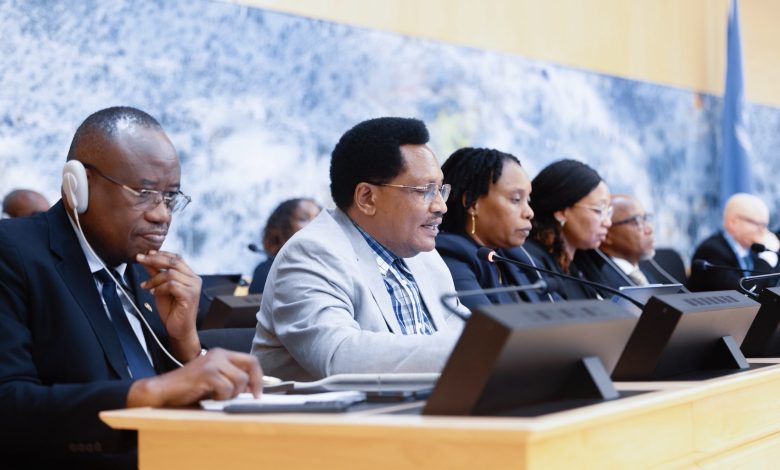
Geneva, Switzerland: At the 53rd session of the United Nations Universal Periodic Review (UPR53) in Geneva, Professor Hamisi Masanja Malebo, Executive Secretary of the UNESCO National Commission of Tanzania, articulated the official position of the Tanzanian government regarding land rights and ethnic categorization.
Prof Malebo, on behalf of the Government of the United Republic of Tanzania, clarified that Tanzania is home to more than 120 distinct ethnic groups, and it is one of the few African nations that encompasses representatives from all four of the continent’s major ethnolinguistic families.
Khoisans, he noted, are the earliest inhabitants, represented by hunter-gatherer communities – the Hadzabe and Sandawe people, who are noted for their distinctive click-consonant languages.
“Cushitics were the first group to set foot in Tanzania and they migrated from the north thousands of years ago, introducing early food production and livestock keeping,” the Executive Secretary told the Session.
He unveiled that descendants include groups like the Iraqw people of the north-central highlands.
Bantus were the second group to set foot in Tanzania and they began arriving from West and Central Africa around 2,000 years ago, bringing ironworking, advanced agriculture, and new forms of social organisation.
Prof Malebo added that they form the overwhelming majority about 95 per cent of the country’s population, including major groups like the Sukuma, Chagga, Nyamwezi, and Makonde.
How about Nilotics?
They were the third group and late comers to set foot in Tanzania and these are the pastoralist groups who migrated south from the Nile River region in later waves up through the 18th century, notably including the Maasai, Datooga, and Barabaig.
It follows true that, during their southward expansion, the Maasai utilized their highly organised warrior society (the Morans) to secure grazing lands.
This expansion, noted the Prof, led to fierce conflicts, bloodshed battles and the disruption and displacement of earlier inhabitants from their land including the Khoisan, Cushitic and Bantu agriculturalists and older pastoralist groups the Datooga from fertile rangelands.
Historically, the Maasai conquered and expanded southward from the Nile Valley through the 17th and 18th centuries, reaching their peak territorial reach in the mid-19th century.
At its height, the Maasailand spanned the Great Rift Valley from central Kenya down through large portions of northern and eastern Tanzania including the Serengeti plains, the Ngorongoro highlands, Arusha, and areas stretching toward the coast and southern plains in Manyara, Kilimanjaro, Coast, Morogoro, and Tanga regions in Tanzania.
Prof Malebo expounds that the history is clear that, during the 18th and 19th centuries, the Maasai disrupted and displaced established populations, including Bantu farmers, Cushitic groups the Iraqw, and older pastoralist groups like the Datooga.
If land rights are determined strictly by who occupied the land first, groups displaced by the Maasai hold a prior claim, making modern Maasai claims to exclusivity less absolute in Ngorongoro and other areas.
The United Republic of Tanzania does not officially recognize nor define indigenous peoples and ancestral land in its Constitution and domestic statutory laws.
The Government views all citizens as equal nationals and generally there is no specific category of indigenous peoples, as all Tanzanians of African descent are indigenous to the country.
The Executive Secretary told the Session that the Tanzanian land policy and legislation do not recognize a distinct legal category of ancestral land.
The malicious and widespread allegations against Tanzania, he insisted, spread by a few people and groups, have decided to ignore the facts alluded to the Session.
“We wish to tell them that Tanzania is a country guided by the rule of law, respect for human rights and the fundamental principles of good governance,” he said.
“The Government of the United Republic of Tanzania will continue to address the challenges facing its people bearing in mind their dignity, livelihood, and traditions are protected,” he said.
Prof Malebo concludes that the 6th phase Government led by President Dr Samia Suluhu Hassan, has continued to enhance efforts to foster socio-economic development while safeguarding the human rights of its citizens by allowing, among others, freedom of speech, movement, freely and peaceably assemble for political rallies in line with the Constitution and ratified International and Regional human rights treaties.
“We urge the HRC to adhere to the principles of universality, impartiality, objectivity, and non-selectivity,” he remarked.
“The United Republic of Tanzania shall continue to promote and protect the human and peoples’ rights of its people regardless of their status, tribe, ethnic group, descent, tradition, religious, race or social status,” he remarked.