

Child eye cancer rises in Mwanza amid delayed care
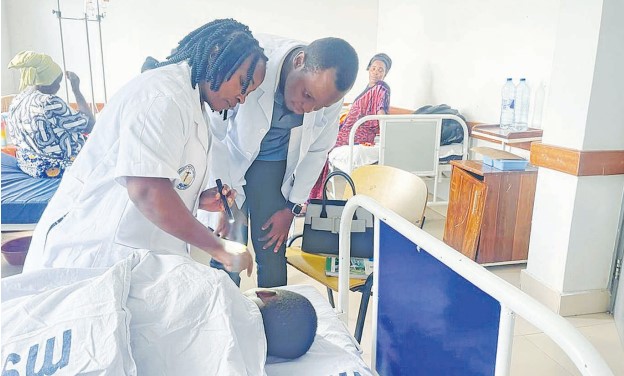
MWANZA: A SILENT but deadly eye cancer is creeping into the lives of Tanzanian children and many parents don’t even know it until it’s too late.
At Bugando Zonal Referral Hospital in Mwanza, specialists are sounding the alarm over a sharp increase in cases of retinoblastoma, a rare but dangerous eye cancer affecting children under five.
The disease, which begins as a swelling behind the eyeball, is both aggressive and potentially fatal if left untreated.
“We are seeing more cases than ever. Last year we treated 27 children and this year we have already recorded 17,” said Dr Evarista Mgaya, an eye specialist at Bugando.
“That means at least four new cases every month and many arrive too late.” For instance, a curable Cancer if caught in time is Retinoblastoma.
It is a genetic or spontaneous mutation that causes tumour growth in the retina, usually in children under five.
Its early signs are subtle and painless making them easy to overlook.
Here, watch for these warning signs: a white reflection in the eye (especially noticeable in photos or dim light); eye redness that doesn’t go away; constant squinting or misaligned eyes and one eye appearing larger than the other as well as unusual teariness.
“Unfortunately, many parents take these signs lightly,” said Dr Mgaya.
“By the time they reach us, the tumour may have pushed the eyeball out of the socket or spread to the brain, leading to epilepsy, neurological damage or worse.”
One of the biggest challenges facing healthcare providers is the widespread reliance on traditional medicine and non-prescribed drugs.
“Some parents still trust traditional herbs over medical diagnosis,” Dr Mgaya explained.
“Others buy drugs from pharmacies without any prescription or expert advice. The wrong dose can do more harm than good.” Such was the case for Ahmad Ally, a father from Kigoma.
When he noticed a strange glow in his son’s eye, he didn’t think much of it. His community elders suggested herbs and he followed their advice.
“We tried everything tree bark, boiled leaves, traditional eye washes,” Ahmad recalled.
ALSO READ: Bugando raises alarm over rising eye cancer cases
“I trusted our elders. A month later, my son’s eyeball came out. That’s when I knew we had made a terrible mistake.”
Ahmad rushed his four-year-old son to the regional hospital. Doctors immediately referred them to Bugando. Today, his son is preparing for major eye surgery and faces a lifetime with a prosthetic eye.
“I’ve learned the hard way,” he said.
“What we need most is public education. People simply don’t know.” It’s not just Kigoma, Kagera Region tells the same story.
Here, another parent, Aneth Emmanuel from Kagera, shared a similar experience.
She noticed a white reflection in her three-year-old son’s eye but chose to treat him with over-the-counter medication.
“I assumed it was just an eye infection,” she said.
“I kept buying random medicines from the pharmacy without a doctor’s prescription. Now, his natural eye has been replaced.”
Cultural beliefs complicate recovery Doctors say that religious beliefs and spiritual practices are also interfering with treatment.
“Some parents interrupt cancer treatment to attend spiritual healing sessions,” said Dr Goodluck Nchasi, an oncologist at Bugando’s Cancer Department.
“Others are told by faith leaders that medical help isn’t needed. This false hope costs lives.”
Dr Nchasi added that cancer treatments are long and periodic. Patients often return home during breaks.
Bugando now offers accommodation at its newly built cancer hostels to help ease travel burdens. But still, some patients disappear after their first visit and never return.
“When they do return, it’s usually too late,” he said. Why is Geita a hotspot? Bugando reports that many advanced cases are arriving from Geita Region, particularly Katoro town despite its close proximity to Mwanza.
“We received four children from Geita last year with advanced eye cancer,” said Dr Mgaya.
“The distance isn’t the problem, lack of awareness is.” In turn, the hospital’s Eye and Cancer departments have teamed up to:- Conduct awareness campaigns across the Lake Zone; Train health workers in early detection and referral; Educate communities on early signs and symptoms; Offer accommodation and financial support to patients in need.
“We’re building capacity at lowerlevel hospitals,” said Dr Mgaya.
“That way, health workers can recognise retinoblastoma early and refer cases before it’s too late.” Retinoblastoma is curable, but only if caught early.
ALSO READ: State eyes high quality services at BMH
Experts urge parents to seek professional help the moment they spot something unusual in their child’s eyes.
“No child should lose an eye or their life because someone said herbs would work,” said Dr Nchasi.
“We need everyone on board: parents, teachers, community leaders and especially religious figures.” For many families, financial constraints are the final obstacle.
Ahmad Ally, the father from Kigoma, says he now faces regular trips to Bugando that are difficult to afford.
“I support the push for universal health coverage,” he said.
“If we want to save lives, treatment must be affordable.” The message from Mwanza is loud and clear: Time is vision. The earlier the detection, the better the outcome.
Retinoblastoma doesn’t have to be a tragedy. It can be a treatable condition, a curable disease and a preventable loss if only we act fast enough.
So, the next time someone tells you to rub tree sap into your child’s eye, remember: it’s 2025, not 1825.
And modern problems require modern medicine. In a nutshell, you need to know quick facts about Retinoblastoma that it is a rare eye cancer affecting mostly children under 5.
Is it painful? Not at first-making early signs easy to ignore. Can it be cured? Yes, if caught early; Where to go? Any regional referral hospital; Bugando in Mwanza is a top centre; Key symptoms: White pupil reflection, redness, squinting, eye size change, tearing and act fast. Delays can lead to blindness, brain damage, or death.


354359 882087It can be tough to write about this subject. I feel you did an superb job though! Thanks for this! 450837