Building strong parties through accountability, people-centred leadership
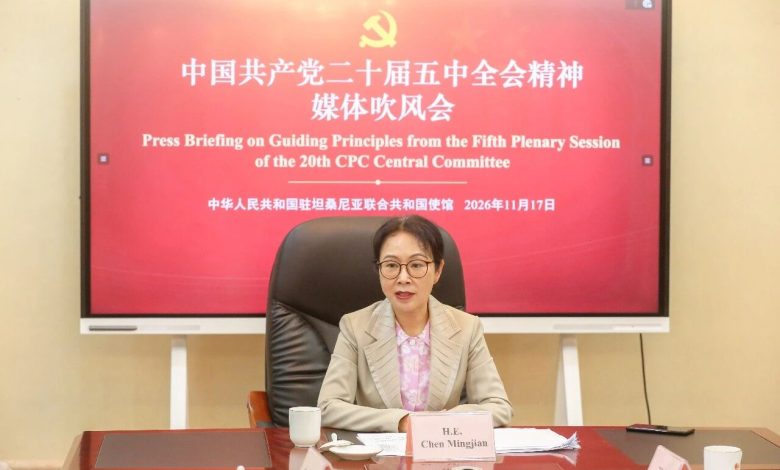
DAR ES SALAAM: THE relationship between political leadership and the people it serves is tested not only during elections or moments of national progress, but also in how consistently leaders respond to everyday concerns, improve livelihoods and remain accountable to those who entrust them with power.
For Chinese Ambassador to Tanzania Chen Mingjian, this relationship Building strong parties through accountability, people-centred leadership lies at the heart of effective governance, with political parties expected to place people’s interests above all else while continuously strengthening their own institutions.
She believes that maintaining public confidence requires more than political authority. It calls for leadership that listens, responds to changing expectations, addresses internal weaknesses and remains committed to improving people’s well-being.
“Political parties must always put the people’s interests first and strengthen their own foundations by responding to people’s expectations and improving their well-being,” she said.
The principle formed an important part of her explanation of China’s approach to Party building and governance following the Fifth Plenary Session of the 20th Central Committee of the Communist Party of China (CPC), held in Beijing from October 26 to 29, 2026.
At the centre of the discussions was a question confronting political parties across different political systems on how can they maintain their governing capacity, remain responsive to citizens and strengthen public confidence amid changing social, economic and global circumstances?
For the CPC, one of the answers lies in the ability of a political party to reform itself. With more than 100 million members and over 5.43 million primary-level Party organisations, the CPC operates within a country of more than 1.4 billion people. The scale of its responsibilities, Ms Chen explained, makes institutional discipline, effective leadership and continuous self-improvement important elements of its governance approach.
This thinking is reflected in the principle of full and rigorous Party self-governance, which featured prominently in the plenary session.
The meeting adopted a resolution on major issues concerning the continued implementation of full and rigorous Party self-governance, setting out measures aimed at strengthening discipline, accountability and institutional effectiveness.
“To govern the country well, the Party must first govern itself well, and to make the country strong, the Party must first strengthen itself,” Ms Chen said.
The principle suggests that political parties cannot effectively address challenges facing society without first examining their own structures, conduct and performance.
In her explanation, the Ambassador pointed to the pressures that accompany long-term governance, including economic reforms, market forces, changes in the external environment and rising public expectations.
Such pressures, she said, require political organisations to remain alert to their weaknesses and develop mechanisms for correcting mistakes before they undermine their ability to govern.
Citing President Xi Jinping, she said the CPC’s strength did not lie in never making mistakes, but in having the courage to confront problems, undertake reforms and correct its shortcomings.
This approach is supported by seven priority areas outlined during the plenary session, covering the integrity of Party members, democratic centralism, leadership development, organisational structures, Party conduct, anti-corruption efforts and institutional regulations.
Leadership development is one of the areas receiving attention, with emphasis on building a cadre of leaders possessing political commitment, professional competence and discipline.
Ms Chen said this required strict standards in the education, training, selection, appointment and supervision of Party officials.
Equally important is the strength of organisational structures at different levels, ensuring that policies and decisions are translated into coordinated and effective action.
However, institutional reforms alone cannot guarantee public confidence without accountability in the exercise of power.
Corruption, therefore, remains another area in which the CPC is seeking to strengthen its internal governance mechanisms.
Ms Chen said China was committed to ensuring that officials did not have the audacity, opportunity or desire to engage in corrupt practices.
Achieving this, she explained, required stronger checks on the exercise of authority, effective oversight and institutional safeguards capable of preventing abuse of power.
The intention is to make discipline and accountability permanent features of Party operations rather than responses introduced only after misconduct has occurred.
Beyond China’s experience, the Ambassador believes that lessons from Party building and governance can provide useful perspectives to political organisations in other parts of the world, particularly in the Global South.
Although countries differ in their political systems, historical experiences and levels of development, she said, political parties share common responsibilities in maintaining public confidence, strengthening institutions and responding to citizens’ expectations.
But drawing lessons from another country’s experience does not necessarily mean adopting its entire governance model.
Ms Chen cautioned that every country needed to develop approaches consistent with its own national conditions, development priorities and people’s aspirations.
For Tanzania, this creates an important area of engagement through the longstanding relationship between the CPC and Chama Cha Mapinduzi (CCM).
The two parties’ relationship is rooted in the historical friendship established by their founding leaders, Chairman Mao Zedong and Mwalimu Julius Nyerere, and has evolved over the years to include exchanges on leadership development, Party organisation and state governance.
According to Ms Chen, these exchanges provide opportunities for the two sides to learn from each other’s experiences while strengthening their respective institutional capacities.
Among the platforms facilitating this cooperation are the Mwalimu Julius Nyerere Leadership School and the Research Centre for Xi Jinping Thought on Socialism with Chinese Characteristics for a New Era.
The cooperation has continued under the strategic guidance of President Xi Jinping and President Samia Suluhu Hassan, with both parties maintaining engagement on governance and national development issues.
Ms Chen said CCM Secretary-General Asha-Rose Migiro had also spoken positively about the outcomes of the CPC plenary session, particularly the lessons relevant to strengthening Party structures, internal discipline, accountability and leadership development.
The shared interest, she said, extends to promoting peoplecentred leadership, strengthening institutions and pursuing development approaches that improve citizens’ well-being.
For the Ambassador, the relationship between the two parties should therefore go beyond historical friendship to embrace practical exchanges that respond to contemporary governance and development challenges.
“We stand ready to work with the CCM to carry forward our traditional friendship, deepen exchanges of experience in Party and state governance, and support each other in exploring development paths suited to our respective national conditions, so as to better benefit the peoples of our two countries,” she said.
The coming years also provide an opportunity to renew the partnership. China marks the 105th anniversary of the CPC’s founding in 2026, while CCM prepares to celebrate its 50th anniversary next year.
Ms Chen said the milestones offered an opportunity to strengthen the traditional friendship and deepen cooperation between the two parties.
She also welcomed Tanzanian stakeholders to continue following China’s experiences in Party building, state governance and economic and social development as part of efforts to promote mutual understanding.
Ultimately, the message running through China’s governance approach, as presented by the Ambassador, is that the strength of a political party should not be judged solely by the size of its membership, the reach of its structures or its ability to exercise authority.
It should also be reflected in its willingness to listen to citizens, correct its weaknesses, maintain accountability and translate leadership responsibilities into improvements in people’s lives.
For political parties navigating changing public expectations, the challenge is not simply to remain in leadership, but to ensure that their institutions and decisions continue to serve the people.