Breaking silence as Tanzania expands treatment options for erectile dysfunction
DAR ES SALAAM: FOR many years, erectile dysfunction has remained a health challenge that many men keep hidden because of embarrassment, stigma and fear of judgment. Some live with the condition for years without seeking medical attention, believing there is no solution.
Health experts, how ever, say erectile dysfunction is a medical condition that can be treated and should not be silently endured. Tanzania has now taken an important step in specialised men’s healthcare, with Benjamin Mkapa Hospital offering penile implant surgery, a procedure previously available in only a limited number of countries.
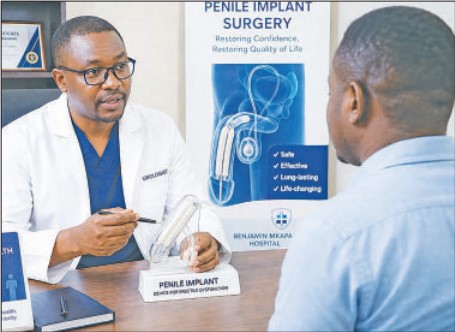
Urology and men’s health specialist at the hospital, Dr Remigius Rugakingira, says the service is intended for men who have completely lost the ability to achieve an erection and whose conditions have not responded to other treatments.
“What we do is not transplanting a new penis from another person, nor is it increasing the size of the penis. We insert a special device that helps a man regain the ability to achieve an erection so that he can continue with his marital life,” he says.
Erectile dysfunction is more common than many people realise. Studies worldwide indicate that between 30 and 60 per cent of men may experience the condition at some point, although rates vary among populations.
In Tanzania, a 2016 study involving 18,441 men in Kinondoni District, Dar es Salaam, found that 24 per cent had experienced erectile dysfunction. Dr Rugakingira says the figure may not reflect the actual scale because many men avoid medical care due to shame and stigma. Some view the condition as a failure of masculinity, yet it is a medical problem like any other.
“Many men remain silent when they experience this problem. Some consider it a failure as men, but the truth is that it is a medical condition just like any other health problem,” he says.
Several conditions can contribute to erectile dysfunction, including diabetes, high blood pressure, heart disease, blood-vessel disorders, spinal-cord injuries and psychological stress. These conditions can affect blood vessels, nerves and other systems involved in achieving and maintaining an erection.
For men considered for an implant, treatment begins with comprehensive medical assessment to identify the cause and determine whether other options can help.
“Before performing surgery, we conduct various tests. We want to establish whether the problem can be solved through medication, lifestyle changes, or counselling. This implant is the last option for patients who have not benefited from other treatments,” Dr Rugakingira explains.
The service followed preparations within Tanzania’s urology field. Some Tanzanian doctors received specialised training in India between 2018 and 2019, while development of the service began in 2023 through collaboration among local urology specialists. Benjamin Mkapa Hospital subsequently performed the procedure on its first two patients. So far, 14 men have received penile implants and are progressing well.
The implant is not a human organ from another person. It is a specialised medical device made from materials compatible with the human body.
“These implants can last for more than 20 to 25 years and in many cases, they can remain in the patient’s body for life. The device is not visible from outside and does not remove a man’s sensations,” Dr Rugakingira says.
The effects of erectile dysfunction can extend beyond sexual function. Men may lose confidence, experience relationship difficulties and suffer stress that affects their work performance. Treatment can therefore improve emotional wellbeing, relationships and overall quality of life.
“When we help such a man, we are not only addressing the physical problem. We help restore his confidence, relationships and overall quality of life,” he says.
Another misconception is that an implant leaves a man permanently erect. Dr Rugakingira says this is not the case.
ALSO READ: RC’s crackdown needs teeth beyond promises
“There are different types of implants. The type we use here enables a man to achieve the firmness required during sexual intercourse. However, he still needs sexual stimulation and experiences sensations like any other man,” he explains.
Recovery requires patience. Patients are advised to wait approximately six weeks before resuming marital activities. They are assessed after that period to ensure healing has progressed satisfactorily. Importantly, not every man with erectile dysfunction requires an implant.
Depending on the cause and severity, treatment may involve lifestyle changes, medication or counselling. Dr Rugakingira advises men to exercise regularly, maintain a healthy diet, get adequate sleep and reduce stress. He also warns against products marketed as maleenhancement solutions without clear knowledge of their contents.
“We need to understand what we eat. We should not rush to products marketed as male enhancement solutions without knowing what they contain. A healthy diet, exercise and a healthy lifestyle play a major role in protecting men’s health,” he says.
The penile implant service at Benjamin Mkapa Hospital costs approximately 10 million Tanzanian shillings, including medical tests, the implant device and surgery. Although the cost may appear high, Dr Rugakingira says it is generally a one-time procedure, with the device capable of lasting many years.
The availability of this specialised service represents a significant development in Tanzania’s men’s healthcare. It also provides an opportunity to challenge the silence surrounding reproductive health and encourage men to seek medical attention earlier. Dr Rugakingira urges men to stop viewing reproductive health challenges as issues that must be hidden.
“Men’s health is family health and national health. A man experiencing challenges should not feel ashamed to visit a hospital. When the problem is identified early, it can be treated,” he says.
As Tanzania expands specialised healthcare, penile implant surgery at Benjamin Mkapa Hospital brings advanced treatment closer to men who need it and may reduce the need to seek care abroad. More importantly, it reinforces a simple message: erectile dysfunction is a medical condition, not a source of shame and seeking treatment is an act of responsibility rather than weakness.