Beyond COP17 strengthening civil society action to combat desertification and build climate resilience
DODOMA: Across the world, land is becoming one of the most pressured natural resources as desertification, drought, and land degradation continue to accelerate at an alarming pace.
From Asia’s expanding drylands to Latin America’s shrinking fertile zones, scientists and policymakers are increasingly warning that environmental degradation is no longer a distant threat, but a present-day crisis shaping food security, migration patterns, and economic stability.
At the center of global response efforts is the United Nations Convention to Combat Desertification (UNCCD), which continues to rally countries and stakeholders toward achieving Land Degradation Neutrality (LDN) and restoring degraded ecosystems.
As preparations intensify for COP17, global attention is once again turning to the role of inclusive partnerships particularly the contribution of civil society organizations (CSOs) in driving action on the ground.
Across Africa, where the impacts of land degradation are deeply felt in rural livelihoods and agricultural systems, CSOs have emerged as critical actors bridging policy and community action.
Their work spans environmental advocacy, community education, ecosystem restoration initiatives, and grassroots mobilization aimed at strengthening resilience in vulnerable landscapes. It is within this broader continental and global context that Tanzania is positioning itself ahead of the 17th Session of the Conference of the Parties (COP17), scheduled to take place in Ulaanbaatar, Mongolia, from 17 to 28 August this year.
ALSO READ: Mission 300 emerges as Africa’s blueprint for energy and economic transformation
The country is actively strengthening stakeholder engagement through national preparatory processes designed to ensure meaningful participation in global negotiations.
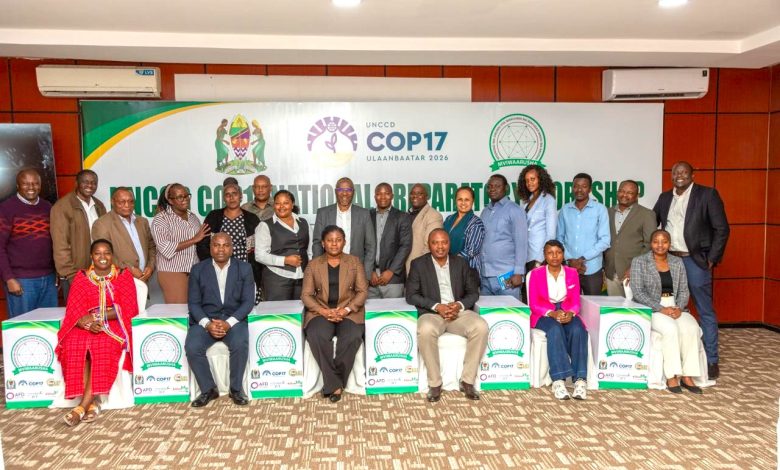
Speaking during the UNCCD COP17 National Preparatory Workshop recenlty in Dodoma, the Executive Director of the Journalists’ Environmental Association of Tanzania (JET), John Chikomo, emphasized the indispensable role of civil society organizations in addressing desertification and land degradation.
Chikomo noted that CSOs are not only awareness creators but also strategic partners in environmental governance.
“Through environmental journalism, public awareness campaigns, and media engagement, organizations such as JET are helping to shape public understanding and strengthen accountability in environmental management,” she said
He further highlighted that CSOs contribute directly to Tanzania’s implementation of its National Action Programme (NAP) under the UNCCD framework, reinforcing national efforts toward achieving Land Degradation Neutrality by 2030.
According to him, these organizations complement government interventions by empowering communities, building local capacity, and advocating for sustainable and equitable natural resource governance.
He indicated, “The workshop contributes to the broader mission of the UNCCD by preparing countries like Tanzania to effectively participate in global negotiations. This ensures that developing countries’ voices are reflected in international decisions on land restoration and sustainability,”
Opening the workshop, Abdallah Lungo, representing the UNCCD National Focal Point from the Vice President’s Office – Division of Environment (Vice President’s Office – Division of Environment (VPO-DoE)), called for stronger partnerships between government institutions, civil society, and development actors. He stressed that sustainable land management can only be achieved through coordinated action and shared responsibility.
He added that, “One of the most significant contributions of CSOs is raising public awareness. Environmental challenges such as desertification often progress silently, affecting soil fertility, water availability, and agricultural productivity over time,”
“CSOs help bridge the knowledge gap by educating communities about sustainable land use practices, climate change impacts, and ecosystem restoration. Through environmental journalism, community outreach, and advocacy campaigns, they make complex environmental issues more understandable and actionable for
ordinary citizens,” he briefed.
“CSOs play a vital role in empowering local communities. In many rural areas,land degradation directly affects livelihoods that depend on agriculture and natural resources. CSOs support these communities by building capacity in sustainable farming techniques, agroecology, soil conservation, and climate resilience
strategies,” he addressed
“This empowerment enables communities to take ownership of environmental protection efforts rather than relying solely on external interventions,” he said “Another key importance of CSOs is their role in policy advocacy and accountability. They act as a bridge between communities and government institutions, ensuring that the voices of vulnerable groups are heard in environmental decision-making processes,”
He summarized, “By engaging in national and international platforms such as the United Nations Convention to Combat Desertification (UNCCD), CSOs influence policies, monitor implementation, and promote transparency in environmental governance,”
Participants also reflected on the outcomes of Désertif’actions 2026 and explored opportunities for collaboration in sustainable land management, agroecology, ecosystem restoration, and climate resilience.
The discussions underscored the importance of aligning national priorities with global environmental commitments while ensuring local realities remain central to decision-making.
The workshop itself, organized under the Kilimo Endelevu Arusha (KEA) Project and implemented by MVIWAARUSHA, CARI, and RECODA with support from the French Development Agency (AFD), served as a critical platform for strengthening Tanzania’s readiness for COP17.
ALSO READ: Tourism cooperation to deepen ties
It brought together government representatives, development partners, civil society actors, and environmental stakeholders to deepen understanding of the UNCCD process and enhance coordination ahead of global negotiations.
Combating desertification and land degradation requires a collective and sustained effort that brings together governments, development partners, communities, and civil society organizations. While global frameworks such as the United Nations Convention to Combat Desertification (UNCCD) provide the necessary direction and commitments, it is the active engagement of stakeholders at national and local levels that transforms these commitments into meaningful results.
Civil society organizations remain at the heart of this process, bridging the gap between policy and practice, amplifying community voices, and driving awareness on sustainable land management. Their contribution ensures that environmental action is not only top-down but also inclusive, participatory, and grounded in local
realities.
As Tanzania and the global community move closer to COP17 and beyond, strengthening collaboration among all actors will be essential. Only through shared responsibility and coordinated action can the world achieve land degradation neutrality and secure a more sustainable and resilient future for present and future generations.
Civil society organizations are indispensable in the fight against desertification and land degradation. Their importance lies in their ability to educate, empower, advocate, and collaborate across all levels of society. By connecting global environmental commitments with local action, CSOs ensure that sustainability goals are not only agreed upon in international forums but are also achieved in the real world where they matter most.
CAPTION