The Diplomacy Beneath the Veto: Tanzania, Russia, and the Mechanics of Multilateral Leverage: Stratgic Non-Alignment and Executive Realism in Modern Geopolitics
Western foreign policy establishments are sleepwalking into a multipolar reality they refuse to name. While Washington and Brussels obsess over a rigid binary demanding that the Global South choose between a Western-led consensus and an ascendant Eurasian bloc, developing middle powers are quietly rewriting the rules of international leverage. Tanzania’s strategic hedging is not an ideological defection, or a naïve ideological drift toward China or Russia. It is a masterclass in how sovereign states extract maximum value from competing superpowers without firing a shot, and without getting crushed in the ideological crossfire.
Ever since the post-Cold War procedural shifts formalized informal drafting habits in the early 1990s, crystallized by landmark General Assembly transparency mandates such as Resolution 48/26 of December 1993, multilateral power has shifted away from open floor debates into closed rooms.
And as the demographic line of Africa is growing, and economic growth on the rise, the United Nations can no longer afford dismissing Africa’s institutional gravity in the Security Council as far-fetched. Especially against the backdrop of Beijing’s expanding economic footprint on Earth, and diplomatic reach across the continent. It is a catastrophic misreading of where twenty-first-century power actually resides. Ever since the post-Cold War procedural shifts formalized informal drafting habits in the early 1990s, crystallized by landmark General Assembly transparency mandates such as Resolution 48/26 of December 1993, multilateral power has shifted away from open floor debates into closed rooms.
When African capitals engage with Moscow or Beijing today, Western policy circles frequently default to assumptions of ideological alignment or passive dependency.
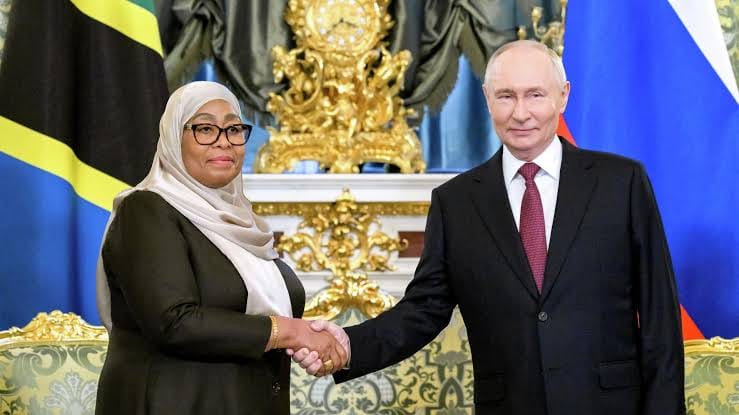
Between January 20th 2001, to January 20th 2017, reminiscent of the pragmatic institutional bridges built during the late Bush and the Obama years. That view ignores the primary rule of modern statecraft: middle powers do not act out of sentimentality; they act out of calculated national interest. The recent diplomatic and economic engagements between Dodoma and Moscow—underscored by President Samia Suluhu Hassan’s state visit to Russia and high-level economic negotiations in June 2026. The bilateral State visit illustrates how a developing nation uses strategic hedging not to pick a side, but to maximize its own sovereign leverage.
The Structural Drivers of Eurasian Outreach:
To understand why Russia invests heavily in diplomatic outreach across the Global South, one must examine the structural transformation of Moscow’s foreign policy over the past decade. As British defense and security analyst Keir Giles documents in The Rise of Russia: The Turning Point for Russian Foreign Policy, the Kremlin’s strategy shifted fundamentally following its rupture with Europe over Ukraine. Cut off from Western capital markets and subjected to sweeping economic sanctions, Moscow recognized that breaking its international containment required constructing alternative commercial and diplomatic networks across Africa, Asia, and Latin America. This dynamic closely mirrors the patterns mapped by strategic scholar R. Evan Ellis in The New Russian Engagement with Latin America, where Moscow’s diplomatic and economic overtures serve as an asymmetric counter-strategy to project presence and secure resource partnerships in regions where Western dominance was once taken for granted.
Yet, as political scientist Andrei P. Tsygankov demonstrates in Russia’s Foreign Policy: Change and Continuity in National Identity, Moscow’s external ambitions are driven less by ideological proselytizing than by an existential quest for great-power recognition. For a middle power like Tanzania, this structural vulnerability creates a valuable asymmetric bargaining opportunity. Unlike the historic solidarity of the Cold War era, when Tanzania first President and father of the nation Julius Nyerere, traveled to Moscow in October 1969 primarily to secure political and material backing for African liberation movements contemporary bilateral engagements are strictly transactional. Following shifting global energy dynamics, Tanzania aims to diversify its energy sources and industrial financing structures, utilizing Eurasian capital as a practical counterweight against Western monopolization of development aid and infrastructure financing.
Concrete Economics and Sovereign Hedging:
Tanzanian policy makers and contemporary intellectuals understand Russia is not the Soviet Union, and economic diplomacy needs pragmatic approach with Russia. The material substance of this partnership is increasingly visible in concrete economic and resource data. Bilateral trade between Tanzania and Russia, while historically modest, has expanded steadily toward the $307.5 million mark, anchored by Russian grain and fertilizer exports alongside Tanzanian agricultural commodities such as coffee, tea, and tobacco. More significantly, high-level discussions during President Hassan’s June 2026 visit accelerated cooperation on the $1.2 billion Mkuju River uranium project in southern Tanzania’s Ruvuma Region. Developed through Mantra Tanzania, a subsidiary of Russia’s state nuclear corporation Rosatom, the project holds an estimated resource base of 58,500 tonnes of uranium and is scheduled to reach full commercial production by 2029. Alongside mining, bilateral frameworks now encompass nuclear medicine, workforce training, and exploratory discussions on small modular reactors. For Dodoma, engaging Russian technical and capital capacity ensures that national resource rents are maximized through competitive bidding rather than exclusionary dependency.
Crucially, this economic and diplomatic hedging does not translate into an abandonment of Western partners. Empirical tracking of United Nations voting records demonstrates that Tanzania’s foreign policy is governed strictly by sovereign national interest rather than bloc conformity. When the UN General Assembly convened its Eleventh Emergency Special Session in March 2022 to vote on Resolution ES-11/1, condemning Russia’s invasion of Ukraine, Tanzania joined 16 other African nations in abstaining from the vote. That abstention—and similar non-aligned stances on subsequent punitive sanctions resolutions—reflects a sober assessment of systemic costs: alienating a nuclear-armed permanent member of the Security Council yields zero strategic return, just as unconditional alignment with Russia would jeopardize vital Western trade access, multilateral concessional financing, and export markets.
Beyond the Binary of Global Coalitions:
Following the escalation of the Russia-Ukraine conflict in February 2022, Western commentators often interpreted African abstentions as either tacit support for revisionist aggression or evidence of sub-Saharan vulnerability to foreign disinformation and coercion.
However, a rigorous examination of the United Republic of Tanzania’s diplomatic posture reveals a far more sophisticated reality. Operating under a framework of structural non-alignment inherited from the Nyerere era but modernized for twenty-first-century economic realities, Dodoma exercises what can be termed executive realism. By examining the economic anchors, institutional mechanisms, and voting patterns that define Tanzania–Russia relations, to date, Tanzania demonstrates how multilateral voting is deployed not as an index of alignment, but as a calculated instrument of sovereign leverage.
Mastering the Machinery of Penholding:
This brings us to the true center of gravity in multilateral diplomacy: the United Nations Security Council. For all the ink spilled in international commentary, public debate remains hypnotized by a single mechanism the presidential veto under Article 27 of the UN Charter. Analysts constantly fixate on the P5: America, Britain, France, Russia, and China. Because any single member of this permanent quintet can crush a substantive resolution with one negative vote, the global press treats the veto as the alpha and omega of international power.
Yet, as empirical tracking by the Security Council Report reveals, real multilateral power is rarely forged through dramatic vetoes thrown across an open chamber. Instead, it is quietly monopolized in the back rooms through penholdership the unwritten practice where select member states control the drafting room, dictate the legal thresholds of human crises, and steer negotiations completely out of sight. That dynamic inflicts a profound structural paradox: with African capitals carrying over sixty percent of the Council’s formal operational workload on peacekeeping and regional security, the continent remains the primary subject of Council enforcement while being systematically locked out of the drafting table. For a middle power like Tanzania, which proved during its 2005–2006 Council tenure that procedural mastery can shape regional peace, navigating this exclusionary hierarchy requires a sobering realization. Much like New Delhi’s calculated balancing act during the height of the Cold War, true strategic agency is won not by shouting against the P5 veto, but by mastering the procedural machinery where the world’s rules are actually written. Reviving that institutional memory today requires moving past passive appeals for Security Council reform toward rigorous technical competence and disciplined hedging. As great-power competition intensifies across global institutions, African foreign ministries must invest in specialized international legal teams capable of drafting alternative resolution texts and challenging procedural monopolies in New York.
Ultimately, in an international system marked by structural volatility, nations that master the quiet diplomacy beneath formal multilateral machinery will prove indispensable. As Leo Tolstoy observed in War and Peace and his reflections on history, sailing the future is far more difficult than sailing the ocean, because the future is shaped by both human agency and shifting circumstances. Tanzania’s navigation of great-power rivalry demonstrates that true strategic autonomy belongs not to the states that submit to false geopolitical binaries, but to those that convert their geographic positioning, natural resources, and diplomatic independence into undeniable leverage.
Novatus Joseph Igosha is an Advocate of the High Court of Tanzania, Commissioner for Oaths, and international affairs columnist. He is currently a Master of Arts scholar in Politics, International Relations, and Diplomacy.
Contact: Mobile: +255747130688 | Email: norvum728@gmail.com