The strowger switch: One invention that changed telecommunications forever
DAR ES SALAAM: IMAGINE living in a world where making a telephone call depended entirely on another person deciding whether to connect you. Now imagine that this person could deliberately prevent your calls from reaching their intended destination, perhaps because of personal disagreements or business competition.
This may sound like a story from a movie, but it reflects the circumstances surrounding one of the most fascinating inventions in telecommunications history. More than 130 years ago, an American funeral director named Almon Brown Strowger developed a technology that would transform how people communicate.
His invention, known as the Strowger switch, helped introduce automatic telephone exchanges, removing the need for human operators to connect every telephone call.
Interestingly, the story behind this invention offers valuable lessons for Tanzania as the country continues its journey towards a digital economy.
A Funeral director with an unusual problem
In the late 1880s, telephone services were still relatively new. Making a telephone call was very different from what we experience today.
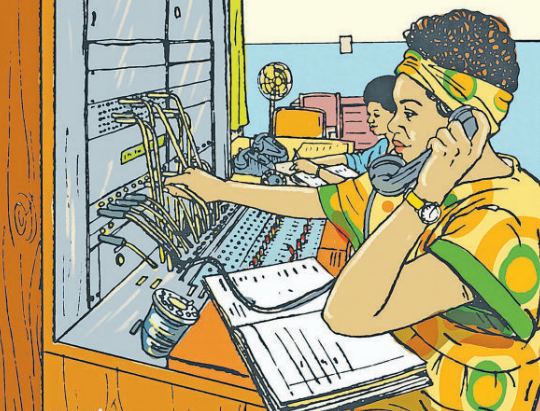
A caller would pick up the telephone and speak to an operator, usually a woman working at a telephone exchange. The operator would then physically connect wires to establish communication between the caller and the intended recipient.
For example, if a businessman wanted to call a customer, he would ask the operator to connect him to that customer’s telephone line.
This arrangement worked, but it had one major weakness, the entire process depended on human intervention.
Strowger operated a funeral business in Kansas City, Missouri, in the United States. According to a widely repeated historical account, he became suspicious that a telephone operator was deliberately directing calls intended for his business to a competing funeral director.
The story suggests that the operator had a personal connection to his competitor, resulting in Strowger losing potential customers.
Although historians have questioned some details of this popular account, the underlying problem was real. Telephone connections depended heavily on operators, creating opportunities for mistakes, delays and favouritism.
Strowger believed there had to be a better way.
Instead of continuing to complain about the operators, he decided to invent a system that would allow callers to connect directly without human assistance.
The birth of automatic telephone switching
In 1891, Strowger received a patent for an automatic telephone switching system. His invention introduced a revolutionary idea: a telephone exchange could establish connections mechanically, based on instructions from the caller.
The technology became known as the Strowger switch, or step-by-step switching system.
Its operation was surprisingly straightforward.
When a caller dialled a number, electrical pulses activated mechanical components inside the exchange. These components moved vertically and horizontally, selecting the appropriate telephone connection.
Imagine entering a large building with ten floors, each containing ten rooms. Instead of asking a receptionist to direct you, an automated system takes you to the correct floor and room using the numbers you select. That is broadly how the Strowger switching principle worked.
The first commercial Strowger automatic telephone exchange began operating in La Porte, Indiana, in 1892.
This achievement marked an important milestone in telecommunications history. For the first time, telephone subscribers could establish connections automatically without depending on an operator for every call.
The invention also encouraged the development of telephone dialling systems, eventually leading to the familiar rotary telephone.
From manual operators to automatic exchanges in Tanzania
Tanzania’s telecommunications history provides an interesting connection to Strowger’s invention.
During the colonial period, telephone services were limited mainly to government offices, businesses and a relatively small number of subscribers.
Early telephone networks depended on manual exchanges, where operators connected calls through switchboards.
As telecommunications infrastructure expanded, automatic electromechanical exchanges, including Strowger-type systems, became part of the technological evolution of telephone services.
For many Tanzanians who experienced fixed-line telephones several decades ago, making a call involved rotating a circular dial containing numbers from zero to nine.
Each rotation generated electrical pulses that instructed the exchange to establish the connection. Older telephone exchanges also produced distinctive clicking sounds as mechanical switches moved to connect calls.
These systems represented significant progress because subscribers could make calls without requesting an operator to connect them manually.
However, Strowger technology had limitations. Its mechanical components required regular maintenance, occupied considerable space and could become unreliable as equipment aged.
Eventually, more advanced switching technologies, including crossbar and electronic exchanges, replaced many step-by-step systems.
Later, digital exchanges transformed telecommunications further, paving the way for modern mobile networks.
What Does Strowger Have to Do with Today’s Smartphones?
At first glance, there appears to be little connection between a mechanical telephone switch invented in 1891 and the smartphones used by millions of Tanzanians today.
However, the fundamental principle remains remarkably relevant.
Strowger wanted telephone connections to happen automatically, without unnecessary human involvement.
Today, when someone in Mbeya calls a relative in Dar es Salaam, sophisticated telecommunications systems automatically identify the destination and establish the connection.
Unlike Strowger’s mechanical switches, modern networks use digital switching, software and advanced communication protocols.
The caller does not need to understand what happens behind the scenes.
Similarly, when someone sends money through a mobile money service, several automated systems work together to authenticate the transaction, identify the recipient and transfer funds.
The technologies are different, but the underlying ambition is similar: making complex processes faster, more reliable and less dependent on manual intervention.
Five lessons for Tanzania’s digital future
Strowger’s story offers important lessons as Tanzania expands digital services across banking, healthcare, agriculture, education and public administration.
First, innovation often begins with an everyday problem. Strowger was not originally a telecommunications engineer. He was a businessman frustrated by an inefficient system. Tanzanian entrepreneurs should similarly look for practical problems affecting ordinary citizens.
Second, automation can improve efficiency. Digital government services, electronic payments and automated business processes can reduce delays and improve service delivery.
Third, technology can promote fairness. Strowger wanted to eliminate the possibility of operators favouring particular customers. Similarly, well-designed digital systems can reduce opportunities for discrimination and favouritism.
Fourth, innovation requires continuous improvement. Strowger switches were eventually replaced by better technologies. Tanzania must therefore continue investing in modern infrastructure, technical skills and research.
Finally, automation must be accompanied by accountability. Although machines reduce certain human errors, modern digital systems introduce new challenges, including cybersecurity threats, software failures and data privacy risks.
Technology alone cannot guarantee fairness or reliability. Effective governance and human oversight remain essential.
The bigger message
More than a century after Strowger’s invention, telecommunications have transformed, but the principle of innovation remains the same: identifying everyday problems and finding practical solutions.
For Tanzania, the next breakthrough could come from a farmer, student or young entrepreneur. Strowger’s story reminds us that innovation is not defined by profession, but by the ability to turn challenges into solutions that benefit society.