How 1.15tri/- BOOST transformed education sector in Tanzania
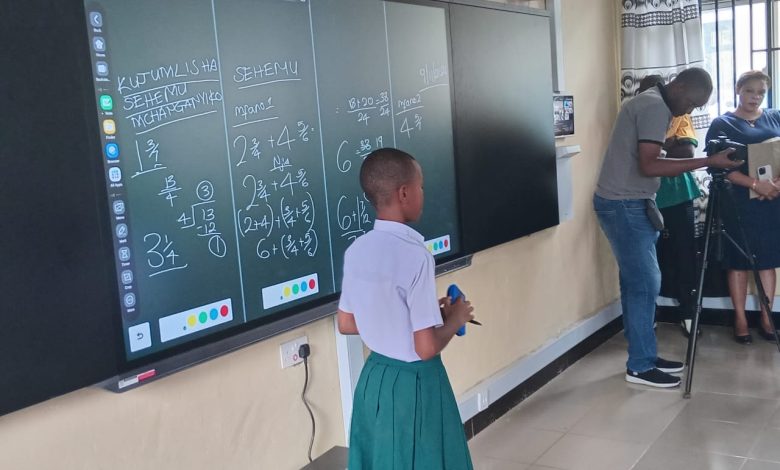
MWANZA: The four-year BOOST Primary Student Learning Programme, valued at 1.15tri/-, has transformed educational infrastructure and learning environments, enabling one teacher to instruct more than one class at a time at schools equipped with ICT.
This was revealed early this week by the Deputy Minister in the Prime Minister’s Office, Regional Administration and Local Government (PO-RALG), Dr Festo Dugange, when he inspected ICT infrastructure at Samia Primary School in Nyamagana District, Mwanza Region.
The school is among 800 primary schools provided with ICT equipment through the BOOST program, as part of the Government’s strategy to enhance teaching and learning through the use of ICT.
According to the Deputy Minister, the 2022/23 and 2025/26 financial years, the Government through the BOOST program has purchased and distributed ICT equipment worth 67.9bn/- to 800 primary schools across all 26 regions.
Out of those 800 schools, 600 have been supplied with smartboards and smart classrooms.
Prior to this initiative to enhance the use of ICT in teaching and learning, no primary school was utilizing smart classrooms and smartboards for teaching and learning.
Thus, through BOOST, the Government has brought about a major revolution in the use of ICT in education, which is a specialized initiative under the Education Program for Results II (EPforR II).
ALSO READ: What Tanzania’s 604.6bn/- school investment means for education
Through this project, Dr. Samia has provided over one trillion shillings, which has enabled the construction of more than 16,000 classrooms—surpassing the target of 12,000 classrooms.
Additionally, 237.9bn/- was used to rehabilitate 1,059 dilapidated primary schools, and 53.9bn/- was used to renovate 369 dilapidated primary schools while rebuilding 51 others that were severely damaged.
Furthermore, he sa8d, these funds have been used to build smart classrooms where a teacher can instruct more than one school using a single room, purchase ICT learning and teaching equipment, and provide training for teachers and students across all 26 regions of the country.
He stated that the use of ICT has simplified student instruction, reduced teacher shortages, and increased the application of technology in schools.
He noted that through this ICT infrastructure, a single teacher can instruct more than one school simultaneously using a smart classroom and a smartboard.
The Deputy Minister personally witnessed a teacher teaching Samia and Kanemwa primary schools—located in different wards—at the exact same time.
“This is a massive investment made by President Samia Suluhu Hassan in the country’s education sector.”
He added itvwas the responsibility of teachers and parents to unite to ensure students study well and take care of the existing infrastructure.
According to Dr Dugange, through the BOOST project in Mwanza Region, 26 schools have been built, which has catalyzed students’ development in ICT literacy.
He noted that at Samia Primary School, the Government provided more than 200 million shillings to construct 10 classrooms and procure teaching and learning materials.
Similarly, Dr Dugange inspected the project’s infrastructure built at Kigongo Primary School in Misungwi District in the region, costing 141m/-.
While at the school, he witnessed a smart classroom—a modern facility for early childhood students equipped with advanced learning and teaching equipment—a situation that has boosted the pass rate from 95 percent in 2015 to 100 percent in 2026.
On her part, Mwanza Regional Administrative Secretary, Dr Fatma Mganga, stated that President Dr Samia deserves praise as the project has brought about a major revolution in the education sector.
Meanwhile, the Headmaster of Samia Primary School, Chacha Joseph, stated that through the BOOST project, the school has been provided with a smart classroom equipped with modern ICT equipment, including 20 computers and one smartboard.
“This funding has been a catalyst for enhancing the use of technology in teaching and learning, as well as building the capacity of students and teachers to utilize technology in educational activities,” he explained.
He said the project has equipped students with basic computer skills, digital learning capabilities, and the ability to practice various subjects.
Regarding Kigongo Primary School, he noted that within Idetemya Ward, there are 10 schools built through the BOOST project.
“Despite having a large population of children, Mwanza Region has become a leader in the education sector due to these projects, finishing second in last year’s standard seven examination pass rates,” he pointed out.
The school’s ICT teacher, Silvano Pamba, stated that the smart classroom has reduced teacher shortages because a single instructor can teach multiple schools at the same time.
He also mentioned that it has helped improve administrative record-keeping for teachers and inspired greater motivation among students to learn while at school.
Charles Mayela, a member of the Mkapa Street Government in Igoma Ward, stated that the use of ICT at the school has enhanced students’ capabilities.
“The modern world is moving towards ICT utilization. We thank our President, Dr Samia, for seeing this and bringing these types of classrooms to our school,” he emphasized.
Kigongo resident Mzee George Ngole, from Misungwi District, stated that the improvements have enabled students to study in much better environments than before.
“We thank President Samia for improving the educational environment so that our children now study closely in a friendly setting.”
“Students study via the internet, there is no inconvenience for teachers, and the education received by children in urban areas is the exact same education received by those in rural areas,” he stressed.
Kasene resident in Misungwi District, Hellena Kafipa, said the project has enabled the construction of modern classrooms, eliminating previous shortages.
A fifth-grade student at the Samia Primary School, Witness Kigongo, stated that the smart classroom allows for rapid learning and helps students acquire deeper knowledge in ICT usage.