Nyerere, Castro legacy drives Tanzania–Cuba diplomatic ties
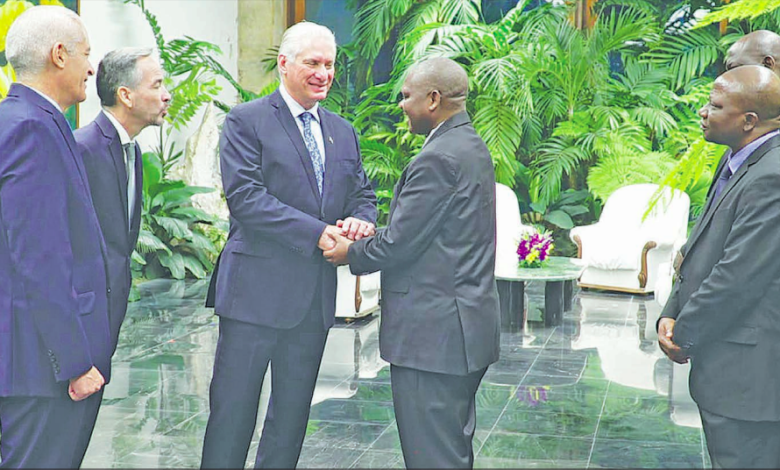
DAR ES SALAAM: TANZANIA and Cuba are seeking to build a stronger partnership between Africa and Latin America, drawing on more than six decades of diplomatic relations shaped by political solidarity, mutual respect and a shared commitment to national sovereignty.
Established in 1962, shortly after Tanzania attained independence, relations between the two countries developed during a period when much of Africa was still struggling against colonialism and minority rule.
Their partnership was influenced by the political outlook of Tanzania’s founding President, Mwalimu Julius Nyerere, and Cuba’s revolutionary leader, Fidel Castro Ruz.
More than six decades later, that historical connection remains an important foundation for engagement between Dodoma and Havana, although the focus has increasingly shifted towards strengthening institutional cooperation, regional integration and the voice of developing countries in international decision-making.
In an exclusive interview with the Daily News Diplomatic Bench, Tanzania’s Ambassador to Cuba, Lieutenant General Mathew Mkingule, reflects on the historical roots of TanzaniaCuba relations, their political foundations and emerging opportunities to deepen cooperation between the two countries.
“The relations between the United Republic of Tanzania and the Republic of Cuba are excellent and continue to blossom. Tanzania and Cuba have over the years, enjoyed high level political and diplomatic relations at bilateral, regional and multilateral levels,” he says.
The establishment of diplomatic relations in 1962 placed Tanzania and Cuba among countries whose international engagement was influenced by the changing political landscape of the post-colonial era. Cuba opened its embassy in Dar es Salaam in February 1964.
Tanzania initially represented its interests in Havana through its High Commission in Ottawa, Canada, before establishing its embassy in the Cuban capital in April 2019.
The early relationship was strengthened by the shared political positions of Nyerere and Castro, particularly their support for independence movements and the right of nations to determine their own political and economic paths.
During the liberation struggles in Southern Africa, Tanzania emerged as a major centre for African liberation movements, providing political and diplomatic support to organisations fighting colonialism and minority rule.
Among the movements hosted by Tanzania were Mozambique’s FRELIMO, Zimbabwe’s ZANU-PF, Namibia’s SWAPO and South Africa’s African National Congress (ANC).
Tanzania also played a central role in coordinating support for these movements through the African Liberation Committee, which was headquartered in Dar es Salaam under Tanzanian Secretary-General Brigadier General Hashim Mbitta.
Cuba, meanwhile, supported liberation struggles in Southern Africa and extended assistance to countries pursuing independence and socio-economic development.
“Since then, the relations have remained excellent, vibrant and continue to solidify. The strong foundation laid down by the two great leaders, Mwalimu Julius Kambarage Nyerere, founder President and Father of the Nation of Tanzania, and Comandante Fidel Castro Ruz, historic leader of the Cuban Revolution remains solid and has been maintained by the subsequent national leaders of the two countries,” he says.
Amb Mkingule says these experiences created a shared understanding between the two countries about the importance of political independence, equality among nations and respect for national sovereignty.
“The key pillars have been mutual trust, confidence, respect for each other’s national sovereignty and common beliefs and defence of human rights as well as human dignity in the world,” he says.
The liberation struggle consequently became more than a historical episode in their relationship. It helped establish a diplomatic outlook that continues to influence how the two countries approach international cooperation.
Tanzania’s subsequent participation in the establishment of the Organisation of African Unity (OAU) in 1963, later transformed into the African Union (AU) in 2001, reflected its commitment to continental unity and collective action.
The country also became a founding member of the East African Community (EAC) and the Southern African Development Community (SADC), while participating in the International Conference on the Great Lakes Region (ICGLR).
These institutions have provided platforms for political dialogue, regional integration, peace and socio-economic development.
Cuba’s regional engagement has included participation in initiatives such as the Community of Latin American and Caribbean States (CELAC) and the Bolivarian Alliance for the Peoples of Our America – People’s Trade Treaty (ALBATCP).
The two countries therefore bring different but complementary regional experiences to their diplomatic relationship.
As bilateral relations matured, both governments recognised the need for institutional arrangements that could sustain cooperation beyond personal relationships and historical goodwill.
An important milestone came in 1986, when Tanzania and Cuba established the Joint Permanent Commission of Cooperation (JPC).
The commission provided a formal framework for identifying areas of mutual interest, coordinating bilateral initiatives and following up on cooperation between institutions in the two countries.
Its establishment marked a shift towards a more structured relationship, creating opportunities for engagement across political, economic and social sectors.
The subsequent opening of Tanzania’s embassy in Havana in April 2019 further strengthened the country’s diplomatic presence in the Caribbean and provided an additional channel for direct engagement.
ALSO READ: Tanzania, Cuba explore solutions to turn environmental challenge into economic advantage
Amb Mkingule says the historical foundations of the relationship remain relevant as both countries respond to changing international political and economic circumstances.
He argues that political dialogue remains essential to sustaining the partnership and developing cooperation between the two regions.
“Political dialogue as a process of negotiation is key to enhancing relations and cooperation between parties,” he says.
He adds that dialogue promotes mutual understanding, which is an important foundation for sustainable peace and development.
The Ambassador believes Tanzania and Cuba can use their diplomatic experience to encourage closer engagement between African and Latin American institutions.
Such engagement could create opportunities for cooperation in areas including education, healthcare, agriculture, scientific research and economic development.
However, he stresses that political dialogue should remain central to efforts to establish sustainable partnerships.
A stronger voice for the Global South
Beyond their bilateral relationship, Tanzania and Cuba share an interest in strengthening cooperation among developing countries, particularly through South–South cooperation.
The approach emphasises solidarity, equality, respect for state sovereignty, non-interference in the internal affairs of other countries and collective self-reliance.
It also seeks to complement existing international cooperation arrangements by enabling developing countries to share experiences, address common challenges and advance their interests.
Amb Mkingule identifies poverty, widening economic inequalities, climate change and unequal access to technology among the challenges requiring greater collective attention.
“These are some of the challenges that need the countries of the South to work together,” he says.
He says developing countries need stronger cooperation because many of the challenges they face cannot be effectively addressed through individual national efforts.
“South-South cooperation is based on the principles such as solidarity, equality, respect of state sovereignty and noninterference into others’ internal affairs and collective self-reliance,” he says.
“In the same vein, Tanzania and Cuba have the opportunity to continue working together guided by the standing principles of South-South cooperation in order to bring about positive political and socio-economic developments,” he says.
Tanzania and Cuba coordinate positions on international issues through several multilateral platforms, including the United Nations, the Group of 77 plus China and the Non-Aligned Movement.
Their engagement also extends to regional and interregional organisations, including the African Union, CELAC and the Organisation of African, Caribbean and Pacific States (OACPS).
Through these institutions, the two countries support efforts to promote a more equitable international economic order and strengthen the representation of developing nations in global decision-making.
“Tanzania and Cuba are staunch supporters of a more equitable international economic order, democratisation of the UN System and remain strong supporters of South-South Cooperation,” Amb Mkingule says.
Their position reflects a shared interest in ensuring that developing countries have a stronger voice in discussions on international peace, security and development.
Tanzania’s participation in the Summit of Heads of State and Government of the Group of 77 plus China, held in Havana on September 15 and 16, 2023, illustrated this diplomatic engagement.
President of the Revolutionary Government of Zanzibar, Dr Hussein Mwinyi, represented President Dr Samia Suluhu Hassan at the meeting, which brought together leaders and representatives of developing countries to discuss common development challenges.
The summit provided an opportunity to strengthen cooperation among member states and advance discussions on issues affecting the Global South.
Amb Mkingule says continued engagement through international institutions enables Tanzania and Cuba to coordinate positions on matters of mutual interest and defend the interests of developing countries.
Bridging Africa and Latin America
Lt Gen Mkingule envisages considerable potential for Tanzania and Cuba to strengthen relations between Africa and Latin America, drawing on their respective diplomatic experiences and regional connections.
Amb Mkingule says Tanzania’s historical contribution to African liberation and its participation in continental institutions provide a basis for engagement with Latin American countries.
Meanwhile, Cuba’s experience in regional cooperation and international humanitarian engagement offers a complementary perspective.
Amb Mkingule also points to the challenges Cuba has faced over more than six decades of economic, commercial, financial and energy restrictions imposed by the United States Government.
Despite these constraints, he says, Cuba has continued to engage with countries across Africa, the Caribbean and Latin America, supporting selfdetermination, socio-economic development and regional cooperation.
The Ambassador argues that closer engagement between the two regions should be supported by stronger institutional links capable of translating diplomatic commitments into practical cooperation.
For Tanzania, such engagement could widen opportunities for partnerships with Latin American countries, while Cuba could benefit from stronger connections with African institutions and markets.
The two countries’ longstanding relationship places them in a position to facilitate dialogue and encourage cooperation between the regions.
As Tanzania and Cuba look towards the next phase of their relations, Amb. Mkingule says the historical friendship remains an important asset, but its continued relevance will depend on how effectively both countries build on it.
“The future of the TanzaniaCuba relations is based on the strong historical foundations of friendship and collaboration between the two countries,” he says.
He urges Tanzanian institutions to take advantage of opportunities for closer engagement with their Cuban counterparts, particularly as Cuba opens up its economic systems.
“Various Tanzania institutions ought to capitalise on that, especially at a time when the Government of Cuba is opening up its economic systems,” he says.
He stresses the need to maintain political engagement while strengthening institutional cooperation and identifying areas where the two countries can pursue common interests.
More than six decades after diplomatic relations were established, the TanzaniaCuba partnership continues to draw strength from the principles that shaped its beginnings: solidarity, mutual respect, sovereignty and cooperation.
Amb Mkingule says these principles must remain relevant to a changing international environment and that the historical relationship continues to provide a basis for closer engagement between Tanzania, Cuba, Africa and Latin America.