Samia tasks new leaders to deliver
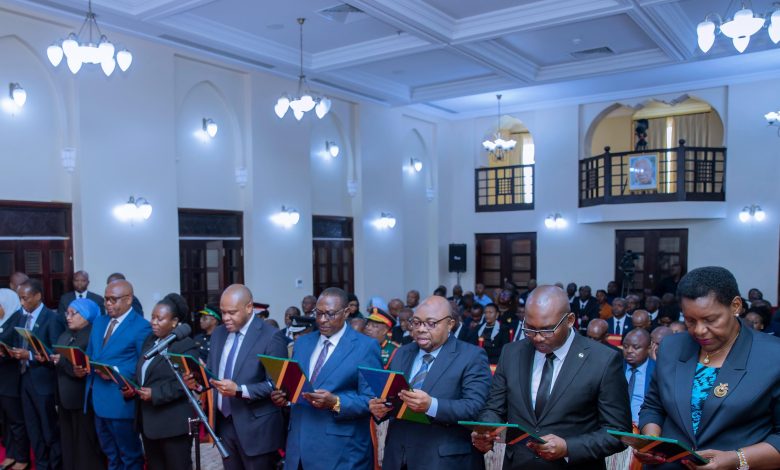
DODOMA: PRESIDENT Dr Samia Suluhu Hassan has called on newly appointed public officials to justify the trust placed in them through dedicated service, directing the Human Rights Commission and Good Governance to proactively address rights concerns and allegations against the country.
“You have been entrusted with the responsibility of serving this nation in the positions assigned to you. Go and justify that trust by serving the people,” she said.
Dr Samia made the call yesterday during a swearing-in ceremony for recently appointed leaders at State House in Chamwino, Dodoma, attended by Prime Minister Dr Mwigulu Nchemba and other government leaders.
Those sworn in included Ms Angelina Mabula, appointed Tabora Regional Commissioner, Mr Dunford Mpelumbe, Chairperson of the Commission for Human Rights and Good Governance and Mr Omar Ali, the Commission’s ViceChairperson.
Others included retired Judge Wilfred Dyansobera, appointed Chairperson of the Commission for Mediation and Arbitration, alongside commissioners of the same institution.
Addressing the new leadership of the Commission for Human Rights and Good Governance, President Samia said the institution has an important responsibility to protect human rights and respond to allegations against the country.
She said the global human rights debate has become increasingly complicated, with countries sometimes facing accusations regardless of their actual records.
“In today’s world, things are turned upside down. Those who respect rights may be told they do not, while those who violate them may be told they are respecting human rights,” she said.
She urged the commission’s chairperson and vice-chairperson to draw on their knowledge and understanding of global developments, including information available through digital platforms, to monitor allegations against Tanzania and respond appropriately.
She said the institution should examine allegations raised internationally against the country and assess them against the actual situation on the ground.
“This is a Commission for Human Rights and Good Governance. You must also examine what the country is being accused of internationally, compare those allegations with the situation at home and respond quickly,” she said.
President Samia also called on the commission to broaden its approach beyond waiting for complaints from individuals whose rights have allegedly been violated.
The Head of State said it should continue receiving complaints from citizens, investigating them and forwarding cases involving violations of good governance to relevant sectors for action.
Turning to Ms Mabula, President Samia expressed confidence in her ability to discharge her new responsibilities, citing her experience in public service, including serving as a District Commissioner, Deputy Minister, Minister and Member of Parliament.
She urged the new Regional Commissioner to work closely with other leaders and stakeholders in Tabora to address challenges facing residents.
President Samia particularly stressed the prudent management of government funds allocated to the region, saying the resources should be directed towards addressing people’s needs.
“You have served as a District Commissioner and understand the challenges at that level. You have also served as a Minister and know how government allocations are made. As a Member of Parliament, you understand the needs of the people. Let us ensure that the funds we send are used to address people’s problems,” she said.
On the Commission for Mediation and Arbitration, President Samia urged its newly sworn-in chairperson and commissioners to discharge their duties impartially, particularly when handling disputes between employers and employees.
ALSO READ: A year of resilience, progress
She said the commission plays an important role in resolving labour disputes, noting that some of its decisions attract appeals, making accuracy and fairness essential.
President Samia said some appeals against the commission’s decisions are upheld because the parties have valid grounds, while others are rejected for lacking sufficient grounds.
She said such outcomes demonstrate the importance of carefully considering evidence and applicable labour laws before reaching decisions.
“Your work is to handle labour disputes without hatred, malice or favouritism. If an employee has committed an offence, the law must guide the decision. The same applies to employers. Justice must be served without discrimination,” she said.
She cautioned the commissioners against allowing personal relationships or familiarity with individuals involved in disputes to influence their decisions.
Dr Samia further said labour disputes are increasing alongside the expansion of the private sector and the country’s investment activities.
“Labour disputes are many, particularly as we continue opening up the country and attracting more private sector investment. You must ensure that our labour laws are upheld and that the rights of both employers and employees are protected,” she said.