Rising seas, failing harvests: Zanzibar seaweed farmers battle a changing ocean
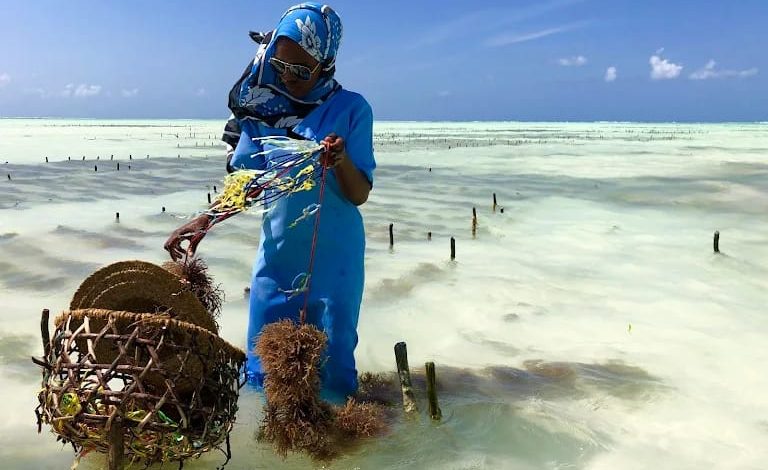
ZANZIBAR: BEFORE the sun reaches Paje, the ocean has already begun its daily retreat.
The water moves back quietly, exposing long stretches of wet sand, shallow pools and rows of rope lines anchored by wooden stakes. From a distance, the farms appear organised, almost carefully arranged across the shallow lagoon. But for the women who work there, the order is fragile. It depends entirely on the tide.
At this hour, the shoreline is neither fully land nor fully sea. It is a temporary working ground, rewritten twice a day by water. Every exposed patch of sand carries memory of harvests, failures, and seasons that once followed predictable patterns.
While tourists in nearby beach lodges are still waking up to breakfast routines and planned excursions, seaweed farmers are already in the water. Their day does not begin with time. It begins with tide.
Asha Juma Kombo is among them. She walks into the shallows as she has done for years, following the familiar lines where seaweed seedlings are tied. Her feet sink into soft sand beneath the water, shaped by repetition and labour.
At the first rope line, she stops. Something is wrong.
Seaweed should resist slightly when pulled, just enough to signal life, growth and weight. Today it gives way too easily, collapsing between her fingers as if its structure has been quietly undone.
She pauses, lifts a strand and studies it closely. “It breaks before it becomes anything,” she says.
There is no shock in her voice. Only recognition.
A few metres away, Fatma Makame Khamis is already working another line. She does not look up. Her hands move steadily through knots and ropes, the rhythm precise, almost automatic. Years of repetition have turned movement into memory.
The tide is still low enough to expose most of the farm lines stretched across the lagoon. Each rope marks effort, expectation, and risk.
“We know before harvest now,” Fatma says without stopping. “The sea tells you early.”
Rehema Ali Juma is further along the line, tying seedlings to rope with quick, practiced movements.
“If I do not come, there is no money,” she says. “If I come and it fails, there is still no money. So I just come.”
Three women. One shoreline. One ocean.
Their stories are different, but the weight they carry is the same; a livelihood tied to waters that no longer behave as they once did.
Seaweed farming in Zanzibar has long been one of the island’s most important coastal livelihoods. It offered income to households with little land, minimal capital and few formal employment options, especially for women.
Over time, it became part of country’s blue economy vision, presented as a model of inclusive marine-based development that could connect coastal communities directly to global markets.
According to the World Bank 2025 report “Seaweed Power: Unlocking Tanzania’s Potential for Sustainable Growth and Climate Action,” tens of thousands of people depend on seaweed farming across Tanzania. Zanzibar accounts for the largest share of production, with women making up more than 80 per cent of the workforce.
For years, the system appeared stable. The sea was predictable. Harvests followed cycles. Income, while modest, was consistent enough to sustain daily life.
That stability is now weakening.
Farmers in Paje describe the change in the same language; “decline without warning.’ Seaweed becomes fragile, harvests reduce, and entire sections of farms fail without explanation at first glance.
They call it “ice-ice”.
“Ice ice,” Asha says again, breaking off a damaged strand. “Once it starts, it finishes everything.”
Among Zanzibar’s seaweed farmers, “ice-ice” refers to a condition affecting cultivated species such as Eucheuma and Kappaphycus. It is associated with environmental stress triggered by changes in temperature, salinity fluctuations and prolonged exposure during low tide.
It begins quietly, the seaweed loses colour, it softens. It weakens at the stem, then it breaks apart before reaching maturity, and what should have been a harvest becomes waste.
For farmers, this is not a scientific condition. It is income disappearing in real time.
Dr Makame Omar Makame of the Institute of Marine Sciences, University of Dar es Salaam (UDSM) Zanzibar campus, has studied these shifts in coastal ecosystems.
In a peer-reviewed study published in Natural Hazards, co-authored with Shackleton and Leal Filho, he argues that coastal livelihoods are shaped by overlapping pressures rather than single environmental shocks.
Climate variability interacts with market dependency, limited access to finance and weak adaptive capacity. Together, these factors deepen vulnerability.
On the shore, however, these systems are not described in technical terms, they are felt.
Fatma puts it simply. “We work here,” she says. “But the value does not stay here.”
Most seaweed harvested in Zanzibar is exported in raw form. It leaves the islands before being processed into carrageenan, a substance used globally in food production, cosmetics and pharmaceuticals.
The highest-value stages of processing occur elsewhere.
Rehema captures the imbalance in a single line. “We are close to the sea, but far from the money.”
As the morning unfolds, more women arrive. Some are older and move slowly but confidently, familiar with every rope and tide shift. Others are younger, still learning how to read the sea instead of the clock.
Work is shared informally. Some tie seedlings, others repair broken lines, others collect decayed seaweed that has already begun to disintegrate.
The coastline around them is no longer defined by farming alone.
Seaweed farms share shallow waters with fishing grounds, seagrass beds and expanding tourism activity. The same lagoon supports multiple livelihoods that increasingly overlap and compete.
Fishermen pass through carefully, lifting nets to avoid damaging farm lines. During storms, entire sections of farms are displaced overnight, forcing communities to rebuild from scratch. Mangroves are cut in some areas for wooden stakes. Broken ropes, fragments of plastic and seaweed debris sometimes wash onto the shore after rough tides.
Tourism development adds another layer of pressure. As hotels expand along the coastline, access to traditional farming areas shifts. Some plots are pushed further offshore. Others shrink. In certain areas, farmers adjust their positions seasonally to avoid conflict with tourism zones.
The shoreline is no longer just a workplace. It is a shared space of competing survival.
The strain farmers describe as “ice-ice” is now also part of a wider policy conversation.
Under President Dr Hussein Ali Mwinyi, Zanzibar has placed seaweed farming at the centre of its Blue Economy strategy through the 2020 Blue Economy Policy, the 2022 Fisheries Policy and the ZADEP 2021–2026 development plan.
The focus, according to government direction, is to move coastal communities beyond raw production and increase the share of value retained locally.
President Mwinyi has said: “We must increase production, secure reliable markets and ensure farmers benefit more directly from their work.”
He has also stressed that without local processing, Zanzibar risks exporting value while retaining only labour at the production level.
The gap Asha experiences at the rope line between effort and return, is the same gap policy is trying to close.
To support this shift, Zanzibar is implementing the UN joint programme on transforming seaweed farming through Integrated Financial Solutions, launched last year and implemented by FAO, UNDP, IFAD and WFP in partnership with the Government of Zanzibar. It targets about 15,000 households.
The programme focuses on access to finance, insurance systems, cooperative strengthening and post-harvest infrastructure designed to reduce losses during climate stress periods.
But even as programmes expand, the ocean continues to change faster than interventions can adjust.
Speaking at this year REPOA Annual Research Workshop, Zanzibar’s Second Vice President Hemed Suleiman Abdulla said: “Climate change is no longer a future concern for Zanzibar.”
Adding that: “It is already affecting livelihoods, from rising sea levels and stronger storms to the pressure on fisheries and marine-based incomes.”
For farmers in Paje, that statement does not feel like policy language. It feels like observation.
Because what officials describe as climate pressure, farmers experience as broken harvests in their hands.
Back at the shoreline, the tide begins to return.
Water creeps in slowly at first, then steadily, covering rope lines, wooden stakes, and seedlings until the farms disappear beneath the surface once again.
Asha stands still, watching the place she worked in the morning being rewritten by water.
“We hear about plans,” she says quietly. “But the sea does not wait for plans.”
Fatma finishes her final knot. Rehema checks a line she already knows will not survive the next cycle.
They walk back from the water in silence, their feet sinking into wet sand as the tide rises behind them.
For them, seaweed farming is neither a project nor a policy. It is a routine shaped by uncertainty, repeated because there is no alternative.
The ocean has always given and taken. But now, it takes sooner, and gives less predictably. And tomorrow, when the tide falls again, they will return.