TZ eyes data-led mining growth
- Aims to end guesswork in small-scale activities
DAR ES SALAAM: TANZANIA has embarked on a major drive to eliminate guesswork in small-scale mining, with the government introducing a mechanism that will retain 10 per cent of gross mineral revenue collections to finance mining research and investment.
Minister for Minerals, Mr Anthony Mavunde said over the weekend that the initiative is among the strongest measures undertaken by President Samia Suluhu Hassan’s administration to address long-standing challenges facing small-scale miners, including lack of reliable geological data, limited capital, inadequate technology and constrained access to affordable financing.
He said President Samia has consistently responded to concerns raised by miners and industry stakeholders, adding that the decision to ring-fence part of mineral revenue for research demonstrates the government’s commitment to making the sector more productive, better organised and more beneficial to Tanzanians.
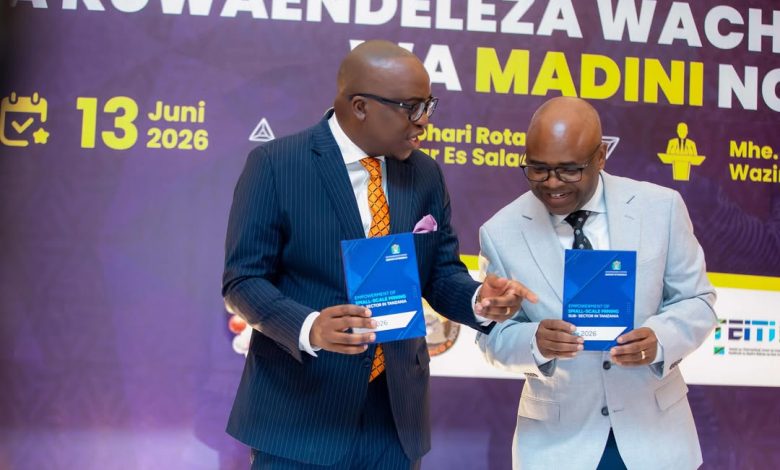
Mr Mavunde made the remarks during the official reception of a report containing recommendations on improving small-scale mining in the country.
The report was received and launched in Dar es Salaam by the Minister of State in the President’s Office for Planning and Investment Professor Kitila Mkumbo.
Under the 2026/27 national budget, the Ministry of Minerals will establish a Mineral Research Fund, through which 10 per cent of gross mineral revenue collections will be retained within the sector to support research and investment.
Mr Mavunde said geological research is the foundation of productive mining, as it enables miners to identify mineral deposits, plan investments, select appropriate technology and prepare credible project proposals that can attract financing.
He noted that the main challenge facing many small-scale miners is not lack of effort, but operating without reliable geological information on their licensed areas.
This, he said, increases costs, reduces productivity and makes mining projects appear too risky for financial institutions.
According to him, the government seeks to shift smallscale miners from speculative operations to data-driven mining supported by accurate geological information, modern technology, safety standards and sound business planning.
Mr Mavunde said the Ministry is implementing the Mining Vision 2030, “Minerals for Life and Wealth” which aims to increase the area covered by detailed mineral surveys from the current 16 per cent to 50 per cent by 2030.
He said a key pillar of the vision is the development of small-scale mining, given its contribution to production, employment, Government revenue and indigenous participation in the mineral economy.
The minister added that the government, through the State Mining Corporation (STAMICO) in collaboration with the Geological Survey of Tanzania (GST), has continued to provide research and drilling support to small-scale miners, including the deployment of 15 modern drilling rigs.
He said the services are helping miners obtain reliable data on mineral deposits, improve production decisions and strengthen the credibility of their projects when seeking financing.
ALSO READ: Tanzania sets mining strategies to boost economic growth
The report recommends strengthening financing systems for small-scale miners, enhancing participation of financial institutions, expanding access to geological data, promoting modern technology, improving market systems and increasing value addition within the country.
It also proposes the establishment of a Mineral Development Fund to support miners with promising mineral areas but limited collateral, equipment and technical documentation required by lenders.
Mr Mavunde said the Ministry will continue to strengthen trust between miners and financial institutions by improving production records, promoting mining business education, enhancing safety practices, strengthening environmental management and expanding access to reliable geological information.
He added that the government will continue pursuing long-term solutions to challenges facing small-scale miners, including expanded research through STAMICO and GST, preparations toward the establishment of a Small-Scale Miners Bank and training programmes to promote formalisation and professionalism in the sector.
Speaking after receiving the report, Prof Mkumbo said smallscale miners play a critical role in Tanzania’s mining sector, contributing about 40 per cent of mining revenues while providing thousands of jobs for youth and women.
He said despite their contribution, small-scale miners continue to face major constraints, including limited capital, outdated technology, high exploration costs, weak access to geological data, market barriers and limited access to formal financial services.
Prof Mkumbo said the report comes at a crucial time as the government intensifies efforts to enable small miners to increase productivity, expand output and gradually grow into medium and large-scale Tanzanian-owned mining enterprises.
Prof Mkumbo said one of the key recommendations is to create a clear pathway for capable small-scale miners to transition into medium-scale operations and eventually into large Tanzanian-owned mining companies.
He said achieving this will require close collaboration between the Ministry of Minerals, its institutions, the private sector, financial institutions, universities, research bodies, miners’ associations and development partners.
The report outlines a shift from speculative mining to a data-driven industry supported by capital, technology and improved market systems.