Tanzania shifts from biomass to clean cooking
DAR ES SALAAM: ACCESS to clean cooking energy remains one of Tanzania’s most pressing development challenges, closely linked to environmental sustainability, public health, and socio-economic progress.
Although the country has made considerable strides in expanding electricity access in recent years, the majority of households still rely heavily on traditional biomass fuels such as firewood and charcoal for daily cooking.
National data indicate that more than 96 per cent of Tanzanians depend on biomass as their primary cooking fuel, with rural households largely using three-stone fireplaces and urban families relying on low-quality charcoal stoves.
These traditional methods are inefficient, consume large volumes of fuel, and produce significant indoor air pollution.
The environmental cost of this reliance is substantial. Between 2001 and 2020, Tanzania lost approximately 2.7 million hectares of tree cover, representing a 10 per cent decline and generating an estimated 910 million tonnes of carbon dioxide equivalent emissions.
In refugee-hosting regions such as Kigoma, the situation is particularly severe. The region lost over 133,000 hectares of forest between 2000 and 2021, amounting to 6.6 per cent of its forest cover.
Growing demand for fuelwood has intensified deforestation, land degradation, and competition over natural resources, sometimes leading to tensions between host communities and refugees.
The health implications are equally alarming. Indoor air pollution from traditional biomass cooking contributes to chronic respiratory illnesses and heart disease.
Approximately 10 million Tanzanians, or about 17 per cent of the population, are reported to suffer from Chronic Obstructive Pulmonary Disease (COPD), including conditions such as emphysema and chronic bronchitis. These diseases are associated with an estimated 33,000 deaths annually.
Women and children, who spend more time near cooking areas, face the greatest exposure to harmful smoke.
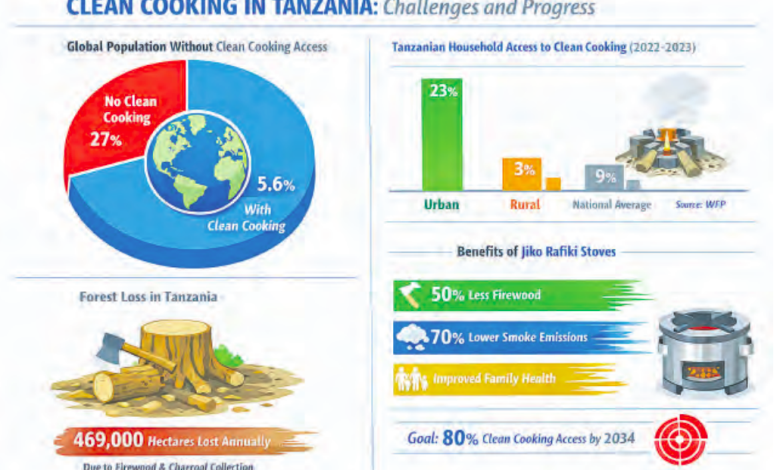
Despite these challenges, access to clean cooking technologies remains limited. Nationally, only about 9 per cent of households use clean cooking solutions.
Urban access stands at roughly 23 per cent, while rural access is as low as 3 per cent.
Recognising the urgency of the situation, the Government of Tanzania has developed a National Clean Cooking Strategy with an ambitious target of transitioning more than 80 per cent of the population to clean cooking practices by 2033–2034.
This strategy aligns with broader goals related to climate change mitigation, forest conservation, gender equality, and sustainable development.
In support of this national vision, the World Food Programme has partnered with the National Carbon Monitoring Centre and the Kasulu and Kibondo District Councils to implement a clean cooking initiative in Kigoma region.
The project focuses on distributing improved cookstoves known as Jiko Rafiki to households in refugee-hosting communities.
A total of 5,000 improved cookstoves are being distributed across 10 villages in Kasulu and Kibondo districts as part of the current phase.
ALSO READ: SADC hails Tanzania’s bold push for clean cooking energy
The Jiko Rafiki stove is produced locally in Tanzania using local materials and labour. Developed by OffgridSun, the stove is designed as a dualfuel system capable of using both firewood and charcoal.
It has a certified thermal efficiency of approximately 41 per cent for wood consumption, significantly higher than traditional open fires.
Each stove is estimated to reduce wood consumption by about 70 per cent and cut approximately 2.5 tonnes of carbon dioxide equivalent emissions per household per year.
By lowering fuel demand, the stove helps reduce deforestation pressures while also decreasing greenhouse gas emissions.
Beyond environmental gains, the project delivers tangible social and economic benefits. Reduced fuel consumption means households that purchase firewood spend less money, allowing savings to be redirected toward food, education, clothing and shelter.
Women, who traditionally spend long hours collecting firewood, benefit from reduced physical burden and increased time for income generating activities or education.
The project also creates employment opportunities in stove production, distribution, installation, maintenance, and marketing, equipping local workers with new technical skills.
Health improvements are another major outcome. The improved combustion efficiency of Jiko Rafiki reduces smoke emissions inside homes, lowering exposure to harmful pollutants and reducing the risk of burns during cooking.
Cleaner indoor air contributes to better respiratory health and improved overall wellbeing for families.
The initiative is designed to generate carbon credits under Gold Standard certification, with the National Carbon Monitoring Centre serving as the owner of the carbon credits.
Revenue from the voluntary carbon market is expected to support scaling up clean cooking interventions in the future, ensuring long-term sustainability of the programme.
Tanzania’s clean cooking transition is therefore not merely about replacing stoves; it represents a comprehensive response to interconnected environmental, health, and social challenges.
The situation in Kigoma highlights both the urgency of action and the potential of targeted, community-based solutions.
By promoting locally manufactured, high-efficiency stoves such as Jiko Rafiki, Tanzania is taking meaningful steps toward reducing deforestation, cutting emissions, improving public health, empowering women, and strengthening resilience in vulnerable communities.
Achieving the national target of 80 per cent clean cooking access by 2033–2034 will require sustained investment, public awareness, and partnerships across sectors.
However, projects like the Kigoma clean cooking initiative demonstrate that with coordinated effort and locally adapted technologies, a cleaner, healthier, and more sustainable future for Tanzanian households is within reach.
Tanzania’s transition to clean cooking is no longer simply an energy issue but a national development priority that touches on health, environmental protection, gender equality, and economic resilience.
The continued dependence on firewood and charcoal by more than 96 per cent of households has placed enormous pressure on forests, contributed to greenhouse gas emissions, and exposed millions of families to harmful indoor air pollution.
The loss of 2.7 million hectares of tree covers over the past two decades and the thousands of deaths linked annually to respiratory diseases illustrate the scale of the challenge.
At the same time, the situation presents a clear opportunity for transformation.
The National Clean Cooking Strategy, with its target of reaching over 80 per cent of the population by 2033–2034, demonstrates strong political commitment to change.
However, achieving this ambition will depend on practical, community-driven solutions that make clean cooking technologies affordable, accessible and widely adopted.
The clean cooking initiative in Kigoma region, particularly the distribution of the locally produced Jiko Rafiki stove, offers a powerful example of how targeted interventions can create multi-dimensional impact.
By reducing wood consumption by approximately 70 per cent and lowering carbon emissions by about 2.5 tonnes per household annually, the project directly addresses deforestation and climate change.
At the same time, it improves indoor air quality, reduces household fuel costs, empowers women through time savings, and creates local employment opportunities.
Sustaining and scaling such initiatives will require continued collaboration between government institutions, development partners, local authorities, and communities.
Clean cooking must be viewed not as a short-term project but as a long-term investment in public health, environmental sustainability, and economic development.
If momentum is maintained and lessons from Kigoma are replicated nationwide, Tanzania can move decisively toward a future where clean, efficient cooking is the norm rather than the exception.